 Cellosophy
Pattern · module scale
Chemotaxis module: from receptor to motor and back
Everything a swimming E. coli cell knows about its world has to end up as one choice: keep going, or tumble. This page is about the set of proteins that makes that choice, linking what the cell detects at its surface to how it swims. Chemical receptors in the membrane tell a kinase how active to be, the kinase passes its message through a small diffusing protein to the flagellar motors, and the motors pick between running and tumbling. A second, slower set of reactions keeps the receptors tuned. That's what lets the cell compare the present with the recent past and drift toward better conditions.
The problem: a swimmer with no steering wheel
E. coli can't steer. It swims in straight runs of about a second and tumbles for about a tenth of a second to face a new random direction observed (Berg, 2000). So a cell about 2 micrometres long has one lever to pull, which is to turn a chemical measurement into a small change in how long its runs last, and that's all it gets.
The measurement has to be a comparison over time. Berg (2000) reports that the response is temporal, and that studies with impulsive stimuli indicate the cell compares the concentration over the past second with the concentration over the previous three seconds observed. The window is set by rotational diffusion, which is a fancy way of saying the cell gets knocked about: a swimming cell drifts about 30 degrees off its heading in a second and loses its direction after about ten. Sourjik and Wingreen (2012) put the same idea in distance, where a one-second run corresponds to a measuring stick of about 20 micrometres observed.
Comparing then needs two things in one place, a sensor and a short memory. The module supplies both, and the four patterns below are how it pulls that off.
How it works: a relay race with a slow referee
Figure 1 follows the signal from left to right. Attractant binds receptors that sit in the membrane in clusters, together with the adaptor CheW and the kinase CheA. Hazelbauer and colleagues (2008) describe patches of about 250 nanometres across on average, and give an example in which one such patch holds about 40 percent of the 7,500 receptor dimers in a cell observed. Binding an attractant lowers the rate at which CheA phosphorylates itself, and CheA uses ATP to do it (Falke et al., 1997) observed. This is the receptor cluster pattern.
CheA passes its phosphate to CheY. Phosphorylated CheY, called CheY-P, leaves the cluster and diffuses through the cytoplasm to a motor, and a phosphatase called CheZ takes the phosphate off again within a short time observed. Falke and colleagues (1997) point out that CheY has to travel from the cluster to a distant motor, which is one reason the signal needs a quick way to switch off. Their review also calls CheZ the least understood component of the pathway - a nice reminder that even the best-mapped decision systems have dark corners. This chain is the signaling pathway pattern.
At the motor, CheY-P binds to the switch protein FliM and stabilises clockwise rotation (Berg, 2000; Micali and Endres, 2016) observed. When the motors turn counterclockwise, the flagella form a bundle that pushes the cell along in a run. When one or more motors turn clockwise, the bundle comes apart and the cell tumbles. Put the chain together and it reads almost like a sentence: attractant lowers CheA activity, CheY-P falls, the motors spend more time counterclockwise, and runs lengthen. Berg (2000) notes that the energy for turning the motor comes from protons flowing into the cell. This is the flagellar motor pattern.
The slow part is the adaptation loop. The enzyme CheR adds methyl groups to the receptors, taking each methyl group from S-adenosyl-methionine (Falke et al., 1997), and CheB removes them. In the account given by Sourjik and Wingreen (2012), CheR prefers inactive receptors and CheB prefers active ones, so the two rates settle at one level of receptor activity whatever the background concentration modeled. After a step of attractant the fast signal falls within moments, and then the methylation level climbs over minutes until activity is back near where it started. The receptors now report the change relative to the new background. Sourjik and Wingreen add that this adaptation stretches the range of concentrations the cell can tell apart from about two orders of magnitude to more than five observed.
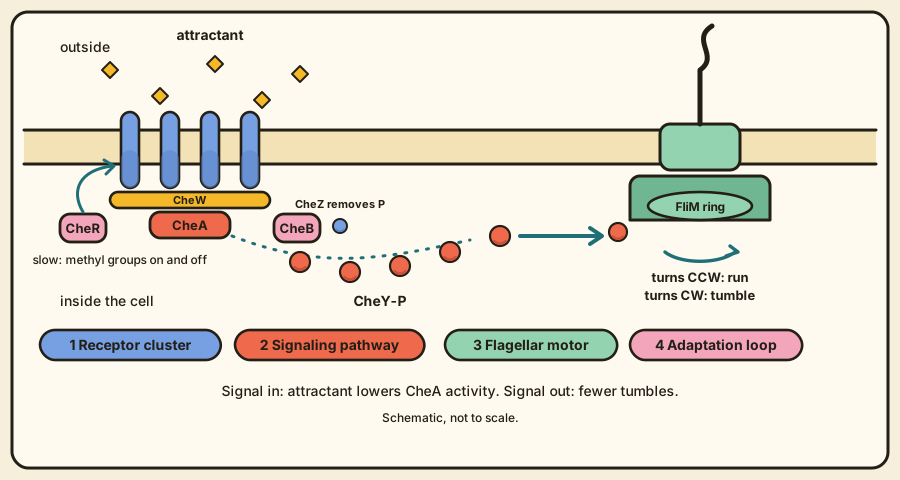
Step back and the four parts make two loops running at two speeds. The fast path runs from ligand to receptor to CheA to CheY-P to motor, and it changes within moments. The slow path runs from receptor activity through CheR and CheB back to the receptors themselves, and it takes minutes. The cell can compare now with a moment ago only because it has both. Take away the slow path and the receptors would stay silenced after a strong dose, and take away the fast path and there'd be nothing to reset inferred.
You can play with both paths on the interactive cell, which runs a simple model of this module. It's a toy and isn't fitted to measurements, so treat its timing as illustration only.
What's still open: a leaky channel that works anyway
As an information channel, the module is far from perfect. Mattingly and colleagues (2021) measured the information in the kinase signal and found that cells make behavioural decisions with much less than the one bit needed to tell whether they're swimming up a gradient, yet they climb gradients within a factor of two of the theoretical bound they derived observed. From the part of the paper we used, we don't know how the loss splits between sensing and the motor. Micali and Endres (2016) mention that the steep dose-response of a single motor may cap what gets through at about one bit, and that having several motors per cell could help inferred.
Adaptation is also less exact in single cells than the clean model suggests. Micali and Endres (2016) note that experiments on swimming bacteria show limits to precise adaptation, and Sourjik and Wingreen (2012) describe slow fluctuations in motor bias over tens of seconds, which they link to the small number of CheR molecules inferred. Sourjik and Wingreen suggest that periods of long runs could help foraging when there's no gradient. It's a lovely idea, noise as a feature, and we don't know how much it matters for real cells.
The larger question is what to call the methylation state. It's a trace of recent conditions held in the cell's own proteins.
Is the module a controller that reacts with a little history, or something that carries a memory of its world?
That's the question taken up in idea D1. We don't know the answer.
Its parts
Receptor cluster: a crowd of receptors that acts as one switch: senses the outside and sets how active the kinase CheA is
Signaling pathway: a short relay from receptors to motor: carries the message from the receptors to the motor
Flagellar motor: a proton-driven rotary switch: turns the message into a run or a tumble
Adaptation loop: a slow dial that resets the receptors: slowly resets the receptors so the cell keeps answering to change
Wholes above it
Swimming cell (page to come)
References
- Berg, H. C. (2000). Motile behavior of bacteria. Physics Today, 53(1), 24-29. doi:10.1063/1.882934
- Sourjik, V., & Wingreen, N. S. (2012). Responding to chemical gradients: bacterial chemotaxis. Current Opinion in Cell Biology, 24, 262-268. doi:10.1016/j.ceb.2011.11.008
- Micali, G., & Endres, R. G. (2016). Bacterial chemotaxis: information processing, thermodynamics, and behavior. Current Opinion in Microbiology, 30, 8-15. doi:10.1016/j.mib.2015.12.001
- Falke, J. J., Bass, R. B., Butler, S. L., Chervitz, S. A., & Danielson, M. A. (1997). The two-component signaling pathway of bacterial chemotaxis: a molecular view of signal transduction by receptors, kinases, and adaptation enzymes. Annual Review of Cell and Developmental Biology, 13, 457-512. doi:10.1146/annurev.cellbio.13.1.457
- Hazelbauer, G. L., Falke, J. J., & Parkinson, J. S. (2008). Bacterial chemoreceptors: high-performance signaling in networked arrays. Trends in Biochemical Sciences, 33(1), 9-19. doi:10.1016/j.tibs.2007.09.014
- Mattingly, H. H., Kamino, K., Machta, B. B., & Emonet, T. (2021). Escherichia coli chemotaxis is information limited. Nature Physics, 17, 1426-1431. doi:10.1038/s41567-021-01380-3