 Cellosophy
Pattern · module scale
Adaptation loop: a slow dial that resets the receptors
A sensor that only counts goes deaf in a rich world. A receptor that only reported attractant would fall silent in a rich soup and stay silent, and the adaptation loop is how the bacterial chemotaxis machinery avoids that. So the loop slowly retunes the receptors, they drift back to a sensitive baseline whatever the background is, and the cell can keep answering to change.
The problem: good news that never stops
An E. coli cell swims by running straight and tumbling at random. To climb toward food it has to notice that things are improving. When attractant first arrives, the kinase CheA behind the receptors goes quiet and the cell runs on. If nothing reset that quiet state, though, the cell couldn't tell a still-improving world from one that has levelled off.
How does a cell tell "better than a moment ago" from "good, and staying good"?
Keegstra and colleagues (2017) saw the first half of this in single cells, where the average kinase signal fell to zero after a saturating dose, and then the slow recovery that follows.
How it works: two enzymes and a running total
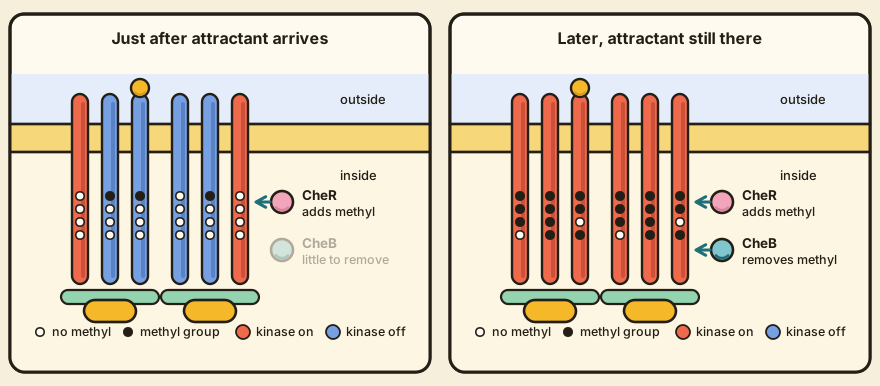
Two enzymes tune the receptors. CheR adds methyl groups, which pushes a receptor toward its active state. CheB takes them off, and in the model Yi and colleagues (2000) analysed, CheB acts only on active receptors. Attractant silences the kinase, so CheB has little to work on, while CheR keeps adding methyl groups and activity climbs back up. Once activity is back at baseline the two enzymes are in balance and methylation stops changing.
The methylation level works as a running total of how far activity has strayed from its target. Engineers call that structure integral feedback, and it's why the return is exact. The balance point depends on the two enzyme rates. The amount of attractant doesn't enter into it, so the same baseline comes back after any dose modeled.
Experiments back the idea that the precision lives in the loop's wiring. Alon and colleagues (1999) changed CheR levels about a hundredfold and found that adaptation time changed strongly while precision did not observed. Real single cells are less tidy. In the Keegstra data, half-way recovery took 416 ± 83 seconds and adaptation precision averaged 0.79 ± 0.32 observed.
What's still open: memory, or only history?
The methylation level is a trace of recent stimulation held in the cell's own parts. A dial that keeps score of the past sounds a lot like remembering. Whether it counts as memory or only as history-dependence is the question idea D1 takes up.
Its parts
CheR, the methyl adder (page to come): adds methyl groups to receptors
CheB, the methyl remover (page to come): takes methyl groups off active receptors
Receptor methylation (page to come): the slow dial that records recent conditions
Wholes above it
References
- Alon, U., Surette, M. G., Barkai, N., & Leibler, S. (1999). Robustness in bacterial chemotaxis. Nature, 397, 168-171. doi:10.1038/16483
- Yi, T.-M., Huang, Y., Simon, M. I., & Doyle, J. (2000). Robust perfect adaptation in bacterial chemotaxis through integral feedback control. PNAS, 97, 4649-4653. doi:10.1073/pnas.97.9.4649
- Keegstra, J. M., Kamino, K., Anquez, F., Lazova, M. D., Emonet, T., & Shimizu, T. S. (2017). Phenotypic diversity and temporal variability in a bacterial signaling network revealed by single-cell FRET. eLife, 6, e27455. doi:10.7554/eLife.27455 · free full text