Better artificial intelligence
By learning how living systems adapt and solve problems without brains, we hope to imagine AI that is more flexible, resourceful, and responsive to its world.
 CELLosophy
An inquiry into microbial cognition
We are exploring how living cells sense, decide, remember, and act - and what their intelligence might teach us about building better AI.
A collaboration among cognitive scientists, computer scientists, microbiologists, and mathematicians.
Cells sense · choose · adapt
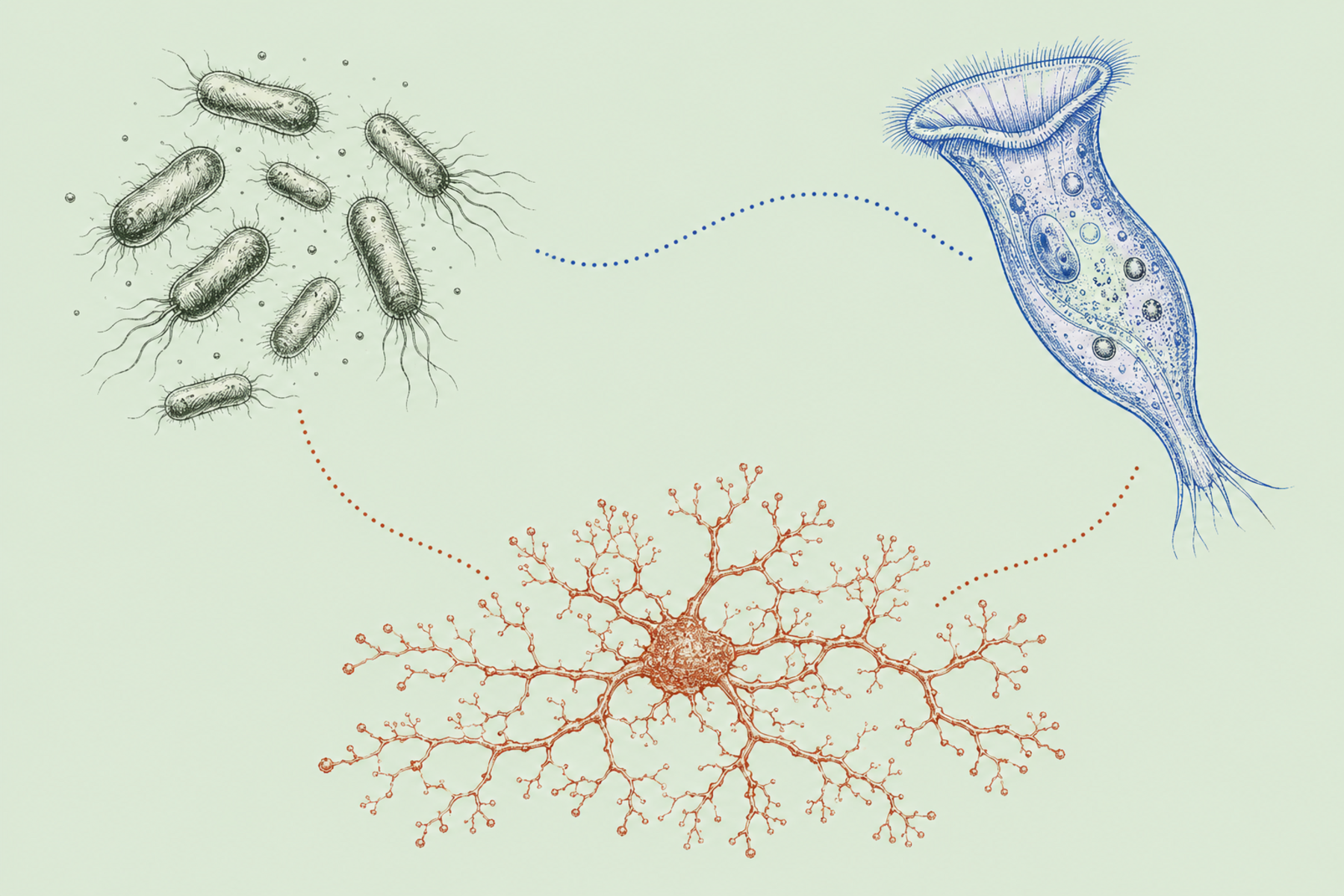
Choose a specimen ↑
01 / Why Cellosophy
We tend to treat brains as the birthplace of perception, memory, and action. But living cells were sensing their surroundings, evaluating possibilities, and changing course eons before neurons appeared. Cellosophy asks whether these capacities are merely the machinery beneath mind, or its earliest forms.
“Not little humans in little cells—but life solving the problem of what to do next.”
02 / Vision
CELLosophy is an inquiry into cognition that begins with the living cell. Its central question - do you need a brain to have a mind?-opens a bottom-up investigation of how autonomous organisms sense, evaluate, remember, regulate, and act in changing environments.
We treat cognition broadly and carefully. Neither do we claim that bacteria think like humans, nor that every biological process is intelligent. Instead, we ask what kinds of problem-solving, agency, and meaning-making are already present in the basic work of staying alive.
Bacterial chemotaxis, especially in E. coli, offers a flagship example: receptors detect change, signaling networks integrate information, methylation provides a memory-like baseline, and flagellar motors turn valuation into movement.
We are exploring the connection between these concrete biochemical mechanisms and larger debates on basal cognition, enactivism, cybernetics, biosemiotics, and embodied intelligence. By its very nature, CELLosophy is both a research program and a public commons for curious minds; one that brings rigorous science, imaginative questions, and collaborative discovery together.
03 / Who we are
CELLosophy brings together cognitive scientists, computer scientists, microbiologists, and mathematicians to think across the usual boundaries between life, mind, and intelligence.
By learning how living systems adapt and solve problems without brains, we hope to imagine AI that is more flexible, resourceful, and responsive to its world.
Unicellular creatures are not merely machinery. They are active beings navigating uncertain worlds—and they may hold clues to the beginnings of mind and life.
We want to understand how sensing, memory, choice, and agency could arise before brains and nervous systems.
04 / Follow or join
Subscribe to our Substack for essays, observations, experiments, and conversations as CELLosophy takes shape. If these questions meet your own work, reply to a note and introduce yourself—we would be delighted to hear from potential collaborators.
Follow the journey. Join the conversation. Perhaps help shape what comes next.