 Cellosophy
Concept C4 · Strand C, Sensing and action
Temporal comparison
Read first: Noise and limits of molecular sensing, Run-and-tumble navigation
A swimming bacterium decides where to go by comparing now with a moment ago. It holds a short record of the chemistry it just swam through and checks it against what it's tasting at present, which is a kind of memory, a very small one. This page asks why the comparison runs along time, and what a comparison between the cell's front and its back would have needed.
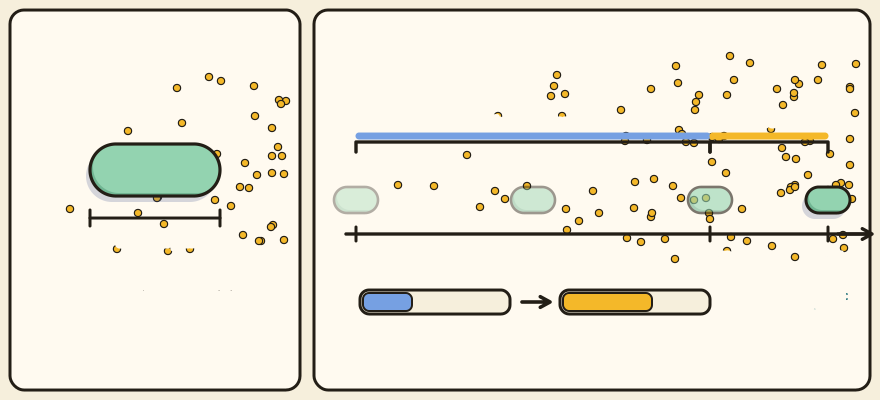
Caught reading the clock
Robert Macnab and Daniel Koshland (1972) built an apparatus that mixed bacteria from one uniform attractant solution into another in about 200 milliseconds, so that the concentration changed in time and never varied from place to place. Clever, because it takes space out of the picture entirely. When the serine level dropped suddenly from 1 to 0.24 millimolar, the cells tumbled erratically, and their swimming went back to normal in about 12 seconds. When it rose from none to 0.76 millimolar, they swam in smoother, better-coordinated paths that relaxed back over minutes. observed With no spatial gradient anywhere in the apparatus, the response had to come from change over time. Adler (1975) describes this as the discovery that bacteria respond to temporal gradients, and says it led to the proposal that they have a kind of memory.
Adler also records that a comparison between the two ends of the cell hadn't been ruled out at the time, though he judged the concentration difference across a cell too small for an instantaneous comparison to work.
A memory made of methyl groups
The memory sits in the receptors themselves. Sourjik and Wingreen (2012) explain that the receptors both sense the present and record the recent past, because the enzymes CheR and CheB add and remove methyl groups, and the methylation level changes slowly. Berg (2000) puts it as a comparison of two readings: the occupancy of a receptor's binding site reflects current conditions, and the methylation level reflects past ones. observed One sensor, two clocks. The adaptation loop page shows the mechanism. In impulse experiments, Berg reports, the cell compares the concentration over the past 1 second with the concentration over the previous 3 seconds and responds to the difference. observed
Squeezed from both sides
Two limits pinch the window. One is the counting problem. Berg and Purcell (1977) showed that the precision of a concentration measurement improves with the time spent measuring, so a window that's too short is mostly chance. The other is orientation. Berg (2000) notes that Brownian rotation scrambles a cell's heading within seconds, so measurements older than that say little about the direction the cell faces now. Count too briefly and you learn nothing, count too long and you've forgotten which way you were pointing. Berg and Purcell worked from three sets of chemotaxis experiments and estimated that the cell needs comparison intervals between roughly a tenth of a second and a second and a half, and they concluded that E. coli compares over about 1 second, adding that even 5 seconds would be too long. modeled
Why not compare front and back?
Surely a cell could just sniff with both ends?
The tempting answer is that the concentration difference across a 2 micrometre body is too small to read against noise. We'd have said so ourselves. The calculation in Berg and Purcell (1977) says otherwise. For one serine experiment they found that a front-to-back comparison would need about 1.7 seconds of measuring, and wrote that a spatial mechanism remains feasible on that analysis. modeled The snag they found lies elsewhere. A cell swimming through uniform fluid takes up more molecules at its front than at its back, which creates an apparent gradient that in their example was about 600 times steeper than the real one, though they add that the problem is milder because a cell takes up only a few percent of the molecules that reach it. The cell's own appetite fogs the reading. Endres (2026), commenting on newer work, gives a compact version of the argument: bacteria are too small to sense reliable differences across their length before rotational diffusion scrambles their orientation, so they rely on memory.
A bit of back-of-envelope arithmetic points the same way. A run of 1 second covers about 20 micrometres (Sourjik and Wingreen, 2012), which is ten times the length of a cell of 2 micrometres (Berg, 2000). In a gradient of steady slope the difference between two samples grows with the distance between them, so we infer that a comparison along a run sees a difference about ten times larger than a comparison along the body. inferred Swimming turns a short body into a long ruler.
Size matters here. For the slime mold Dictyostelium, a cell far larger than a bacterium, Berg and Purcell found that a spatial comparison across the cell is much more effective, and they couldn't rule out a temporal one even there. modeled
Still on the table
Mattingly and colleagues (2021) found that E. coli climb gradients within a factor of two of a theoretical bound while making decisions with much less than one bit. Their later paper (2026) reports that the cells' information is set by noise inside the signalling pathway, with the arrival of molecules a far looser limit. observed Endres (2026) notes that other work found cells function well even when information passes inefficiently, and that how temporal and spatial sensing trade off as cells change size and speed is open. We don't know how the length of the memory window is set. We also don't know whether any bacterium relies mainly on spatial comparison.
What you should be able to do after reading
Explain why a small bacterium compares present and recent conditions rather than distant spatial samples.
A quick test: a cell swims at 20 micrometres per second. Work out how far it goes in 1 second and compare that with its body length. Then say what would go wrong if its memory lasted 10 seconds, using the heading drift described above. C5 asks how the receptors reset so that the comparison keeps working against a steady background.
This leads to
References
- Macnab, R. M., & Koshland, D. E., Jr. (1972). The gradient-sensing mechanism in bacterial chemotaxis. Proceedings of the National Academy of Sciences, 69(9), 2509-2512. doi:10.1073/pnas.69.9.2509
- Berg, H. C., & Purcell, E. M. (1977). Physics of chemoreception. Biophysical Journal, 20(2), 193-219. doi:10.1016/S0006-3495(77)85544-6
- Berg, H. C. (2000). Motile behavior of bacteria. Physics Today, 53(1), 24-29. doi:10.1063/1.882934
- Adler, J. (1975). Chemotaxis in bacteria. Annual Review of Biochemistry, 44, 341-356. doi:10.1146/annurev.bi.44.070175.002013
- Sourjik, V., & Wingreen, N. S. (2012). Responding to chemical gradients: bacterial chemotaxis. Current Opinion in Cell Biology, 24, 262-268. doi:10.1016/j.ceb.2011.11.008
- Mattingly, H. H., Kamino, K., Machta, B. B., & Emonet, T. (2021). Escherichia coli chemotaxis is information limited. Nature Physics, 17, 1426-1431. doi:10.1038/s41567-021-01380-3
- Mattingly, H. H., Kamino, K., Ong, J., Kottou, R., Emonet, T., & Machta, B. B. (2026). E. coli chemosensing accuracy is not limited by stochastic molecule arrivals. Nature Physics, 22(1), 123-130. doi:10.1038/s41567-025-03111-4
- Endres, R. G. (2026). Bacteria may not be good at chemotaxis. Nature Physics, 22(1), 8-9. doi:10.1038/s41567-025-03103-4