 Cellosophy
Concept C3 · Strand C, Sensing and action
Run-and-tumble navigation
Read first: Scale, diffusion, and life at low Reynolds number, Receptors and signal transduction, Molecular motors and cellular action
Escherichia coli can't steer, and it still ends up near food. It swims in a straight run, tumbles to a new random heading, and swims again. The cell never picks a direction. All it controls is how long each run lasts, and that turns out to be plenty.
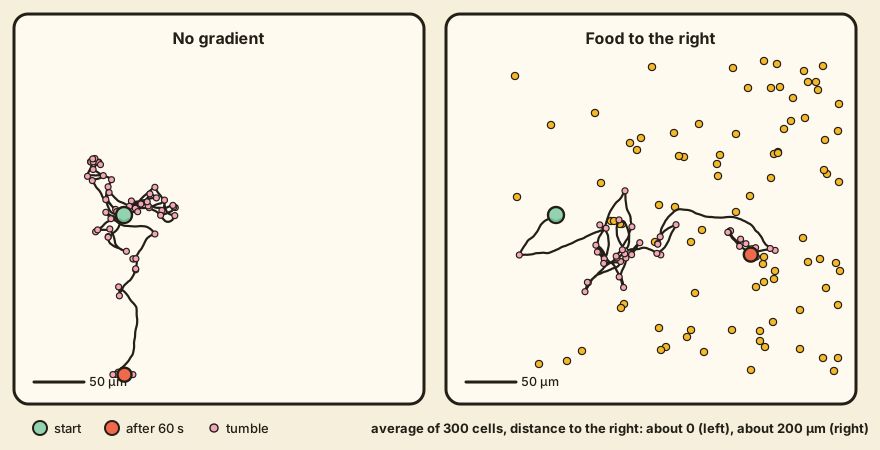
Run, tumble, repeat
Howard Berg (2000) describes what a swimming E. coli does in a uniform medium. When the motors turn counterclockwise the filaments gather into a bundle and push the cell forward in a run, and when one or more motors turn clockwise the bundle comes apart and the cell tumbles, going more or less nowhere. A run lasts about 1 second on average and a tumble about 0.1 second, and both times follow exponential distributions. A tumble leaves the cell facing in an approximately random new direction. observed In one cell tracked over about 30 seconds, Berg shows 26 runs and tumbles, the longest run lasting 3.6 seconds, at a mean speed near 21 micrometres per second.
Random turns suit a cell this small, because it couldn't hold a course anyway. Rotational Brownian motion knocks a swimming cell about 30 degrees off its heading in a second, and after about 10 seconds it has drifted more than 90 degrees and "forgets" where it was going (Berg, 2000). observed If the water keeps spinning you around, a compass is a waste of money.
Tilting the coin
Julius Adler built the quantitative methods for this problem and, in a review of the work, describes two of them (Adler, 1975). On a soft agar plate with a metabolizable attractant, the bacteria eat the local supply, which creates a gradient, and they follow it outward as a ring. In a capillary assay, the experimenter counts the cells that swim into a tube of attractant. observed Berg's own photograph of such a plate shows two rings, because the cells first eat the serine and chase that gradient, and only later the aspartate (Berg, 2000).
What a single cell does in a gradient was worked out by tracking. Berg and Brown (1972) followed single cells in three dimensions and reported that chemotaxis toward amino acids comes from suppressing directional changes - in plain words, from fewer tumbles. Berg's later review puts the result this way. When a cell happens to be moving up a gradient its runs are stretched out, and when it moves the other way its runs go back to the length seen without any gradient (Berg, 2000). Berg and Purcell (1977) report a case from Brown and Berg's experiments with an enzymatically made rise in L-glutamate, in which the mean run length doubled from 0.67 to 1.34 seconds. observed
Drift without a driver
If every new heading is random, how does the cell get anywhere?
No single tumble aims at the food, since each new heading is close to random. What changes is how long a run lasts. A run that happens to point up the gradient keeps going for longer, and a run that points down ends at the baseline time, so the average displacement over many runs comes out positive. inferred The simulation in Figure 1 shows the effect with a crude version of that rule, and it needs nothing else. That's the sense in which a random walk can drift with nobody at the wheel. Lucky streaks are allowed to run long, and unlucky ones get cut short.
Loose ends
The classical picture changes only how often the cell tumbles. Sourjik and Wingreen (2012) report that more recent analyses suggest cells also change how far they turn, so that a cell swimming up a gradient tumbles less often and swings through smaller angles. observed They add that cell-to-cell variation in the pathway throws up the occasional long run, which may help foraging where no gradient exists. We haven't checked the original measurements.
Mattingly and colleagues (2021) asked how well the walk uses the information the cell collects. They found that cells decide with far less than the one bit needed to know whether they're swimming up the gradient, and still climb at speeds within a factor of two of a theoretical bound. observed Less than a bit, and nearly the best you can do. Berg (2000) lists one thing that was then unexplained: how the motors on one cell all end up turning counterclockwise together when a bundle forms, given that they switch independently when studied apart.
Run and tumble isn't the only way to get around, either. Adler (1975) notes that bacteria with polar flagella back up instead of tumbling, and that even E. coli goes back and forth in a viscous enough medium. We don't know how far the biased-walk logic carries across those cases.
What you should be able to do after reading
Explain how biased random movement can produce net migration without anyone steering.
A quick test: write the rule for a cell that tumbles at a rate of 1 per second when its last move was down the gradient and 0.5 per second when it was up. Then say, in two sentences, why the average position moves up the gradient even though every new heading is random. C4 asks how a cell this small can tell which way it's going.
References
- Berg, H. C. (2000). Motile behavior of bacteria. Physics Today, 53(1), 24-29. doi:10.1063/1.882934
- Adler, J. (1975). Chemotaxis in bacteria. Annual Review of Biochemistry, 44, 341-356. doi:10.1146/annurev.bi.44.070175.002013
- Berg, H. C., & Brown, D. A. (1972). Chemotaxis in Escherichia coli analysed by three-dimensional tracking. Nature, 239, 500-504. doi:10.1038/239500a0
- Berg, H. C., & Purcell, E. M. (1977). Physics of chemoreception. Biophysical Journal, 20(2), 193-219. doi:10.1016/S0006-3495(77)85544-6
- Sourjik, V., & Wingreen, N. S. (2012). Responding to chemical gradients: bacterial chemotaxis. Current Opinion in Cell Biology, 24, 262-268. doi:10.1016/j.ceb.2011.11.008
- Mattingly, H. H., Kamino, K., Machta, B. B., & Emonet, T. (2021). Escherichia coli chemotaxis is information limited. Nature Physics, 17, 1426-1431. doi:10.1038/s41567-021-01380-3