 Cellosophy
Concept B1 · Strand B, Life at cell scale
Scale, diffusion, and life at low Reynolds number
Read first: The cell as the unit of explanation
At the size of a bacterium, water behaves like syrup. Most of what we expect from moving, feeding and sensing changes along with it, and this page asks what changes. The answer matters for everything in strand C, because a cell that senses and steers has to do it under these rules and no others.
Edward Purcell (1977) set the scale in a talk he gave in honor of Victor Weisskopf. The Reynolds number is the ratio of inertial forces to viscous forces. For a person swimming it's around ten thousand, and for the bacterium Escherichia coli Purcell puts it near one in ten thousand to one in a hundred thousand. At that value, he calculates, a bacterium that stops pushing coasts about a tenth of an angstrom, so what it does at any moment is set by the forces on it at that moment, "and by nothing in the past." modeled
Swimming in a world where nothing coasts
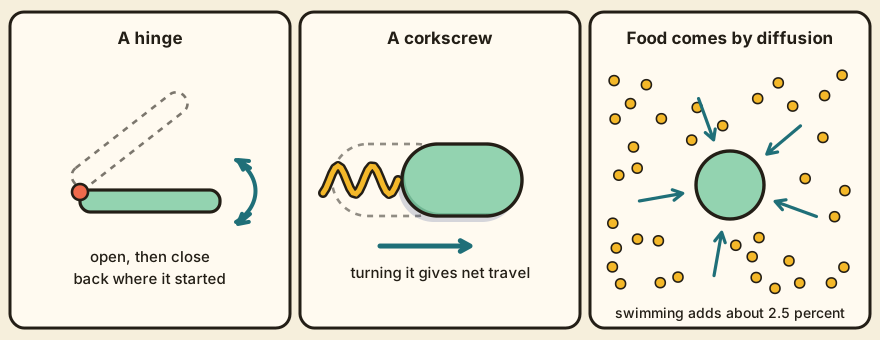
Purcell shows what this does to swimming. If the equations of motion have no inertia in them, a body that deforms and then returns through the same shapes in reverse order has to end up where it started, however fast or slowly it goes. He makes the scallop his example. A scallop opens its shell slowly and shuts it fast, and at this scale that would leave it flapping in place forever. A swimmer needs a cycle of shapes that doesn't run backward, and a rotating helix does exactly that. modeled
Howard Berg tracked single E. coli with a machine that followed one cell in three dimensions. As Purcell describes the tracks, a cell runs straight for a second or two at 20 to 40 micrometers a second and then stops and heads off in a new direction. Berg and Anderson argued in 1973 that the cells must turn their flagella like propellers, and Silverman and Simon then put that to the test. They used mutants that make the hook but no filament, glued the hooks to a slide with antibodies, and watched the whole cell body spin at a steady rate and sometimes reverse. observed It's one of the great tricks in microbiology - pin the propeller down and the boat spins instead. We know this episode only through Purcell's retelling.
How efficient all this is has been argued over. Purcell estimated that a rotating helix turns about 1 percent of the work it's given into useful motion, and judged that the number hardly matters, because moving costs the cell only a small slice of its energy budget. Brewer, Peltzer and Lage (2022) call that estimate a paradox, since bacteria swim at roughly ten body lengths a second. They propose that most of the work goes into breaking hydrogen bonds in the water next to the flagellum. They say this "remains to be tested," and we haven't seen a test. We don't know whether they're right.
The speeds themselves are well documented. Meyer-Vernet and Rospars (2015) collected maximum speeds for running and swimming species spanning about twenty orders of magnitude in mass, and almost all of them land between 1 and 100 body lengths a second, with a typical maximum near 10. A 2.5 micrometer Bacillus subtilis swims at 15 micrometers a second, which is 6 lengths a second. observed Their explanation, in terms of the force molecular motors exert per unit area and the maximum metabolic rate per unit mass, is an order-of-magnitude argument. modeled
Dinner comes to you, slowly
Purcell's second surprise is about eating. Moving fluid carries molecules around faster than diffusion does only over distances longer than D divided by the speed, where D is the diffusion constant. For a molecule in water and a bacterium swimming at 30 micrometers a second, that distance is far bigger than the cell, so stirring the water near the cell gets it nowhere. The cell has to wait for molecules to wander in. modeled
Berg and Purcell (1977) did the sums. A cell of radius a that absorbs every molecule it meets collects 4piD*a times the concentration in molecules per second. Swimming at 30 micrometers a second raises that by only about 2.5 percent, and doubling it would take roughly 3 millimeters a second. Stirring the water well enough to double intake would cost more than ten thousand times the power needed to push the cell along. modeled So much for chasing your food.
Torkel Kiorboe (2016) adds two points from the ecology of plankton. Because intake grows with radius while the cell's volume grows with its cube, a bigger cell collects less per unit of volume, which favors small cells where nutrients are scarce. And the picture shifts with size: models of self-propelled flagellates smaller than 10 micrometers give a gain near 25 percent, and flow measured around 25 micrometer swimming cells shows intake nearly doubled. observed
If swimming barely helps a bacterium eat, what's it for?
Purcell suggests, very tentatively, that a cell swims to get somewhere else. To tell one place from another it has to outrun diffusion, which means traveling about 30 micrometers, which happens to be about what a bacterial run covers. inferred Berg and Purcell add a limit from the other side. Brownian rotation turns the cell's heading in a few seconds, so any comparison of one place with another has to be done within that window. modeled We find that a lovely squeeze, with the physics fixing both the minimum distance and the maximum time. It also raises the next question, which B2 takes up: how well can a cell count the molecules it meets?
What you should be able to do after reading
Predict how microscopic scale changes locomotion, sensing, and environmental encounter.
A quick test: take a cell 1 micrometer across swimming at 30 micrometers a second, in water with a kinematic viscosity of one million square micrometers a second and a small molecule with D near one thousand square micrometers a second. Work out the Reynolds number and the stirring number, which is cell size times speed divided by D. You should get about 3 in 100,000 and about 0.03, and you should be able to say in one sentence what each of them rules out. Then say what a cell with a single hinge couldn't do and what a cell with a rotating tail can.
You need first
This leads to
B2 Noise and limits of molecular sensing
B3 Nonequilibrium maintenance and energetic cost
B6 The cell-relative environment
See it at work
References
- Purcell, E. M. (1977). Life at low Reynolds number. American Journal of Physics, 45(1), 3-11. doi:10.1119/1.10903
- Berg, H. C., & Purcell, E. M. (1977). Physics of chemoreception. Biophysical Journal, 20(2), 193-219. doi:10.1016/S0006-3495(77)85544-6
- Kiørboe, T. (2016). Fluid dynamic constraints on resource acquisition in small pelagic organisms. European Physical Journal Special Topics, 225, 669-683. doi:10.1140/epjst/e2015-50261-1
- Meyer-Vernet, N., & Rospars, J.-P. (2015). How fast do living organisms move: Maximum speeds from bacteria to elephants and whales. American Journal of Physics, 83(9), 719-722. doi:10.1119/1.4917310
- Brewer, P. G., Peltzer, E. T., & Lage, K. (2022). Life at low Reynolds number re-visited: The efficiency of microbial propulsion. Deep-Sea Research Part I, 185, 103790. doi:10.1016/j.dsr.2022.103790