 Cellosophy
Concept H3 · Strand H, Design
Constraints, tradeoffs, and realizability
Read first: Counterfactual biological imagination, Scale, diffusion, and life at low Reynolds number, Noise and limits of molecular sensing, Nonequilibrium maintenance and energetic cost, Boundary, metabolism, and self-production
Physics puts a ceiling on what a small cell can know about its surroundings. Most designs, and most real cells, sit well below that ceiling, which means a good audit has to ask two different questions. Does the design break a limit? And if it doesn't, what stands between it and working?
A bacterium lives in an odd country, where molecules arrive by diffusion, where viscosity matters more than inertia and where thermal jostling is large next to the forces the cell can apply - swimming through honey in a hailstorm, more or less. Berg and Purcell (1977) asked what such a place allows a cell to measure. Their answer is that statistical fluctuations limit how precisely a cell can find the concentration of an attractant in a given time T, and that the best strategy is to watch the occupation of receptors continuously. The least error falls as the measuring time, the cell's size, the attractant's concentration and its diffusion rate go up. They also found that near-best performance needs only a small fraction of the surface to be receptors, so covering the cell with receptors would add little. modeled Because the error shrinks only as the square root of the measuring time, halving it costs four times as much time. Patience is expensive.
Precision comes with a bill
Ten Wolde, Becker, Ouldridge and Mugler (2016) review what has been worked out since. A receptor's state is noisy twice over, because ligand molecules arrive at random and because binding is random once they arrive. A cell can lower the error by using more receptors, or by averaging each receptor's state over a longer time. For one receptor, the average amounts to about T divided by twice the receptor's correlation time independent measurements, where the correlation time is how long the receptor's state stays related to itself. modeled
Averaging isn't free. It needs machinery downstream, and that machinery adds noise of its own. The authors argue that a cell that wants to average without adding noise needs three kinds of resource: receptors and the time over which they're averaged, readout molecules, and energy. Each kind sets its own limit, and precision is bounded by whichever is scarcest, so piling up one kind doesn't help - it's the old barrel that holds water only up to its shortest stave. A network held at equilibrium can sense, but its accuracy is capped by the number of receptors. To store the receptor's state in a standard push-pull signalling network takes at least one readout molecule and at least 4 kT of energy, where kT is the thermal energy scale. modeled The authors also say that cellular copying can never reach the Landauer limit, the least energy an irreversible computation must cost per bit. We haven't checked the underlying calculations, and we're no experts on the thermodynamics of computation.
A ceiling isn't a forecast
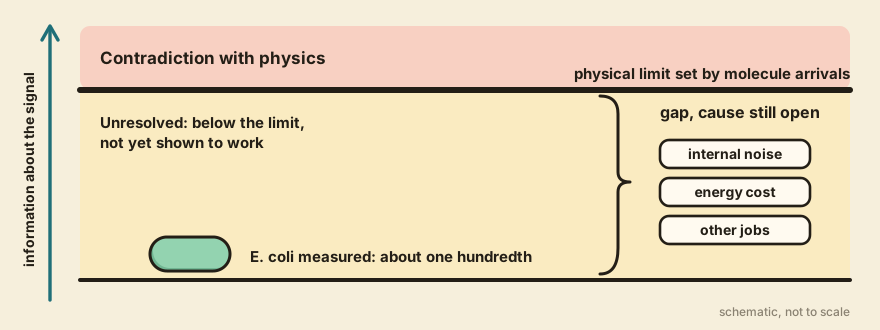
Berg and Purcell's abstract concluded that the chemotactic sensitivity of E. coli approaches that of an optimally designed cell, and that view became widely held. It's a lovely picture, a humble gut bacterium working right at the edge of what physics permits. Mattingly, Kamino, Ong, Kottou, Emonet and Machta (2026) tested it directly. They worked out how accurately a bacterium could estimate the rate of change of an attractant from molecule arrivals alone, and compared that with how accurately the signal can be read from the activity of the cell's CheA kinase, measured in single cells with a fluorescence-based reporter. observed Typical E. coli cells encoded about two orders of magnitude less information than the physical limit.
Two orders of magnitude.
The authors conclude that internal noise in signal processing limits the cell, and arrival noise doesn't. They also give a reason why the older argument may have misled. Berg and Purcell asked whether a cell could judge the change in concentration over a single run, but a cell that makes many imperfect decisions still climbs a gradient on average. inferred A tipsy walker still gets home, eventually. They add that another bacterium's reported nearness to the limit, within a factor of about 6, would become about 90 times further away if the signal's correlation time were counted. inferred
Why E. coli sits so far below the ceiling isn't known. The authors list possibilities and test none of them here: trade-offs in working across a wide range of backgrounds, the need to sense many chemicals, selection in steep gradients in the lab, and the cost in energy or resources of extra information.
Contradiction, or just unfinished
Put these together and an audit has a shape. Take a proposed organism and ask what it must measure, how fast, with how many receptors, readout molecules and joules, and compare the demand with the limits above. If the demand needs more precision than the measuring time and receptor count allow, the design contradicts physics and has to change, because physics doesn't negotiate. If it doesn't, the verdict is that the design is unresolved, something like the old Scottish verdict of not proven. The two-cell memory circuit from H1 is an example. Nothing in the papers on this page rules it out, and nobody has built it.
A revision then means changing one feature and rereading the verdict. If the design needs twice the sensing accuracy, it can wait four times as long and respond more slowly, or it can add receptors, readout molecules or energy supply, depending on which is scarcest. We'll own up to a gap here. This page says little about material upkeep and the limits of cell size, because none of the three papers measures them. Those belong to the audit, and we've no evidence to add.
What you should be able to do after reading
Audit a design for scale, sensing, energy, material maintenance, and incompatible demands; distinguish a contradiction from an unresolved implementation; revise one feature.
A quick test. Pick an alternative you wrote for H1 and list what it demands of the cell for sensing, energy and upkeep. Mark each demand as a contradiction with a limit, or as unresolved, and write down the evidence for the mark. Then change one feature and say which verdict moved. Designs that pass the audit go on to H5, where they get compared.
You need first
H1 Counterfactual biological imagination
B1 Scale, diffusion, and life at low Reynolds number
B2 Noise and limits of molecular sensing
See it at work
References
- Berg, H. C., & Purcell, E. M. (1977). Physics of chemoreception. Biophysical Journal, 20(2), 193-219. doi:10.1016/S0006-3495(77)85544-6
- ten Wolde, P. R., Becker, N. B., Ouldridge, T. E., & Mugler, A. (2016). Fundamental limits to cellular sensing. Journal of Statistical Physics, 162, 1395-1424. doi:10.1007/s10955-015-1440-5
- Mattingly, H. H., Kamino, K., Ong, J., Kottou, R., Emonet, T., & Machta, B. B. (2026). E. coli chemosensing accuracy is not limited by stochastic molecule arrivals. Nature Physics, 22(1), 123-130. doi:10.1038/s41567-025-03111-4