 Cellosophy
Concept H5 · Strand H, Design
Comparing alternative implementations
Read first: Designing organisms and their environments together, Constraints, tradeoffs, and realizability, Adaptation and integral feedback
A bacterium can climb toward food in more than one way, and a model can show what each way would do before anyone runs an experiment on a cell. This page uses one published model to show how such a comparison goes. We'll be plain about how far the comparison reaches, which is less far than you might hope.
The textbook way, and a stranger one
The standard account of E. coli chemotaxis, the one the adaptation loop page describes, puts the sensing in receptors on the cell surface. The receptors bind attractants, and their methylation level carries a memory of recent concentrations, which the cell uses to keep running when things improve and to tumble when they don't (Micali and Endres, 2016). observed We've read this only as summarized in that review.
In 1969 Julius Adler argued that metabolizing an attractant is neither needed for taxis nor enough for it. As Egbert, Barandiaran and Di Paolo (2010) list his evidence, some heavily metabolized chemicals fail to attract bacteria, and some chemicals that can't be metabolized do attract them. observed Eating and wanting came apart. After that, research focused on the path from receptors to motors, and the authors say that all available simulation models of bacterial chemotaxis assumed the path runs independently of metabolism.
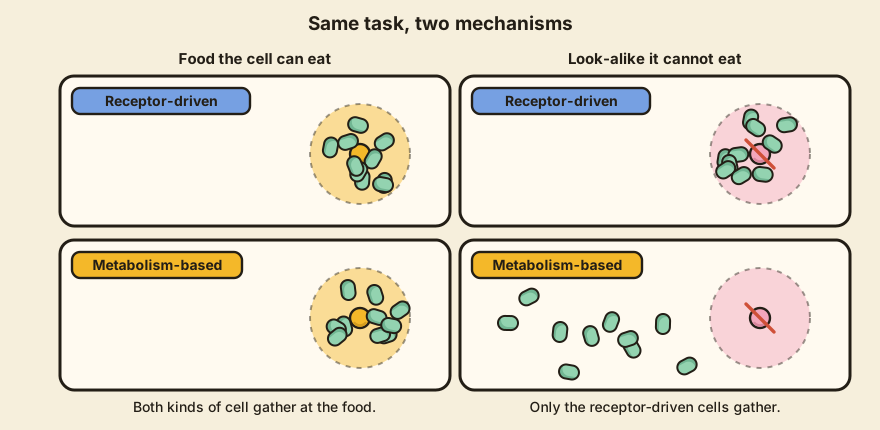
Egbert and colleagues asked what the simplest alternative would look like, and the answer is almost cheeky. Their simulated cell has no receptors and no signaling proteins, and it doesn't adapt its sensitivity. It has one autocatalytic reaction, in which a material M and an energy source E are turned into a catalyst C and waste W, with C speeding up its own production. The chance of tumbling at each time step rises in proportion to the concentration of C. So a cell with plenty of food makes a lot of C, tumbles in place and stays where it is, while a starved cell makes little C, runs, and wanders until it reaches a richer spot. The authors call this selective stopping. modeled You could call it eating your way home. In their first experiment, 100 such cells in a 200 by 200 unit arena ended up gathered around a source of M and E.
Where the two stop agreeing
A comparison earns its keep when the mechanisms agree on the ordinary case and disagree somewhere else. In this model the disagreements appear when the cell's situation or history changes.
Start with a look-alike food, a decoy. A cell that senses by binding should stay drawn to a chemical that fits its receptors and can't be eaten, and Adler found such chemicals attract E. coli. A cell that steers by metabolism should lose interest. In the model, the authors added a chemical that blocks the use of E and M. Cells stopped gathering at the E and M source and kept gathering at a second source that used a separate pathway. modeled
Abundant food elsewhere changes the picture too. When the authors spread a second usable food evenly through the arena, cells stopped gathering at the original source, and their mean distance from it rose from about 56 to about 118 units. modeled The reason is simple. With food everywhere, C stays high everywhere, and the cell tumbles in place wherever it happens to be, since the buffet has come to it. The authors report that a similar inhibition by other metabolizable chemicals was described in Azospirillum brasilense. observed
History matters as well. In one run the cells started with no M, and E alone couldn't support their metabolism. Only after they wandered into a strip containing M did E begin to attract them. modeled On this picture a chemical counts as an attractant when the cell's metabolism needs it at that moment. Appetite first, attraction after. The authors link this to a report that cells grown on a sugar respond more strongly to it.
Then there's the bill
The second thing to change is what the mechanism costs to run. Micali and Endres (2016) review theory on the receptor pathway. They say that processing information costs fuel, that energy cost limits how accurately a cell can sense, and that there's a trade-off between energy use and fast, accurate adaptation. They also report that responding to a simple step in ligand concentration costs about 10 percent of the energy spent holding the pathway at its working state. modeled Egbert's cell pays for its steering through its metabolism directly, and we didn't find an energy bill for that steering in the paper. No paper we read runs both mechanisms through the same cost audit. So a head-to-head comparison on cost is still open, and we don't know which one would come out cheaper.
What a model can promise, and what it can't
The model shows that a mechanism of this kind is enough to produce these patterns. Being enough doesn't show that real cells use it. Egbert and colleagues say their model is a proof of concept, and they leave the likelihood of the specific mechanisms, and their experimental support, outside the paper. They suggest that fumarate, an intermediate of the citric acid cycle that acts on the flagellar motor switch, might be doing something like this in E. coli, and they write that this remains to be tested. inferred
The rival is a choice too. Muok, Olsthoorn and Briegel (2024) review chemotaxis systems that differ from the E. coli one. Bacillus subtilis has three adaptation systems that work together, and the authors write that why some bacteria have such extra systems is unknown. observed So the standard mechanism is one implementation among many, and picking it as the rival is itself a hypothesis.
A model can tell you a mechanism would work. Only a cell can tell you it does.
Only a biological test can say which mechanism a cell uses. A test of this kind would block metabolism, or remove receptors, in living cells and watch where they go. We've no result of that kind to report here for E. coli.
What you should be able to do after reading
Model two mechanisms attempting the same task; compare predictions under a changed history or cost; state which conclusions are about the models and which require biological tests.
A quick test. Pick a task such as moving toward warmth. Write two ways a cell could do it, then one prediction for each under a changed history and one under a changed cost. Mark each prediction as a statement about the models or as something only a cell experiment can settle. H7 asks you to use this kind of comparison when choosing between designs for one part of a larger cell.
You need first
H2 Designing organisms and their environments together
This leads to
See it at work
References
- Egbert, M. D., Barandiaran, X. E., & Di Paolo, E. A. (2010). A minimal model of metabolism-based chemotaxis. PLOS Computational Biology, 6(12), e1001004. doi:10.1371/journal.pcbi.1001004
- Micali, G., & Endres, R. G. (2016). Bacterial chemotaxis: information processing, thermodynamics, and behavior. Current Opinion in Microbiology, 30, 8-15. doi:10.1016/j.mib.2015.12.001
- Muok, A. R., Olsthoorn, F. A., & Briegel, A. (2024). Unpacking alternative features of the bacterial chemotaxis system. Annual Review of Microbiology, 78, 169-189. doi:10.1146/annurev-micro-032421-110850