 Cellosophy
Concept H7 · Strand H, Design
Iterative whole-cell design and research proposal
Read first: Inventing observables and experimental worlds, Comparing alternative implementations, Speculative natural history and discovery, Whole-cell modeling, Synthetic tests of whether a retained state matters for viability, Rival models and discriminating interventions
A design for a cell is ready to propose when its parts have been revised until they stop getting in each other's way, and when someone has written down what would show it to be wrong. No paper we read does that for a whole cell. Each one does a piece of it, so this page lays the pieces side by side, a jigsaw without the picture on the box.
When one cell gets crowded, split the job
Macia, Vidiella and Solé (2017) wanted a microbial circuit that learns by association, so that a signal that did nothing at first comes to trigger a response after it has been paired with a signal that always did. Designs that put this inside a single cell need many connections, and the authors point to crosstalk between them as the problem - too many wires in one small box. Their solution divides the work between two cell types. One cell carries a toggle switch that remembers whether the two signals have been seen together, and a second cell reads that state through a diffusing molecule and produces the response. modeled In their simulations of E. coli with parameters from the literature, a pulse of the chemical IPTG resets the switch and erases the association. They also describe two variants, one that can't be silenced and one that forgets after a short time.
This is a model, and nothing has been built. The authors write that future work should test whether the design can be made to work in cells, and they note that it assumes the two cell types stay together as one consortium. So the trade is plain. The conflict they resolved was between the wiring a single cell would need and the crosstalk that wiring brings, and the price of the fix is a new assumption about how the community holds together. Every fix sends an invoice.
Beat the boring explanation first
A design that learns has a simpler rival, which is that the cell only became more responsive. Abramson and Levin (2021) write a primer for people who build novel organisms and need a way to test for learning. Their main advice is to include several control groups, among them one that receives the two stimuli separately, with half the interval between trials so that the stimuli are spaced as they are in the paired group. If the paired group responds more than the unpaired group, that points to learning. They also describe alpha conditioning, in which two stimuli that already produce some response become linked, and they say the unpaired control is needed to detect it. Applied to the two-cell circuit, an unpaired control would show whether the response to the second signal appears without the pairing. inferred That application is our own.
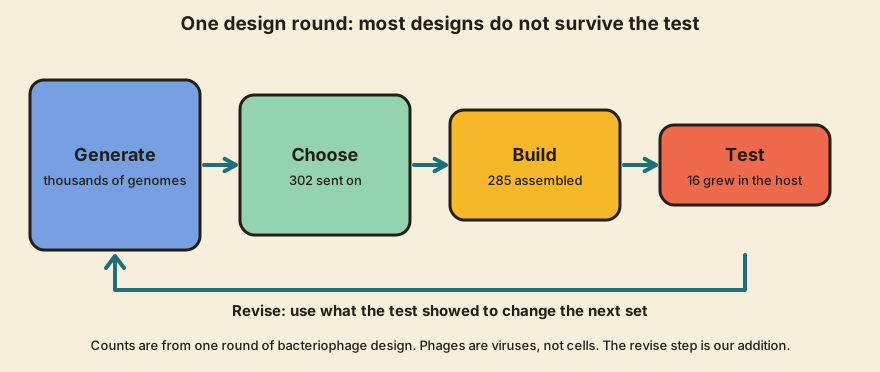
King and colleagues (2026) show a rival that's simpler still, the natural version. They used a language model trained on genomes to design bacteriophage genomes based on the phage ΦX174, built nearly 300 of them, and tested a cocktail of all 16 working designs plus ΦX174 against two E. coli strains that had become resistant to ΦX174. The designed cocktail inhibited growth of both strains within two passages and kept doing so for at least five. A cocktail of 16 natural ΦX174-like phages plus ΦX174 inhibited neither strain, even after five passages. observed The natural cocktail was the rival the design had to beat, and the test could have gone the other way.
What fails, and what just sits there unresolved
Most of the designs failed, which is worth dwelling on. Of 302 chosen genomes, 285 were assembled, and 16 produced phages that grew, which is 12 of 227 designs from one model and 4 of 58 from the other. observed None of the 285 grew on a different E. coli strain, which supports the rule they set for host range. Viability also rose as designs came closer to natural genomes, reaching 46.2 percent for designs 98 to 100 percent similar. observed We read this as an unresolved limit, because it suggests the designs still lean on natural templates. inferred These are viruses with eleven genes, and the paper does not design a cell.
di Bernardo (2026), in a preprint review, names another unresolved limit for the consortium idea. Spreading control across cell populations lowers the burden on each cell but makes it hard to keep the populations in proportion, and he calls long-term stability under evolution an unsolved problem. inferred He also reports that, among the multicellular controllers he reviews, only the antithetic integral design has been validated in living cells, and the proportional and derivative extensions are so far computational. He's one of the originators of the approach, so we read his conclusions with that in mind.
What we don't know
We don't know how to join these pieces into a proposal for a whole cell, because no source here has done it. Our suggestion is to treat each piece as a step: resolve a conflict, then test the result against the natural rival, then write down what's still open. That last step is where the honesty lives. This is our reading of the papers, and no author states it.
What you should be able to do after reading
Integrate a design portfolio; resolve a conflict among subsystems; propose a prospective test against a simpler rival; record an unresolved constraint and a result that would require redesign.
A quick test. Take the two-cell circuit above. Name the conflict the split resolves and the new assumption it adds. Name the simpler rival and the control that separates it from learning. Then write one unresolved constraint, such as keeping the two populations in balance, and one result that would send you back to redesign, such as a response to the second signal in an unpaired control.
You need first
H4 Inventing observables and experimental worlds
H5 Comparing alternative implementations
H6 Speculative natural history and discovery
G4 Synthetic tests of whether a retained state matters for viability
This leads to
See it at work
References
- Macia, J., Vidiella, B., & Sole, R. V. (2017). Synthetic associative learning in engineered multicellular consortia. Journal of the Royal Society Interface, 14(129), 20170158. doi:10.1098/rsif.2017.0158
- Abramson, C. I., & Levin, M. (2021). Behaviorist approaches to investigating memory and learning: A primer for synthetic biology and bioengineering. Communicative & Integrative Biology, 14(1), 230-247. doi:10.1080/19420889.2021.2005863
- King, S. H., Driscoll, C. L., Li, D. B., Guo, D., Merchant, A. T., Brixi, G., Wilkinson, M. E., & Hie, B. L. (2026). Generative design of bacteriophages with genome language models. Science, 393, eaec2657. doi:10.1126/science.aec2657
- di Bernardo, M. (2026). Multicellular feedback control strategies in synthetic microbial consortia: From embedded to distributed control. arXiv preprint arXiv:2602.19666 [eess.SY]. link