 Cellosophy
Concept G5 · Strand G, Whole-cell program
Rival models and discriminating interventions
Read first: Grading claims by evidence, Whole-cell modeling, Synthetic tests of whether a retained state matters for viability
When a cell does something that looks like learning, there's usually more than one way to explain it, and the useful question is which experiment would pull the explanations apart. This page follows two cases, one old and still unresolved, one recent and sharp, to show what such an experiment looks like.
Two stories, one behaviour
A rival model is a second explanation of the same behaviour. A discriminating intervention is an experiment on which the two explanations predict different results. The richer explanation says the cell has changed in a way that carries information about its past, such as an association. The simpler one says the behaviour comes from something more ordinary, like leftover chemistry in the dish. We use the phrase conceptual contraction for the step of giving up the richer account when the simpler one covers the results. To make that step fair, you have to write down the result that would force it before the experiment is run - otherwise everyone wins every argument. These terms are ours, and neither paper below uses them.
Gelber's paramecia, and an argument settled by stirring
Samuel Gershman, Petra Balbi, Randy Gallistel and Jeremy Gunawardena (2021) reopened the work of Beatrice Gelber, who in the 1950s tried to condition the ciliate Paramecium aurelia. She swabbed a wire with bacteria, dipped it into a culture of paramecia, and later dipped the clean wire. According to the review, trained paramecia clung to the clean wire in greater numbers than untrained ones, and a group given the wire alone without bacteria did not. observed We haven't read Gelber's papers, and the review is our only source for what she did.
Donald Jensen offered a rival. Bacteria left near the wire, or a general attraction to touch caused by the bacteria, could produce the same clinging without any change in the paramecia. Gelber replied that she stirred the slide between trials, and that Jensen's bacterial concentrations were much higher than hers. Katz and Deterline later replicated her result and then stirred the culture hard after the last training trial. The clinging vanished. They took this as support for the leftover-bacteria account.
Gershman and colleagues point out that the stirring result fits the other side too. Stirring would also scatter the bacteria and so break the link between the wire and the food, and in animal conditioning a broken link reliably weakens the learned response even when the number of pairings is unchanged. They add that Hennessey and colleagues (1979), using a different task with paramecia, ran a control in which the two stimuli were presented at random and found that this removed the learning. observed The review's own verdict is that Gelber's experiments, though limited, convincingly demonstrated Pavlovian conditioning. That's a judgement, and other readers disagree.
What the episode shows is a discriminating intervention that failed to discriminate. One result, the effect of stirring, was read both ways, so it couldn't choose. Our inference is that a better test would hold fixed the total bacteria the paramecia meet and vary only whether bacteria and wire go together. The leftover-bacteria account predicts the same clinging in both groups. The learning account predicts clinging only after pairing. inferred Gershman and colleagues remark that people in the old debate sorted themselves into those for and against single-cell learning and read the evidence to match, and that designing experiments that avoid this is still hard.
What result would make you give up the story you like?
Decades later, it's an uncomfortable question for any field, ours included.
A sharper case: why E. coli do not sense better
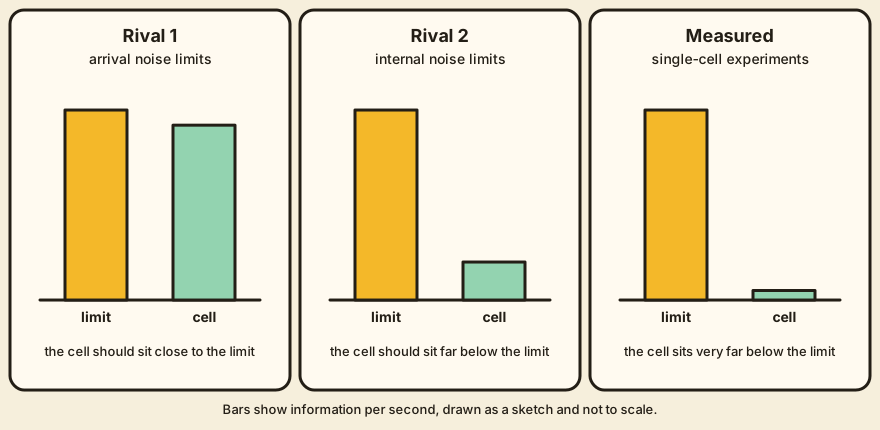
Henry Mattingly, Keita Kamino, Jude Ong, Rafaela Kottou, Thierry Emonet and Benjamin Machta (2026) studied a question where the rivals could be stated in numbers. E. coli climbs chemical gradients by comparing concentrations as it swims. Berg and Purcell argued long ago that the cell's accuracy is limited by the random arrival of molecules at its receptors, and many biologists took the cell to be close to that limit. The rival says the limit is set by noise inside the cell's own signalling network.
The two accounts predict different things about a quantity you can measure. If arrivals set the limit, nearly all the noise in the activity of the kinase CheA, which relays receptor signals to the motors, should come from arriving molecules. If internal noise sets it, slow fluctuations inside the cell should dominate. The authors derived the most information about the changing signal that arrivals could allow, using a model with a shallow gradient, Gaussian statistics and a circular sensor of 60 nanometres radius. modeled They then measured kinase activity in single cells by FRET at three background concentrations of the attractant aspartate. The slow internal fluctuations, on a timescale of roughly ten seconds, were much larger than filtered arrival noise over the range they could observe. observed The information encoded in kinase activity came out at least two orders of magnitude below the physical limit. Its best ratio to the limit was about 0.014, at a background near the receptor's dissociation constant. modeled In simulation, a cell that used the ideal estimate climbed gradients much faster than one using the kinase-based estimate. modeled
So the famous bacterium is a long way from perfect. Some caveats are the authors' own. They measured the median cell of one laboratory strain, and the 95th percentile of the population was only about five times closer to the limit. FRET can't see kinase noise on the fastest timescales. They also say the result raises a new question, which is what constrains the cell, and they offer trade-offs and resource cost as possibilities. We don't know the answer.
What you should be able to do after reading
Formulate rival models, a discriminating intervention, and explicit criteria for conceptual contraction.
A quick test: pick a behaviour from this site, such as a ciliate changing its response to repeated irritation. Write one richer explanation and one simpler one. Then write the single measurement on which they disagree, and the result that would make you give up the richer account, before you imagine the answer.
See it at work
References
- Gershman, S. J., Balbi, P. E. M., Gallistel, C. R., & Gunawardena, J. (2021). Reconsidering the evidence for learning in single cells. eLife, 10, e61907. doi:10.7554/eLife.61907 · free full text
- Mattingly, H. H., Kamino, K., Ong, J., Kottou, R., Emonet, T., & Machta, B. B. (2026). E. coli chemosensing accuracy is not limited by stochastic molecule arrivals. Nature Physics, 22(1), 123-130. doi:10.1038/s41567-025-03111-4