 Cellosophy
Concept A4 · Strand A, Orientation
Grading claims by evidence
Read first: Levels and kinds of explanation
A claim about a cell is worth exactly as much as the work behind it. Two sentences can sound equally sure of themselves and stand on very different ground, and this page is about telling which ground is which. We use three labels across the site. Observed means someone saw the thing in the cell or organism in question. Inferred means it follows from observations through a further step of reasoning, such as a comparison or the ruling out of other explanations. Modeled means it comes out of a model, with whatever assumptions went into it. These labels are ours, made for readers of this site, and neither paper below uses them.
A wire, some bacteria and a very old argument
Samuel Gershman, Petra Balbi, Randy Gallistel and Jeremy Gunawardena (2021) reopened an old fight over whether single cells can learn. Their main subject is Beatrice Gelber, who worked in the 1950s with Paramecium aurelia, a ciliate that eats bacteria. She asked whether paramecia would learn to approach a clean wire after the wire had repeatedly been coated with bacteria. One group of paramecia got bacteria on the wire, and in later tests with a clean wire more of them clung to it than before training and more than an untrained group did. In a second experiment, a group that met the wire alone, with no bacteria, showed no such change. observed We're reading all this through the review and haven't seen Gelber's papers.
Notice how much sits between that result and the words "Pavlovian conditioning". Someone has to argue that the wire came to predict food, and the second experiment is part of that argument. Gelber also used a single mating type and small amounts of bacteria to avoid conjugation and autogamy, two events that reshuffle the cell's nuclear material. She reported that memory lasted three hours after spaced training but not after massed training. observed The step from these results to a claim about learning is an inference, and a textbook example of one, because every control is there to knock out a rival explanation. inferred
And the rivals were real. Donald Jensen argued that bacteria might make the cells stick to surfaces, or might change the culture near the wire, so that no change in the cell was needed at all. Katz and Deterline replicated Gelber's effect, then found that vigorous stirring after training erased it, and took that as support for a residue of bacteria. Gershman and colleagues offer another reading. Stirring would spread the bacteria around and break the link between wire and food, and animal experiments show that breaking the link removes conditioned responding even when the number of pairings stays the same. inferred Their verdict is that Gelber's experiments "convincingly demonstrated" Pavlovian conditioning in paramecia, with limitations. They call the earlier single-cell literature equivocal, and they remark, a little drily, that both sides of the old debate seemed shaped by what they already believed. Scientists are people too.
The last layer is untested. If a paramecium stores a memory, it has to do so inside one cell. Gershman and colleagues list DNA methylation and histone modification as candidates, and they say we still don't understand how paramecia pull this off. We give that claim no tag, because nobody has shown it.
A ladder borrowed from bet hedging
Andrew Simons (2011) had a different headache. Bet hedging is the idea that a trait can lower the swings in reproductive success from generation to generation, at the price of a lower average - the evolutionary version of not putting all your eggs in one basket. The reasoning is a model. Reproduction multiplies, so long-run growth follows the geometric mean of fitness, and that mean falls as fitness varies. modeled A trait like this can look harmful if you watch it for one generation, which means a short study can miss it or get it wrong.
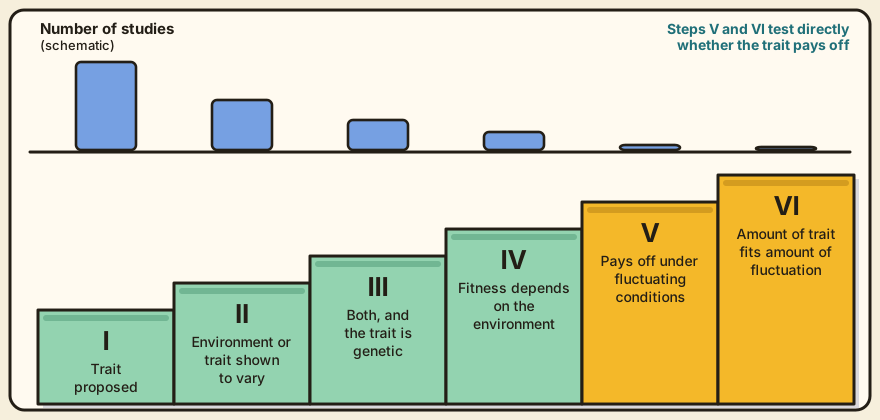
So Simons sorted published studies into six categories by how strong a case each could make. The lowest only proposes a candidate trait. Higher ones add evidence that the environment really is unpredictable, that the trait varies at the level of genotypes, and that fitness depends on the environment. The top two test whether the trait pays off under fluctuating conditions and whether its amount matches the amount of fluctuation. His examples include mosquitoes that delay hatching within a brood, explained by how likely each habitat is to dry out across 22 populations, and Sinorhizobium meliloti bacteria, which under carbon scarcity make both short-term and long-term starvation-resistant daughter cells whose fitness depended on the starvation environment.
He found more than 100 studies covering 114 organisms in 16 phyla. observed Most sat on the lower rungs, and only 12 studies provided evidence that the traits are adaptive, in the top two. observed He's careful about what that means. The placement shows the potential strength of the evidence and doesn't grade a study's quality, so a well-run study on a low rung can be worth more than a sloppy one higher up. His survey also isn't a systematic review, since he says the studies used too many different approaches and terms for a meta-analysis or systematic review to be possible.
Splitting the sentence, grading the pieces
Gershman and colleagues ask what rules out the other explanations for one behaviour. Simons asks how far a claim has climbed from plausible to tested. Put them side by side and a habit falls out. Split a sentence into its parts and grade each part separately.
"Paramecia learn to link a wire with food." How many claims is that?
Pull it apart and you find an observed response, an inferred interpretation and an untested mechanism, all wearing one coat.
We don't know how well Simons's ladder carries over to claims about cognition, since he built it for adaptation. We use it as an analogy and nothing more. We also don't know who's right about every detail of the Gelber debate, because the eLife paper is a review that takes a side and we haven't read the original exchange. We're no historians of protozoology, so we'd happily be corrected.
What you should be able to do after reading
Tag a claim as observed, inferred or modeled, and justify the tag by saying what work stands behind it.
A quick test: take one sentence from A1 or A3 and split it into its separate claims. Tag each one, then write a single line naming the experiment, comparison or model that holds it up. If you can't name one, write "we don't know" for that part. It's an uncomfortable habit at first. You'll need it in every strand that follows.
You need first
This leads to
G2 Actual and possible: the modal status of a claim
See it at work
References
- Gershman, S. J., Balbi, P. E. M., Gallistel, C. R., & Gunawardena, J. (2021). Reconsidering the evidence for learning in single cells. eLife, 10, e61907. doi:10.7554/eLife.61907 · free full text
- Simons, A. M. (2011). Modes of response to environmental change and the elusive empirical evidence for bet hedging. Proceedings of the Royal Society B, 278(1712), 1601-1609. doi:10.1098/rspb.2011.0176