 Cellosophy
Concept H4 · Strand H, Design
Inventing observables and experimental worlds
Read first: Designing organisms and their environments together, Grading claims by evidence, Receptors and signal transduction
A claim about what a cell can do is worth exactly as much as the measurement that could show it wrong. We call that an invented observable: a quantity you could measure that would reveal a proposed capacity, together with an assay for measuring it and an honest statement of how the assay could mislead you.
The story that shows this best is a replication. In 1906 Herbert Spencer Jennings described how the ciliate Stentor roeseli, a trumpet-shaped single cell anchored to debris in pond water, answers repeated irritation with a sequence of responses. First it bends away, then it alters its cilia, then it contracts, and finally it detaches from its anchor. Dexter, Prabakaran and Gunawardena (2019) report that later workers, among them Reynierse and Walsh, couldn't reproduce this, and the account was discredited. observed Dexter and colleagues point out that the failed attempts used a different species, Stentor coeruleus, which prefers to swim and became free-swimming whenever the dye was added, whatever the conditions. Wrong animal, wrong test. The assay had changed the cell's behaviour in a way that hid the question.
Was the old observation wrong, or was the apparatus asking a different cell a different question?
An observable that's allowed to fail
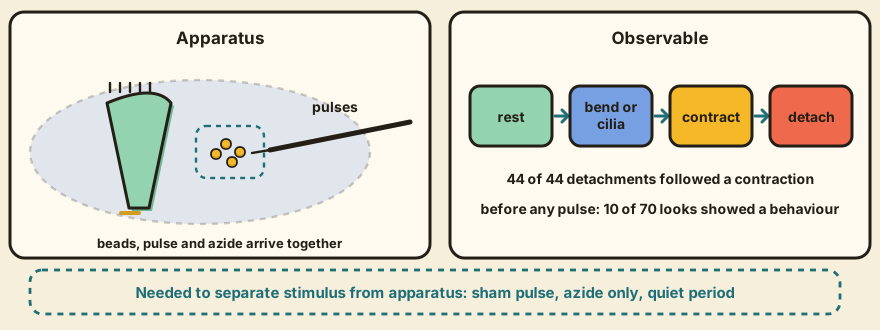
Dexter and colleagues got hold of the correct species and found that Jennings' carmine rarely triggered a response in their hands. So they switched to polystyrene beads in water with sodium azide, delivered through a microinjection needle in pulses from a gravity-fed stopcock, and filmed each cell on an inverted microscope. That made the stimulus new, and they say the cell may recognise it as different from carmine, although the responses looked very similar.
The invented observable was the order of behaviours. If there were no hierarchy, any one behaviour would show up before detachment about as often as not, and the authors tested this against chance with a binomial calculation. All 44 detachments they analysed had been preceded by a contraction. Bending or a change in cilia came before contraction in 40 of 44 comparisons. They conclude that the hierarchy is strongly supported statistically. observed They also looked at what happened after each contraction. The share of cells still attached fell off in a way that fits a coin toss, with about a 50 percent chance of detaching after each contraction. observed Heads you stay, tails you go. That's a description of the pattern, and it says nothing about how the cell makes the choice. The authors call the mechanism an open question.
What the apparatus couldn't separate
The paper is frank about its limits, and each one doubles as a design lesson. Pulses were timed by eye to each cell's apparent return to rest, so a behaviour couldn't be tied to a particular pulse. The beads came with sodium azide, so the authors couldn't say whether the cell responded to the arrival of a pulse, to its length or to azide building up over several pulses. They didn't set aside a quiet period for every cell, and they say they saw the importance of this only when the analysis began - hindsight, the one instrument every lab owns. In partial compensation they counted what cells did before any stimulus, and 10 of 70 observations, or 14 percent, showed one of the four behaviours, mostly bending or ciliary change. Cells also varied a great deal, few showed the full sequence, and day-to-day differences in the number of contractions were borderline, with a p value of 0.11. observed
The authors also considered a Clever Hans effect, in which a cell responds to cues the experimenter gives without knowing. They argue it's unlikely, because two cells given the same pulse once behaved differently, and because the experimenters would have had to learn, without noticing, to coax out a complicated sequence. inferred Our own reading is that a sham pulse of water without beads, a pulse of azide alone, and a fixed quiet period for every cell would separate the stimulus from the apparatus. That's our suggestion, and the authors don't propose it.
Build the room before you run the test
Abramson and Levin (2021) wrote a primer for people who engineer new organisms and have to decide how to test them. They suggest starting with habituation, because it needs only one stimulus, and keeping a catalogue of how an organism responds to each stimulus over a range of intensities before designing anything harder. Walk before you run. In a formal learning experiment they advise several control groups: stimulus only, reinforcer only, a blank, and unpaired presentations, so that a change can be credited to the pairing and not to the stimulus alone.
They also stress that the apparatus is part of the experiment. They report that crabs clamped in place pressed a lever badly and did well in a small box, and that stingless bees learned quickly in small bottles and not in tubes that held them still. observed Both examples come from other people's studies. The authors conclude that organisms should be allowed, as far as possible, to interact with the world and pick which signals matter.
What we don't know
We don't know why beads work where carmine didn't, whether the sequence reflects a decision in any strong sense, or how it works in a pond. The authors describe their results as evidence of complex decision-making, and that reading goes beyond the counts. Abramson and Levin offer a toolkit and no data.
What you should be able to do after reading
Define an observable and a hypothetical assay or apparatus for a proposed capacity; identify measurement limits, apparatus effects, controls, and an outcome that would change the claim.
A quick test. Choose a capacity, such as habituation in a single cell. Write the quantity you'd record, the apparatus, two things the apparatus could do to the cell on its own, a control for each, and a result that would make you drop the claim. Decide that result before you look at any data, because afterwards it's too late to be honest. H7 asks how assays like this feed back into an iterative design.
You need first
This leads to
See it at work
References
- Dexter, J. P., Prabakaran, S., & Gunawardena, J. (2019). A complex hierarchy of avoidance behaviors in a single-cell eukaryote. Current Biology, 29, 4323-4329.e2. doi:10.1016/j.cub.2019.10.059
- Abramson, C. I., & Levin, M. (2021). Behaviorist approaches to investigating memory and learning: A primer for synthetic biology and bioengineering. Communicative & Integrative Biology, 14(1), 230-247. doi:10.1080/19420889.2021.2005863