 Cellosophy
Concept H2 · Strand H, Design
Designing organisms and their environments together
Read first: Counterfactual biological imagination, Viability and organism-relative normativity, The cell-relative environment
A design for an organism is unfinished until it says what the organism can sense, what it can do, where it lives and what it stands to lose. Leave out any one of these and nobody, the designer included, can say what problem the poor creature is supposed to be solving.
We should confess up front that this page stands on very little. Our anchor is one conceptual paper, and the rest is remarks borrowed from papers written for other purposes. We found no study that tests a way of designing an organism and its world together. The four items above are our own summary.
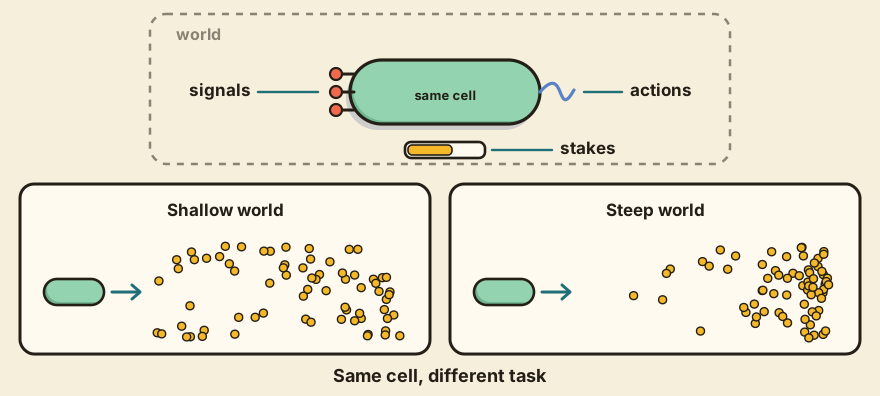
Same cell, different world
Take one job, finding food, and move it from place to place. Muok, Olsthoorn and Briegel (2024) report that bacteria living in specific, steady conditions often have few chemoreceptors, while those from many varied habitats have about five times as many. Marine bacteria often follow sulfate, nitrate and lactate, and soil bacteria often follow aromatic compounds. observed That's the review's summary of genome surveys by other groups, and we haven't checked those surveys ourselves. Still, it suggests that the world gets to decide which signals are worth having a receptor for.
A second case comes from Mattingly and colleagues (2026), who measured how much information E. coli cells get about the rate of change of an attractant. There's a wrinkle in it. The lab strain they used was originally selected in migration assays, where the cells make steep gradients, about 1 per millimetre or steeper, while their simulations used gradients between 0.05 and 0.4 per millimetre. The authors suggest that steep gradients might remove the need for a precise sensor. inferred They didn't test this, and they say more work is needed. If it holds, the same cell sits an easy exam in one world and a hard one in the other - same cell, different paper.
Why a viable bacterium bothers to swim
Ezequiel Di Paolo (2005) asks what makes a bacterium swim up a sugar gradient when it could simply stay put. He starts from autopoiesis, the idea that a living thing is a network of processes that keeps producing its own parts and its own boundary. Such a network has one built-in norm. Stay organized or fall apart. Di Paolo points out that this norm, on its own, makes no difference between degrees, so a bacterium that is already viable across a range of sugar concentrations has, on that account, no reason to prefer the higher ones.
Why should a cell that's doing fine care about doing better?
His addition is adaptivity. A system is adaptive when it can regulate its own states and its relation to its surroundings so that, close to the edge of viability, it tells apart tendencies that lead toward the edge from tendencies that lead away, and acts on that difference. He says this takes two things together, monitoring and a fitting response. Monitoring without a response means nothing to the system, and regulation without monitoring is cut off from the situation it has to answer - an alarm ringing in an empty house. inferred This is a philosophical argument supported by one worked cell-growth example in a footnote, and there's no experiment behind it.
For a designer, the useful consequence is that stakes need a physical basis. A signal matters to a cell because the cell's own continuing existence depends on it. Di Paolo marks the difference in a footnote that deserves to be a slogan: bacteria are partly made of sugar, and thermostats are not made of temperature changes. He also leaves open whether an artificial system without a metabolism could have stakes of its own. So we don't know whether a simulated organism with a "health" variable has stakes in his sense or only an imitation of them.
Let the organism choose what matters
Abramson and Levin (2021) offer a practical warning to anyone who thinks they already know what their creation cares about. They describe novel organisms, such as constructs built from frog cells, as having their own problem space, so a designer can't assume which stimuli will matter to them. Their examples are almost comic. They report that crabs clamped in place pressed a lever badly and did well when allowed to move in a small box, and that stingless bees learned quickly in small bottles but not in restraining tubes. observed These are other people's studies, reported in a primer. The authors recommend letting organisms interact with the world and pick the signals that are salient. Nobody does their best work in a clamp.
Macia, Vidiella and Solé (2017) go the other way and leave the world implicit. Their modelled two-cell learning circuit specifies its inputs and its output, and it assumes that the outside context acts as a selection filter that keeps the two cell types together. In that design the stakes are assumed and never specified. modeled
What you should be able to do after reading
Specify a possible organism's accessible signals, available actions, environment and stakes, and show how changing the environment changes the task.
A quick test. Describe a bacterium with one sugar receptor, run-and-tumble swimming and a limited energy store, and write one sentence each for what it senses, what it can do, where it lives and what it risks. Then move it out of its smooth gradient and into a world where sugar arrives in short-lived patches. Which of your four sentences did you have to rewrite, and what does the cell now have to do differently? How you'd check that it does it is the question H4 picks up.
You need first
H1 Counterfactual biological imagination
This leads to
H4 Inventing observables and experimental worlds
See it at work
References
- Di Paolo, E. A. (2005). Autopoiesis, adaptivity, teleology, agency. Phenomenology and the Cognitive Sciences, 4, 429-452. doi:10.1007/s11097-005-9002-y
- Muok, A. R., Olsthoorn, F. A., & Briegel, A. (2024). Unpacking alternative features of the bacterial chemotaxis system. Annual Review of Microbiology, 78, 169-189. doi:10.1146/annurev-micro-032421-110850
- Abramson, C. I., & Levin, M. (2021). Behaviorist approaches to investigating memory and learning: A primer for synthetic biology and bioengineering. Communicative & Integrative Biology, 14(1), 230-247. doi:10.1080/19420889.2021.2005863
- Mattingly, H. H., Kamino, K., Ong, J., Kottou, R., Emonet, T., & Machta, B. B. (2026). E. coli chemosensing accuracy is not limited by stochastic molecule arrivals. Nature Physics, 22(1), 123-130. doi:10.1038/s41567-025-03111-4