 Cellosophy
Concept H1 · Strand H, Design
Counterfactual biological imagination
Read first: The cell as the unit of explanation, Levels and kinds of explanation
Every cellular solution we know about is one choice out of many that could have been made. A bacterium keeps its receptors sensitive with one particular set of enzymes, packs them into one particular lattice, and does whatever learning it does inside one particular membrane. Counterfactual imagination is the habit of asking what would follow if one of those choices were different while the others stayed put. It's harder than it sounds, because an alternative that changes everything at once teaches us nothing about anything.
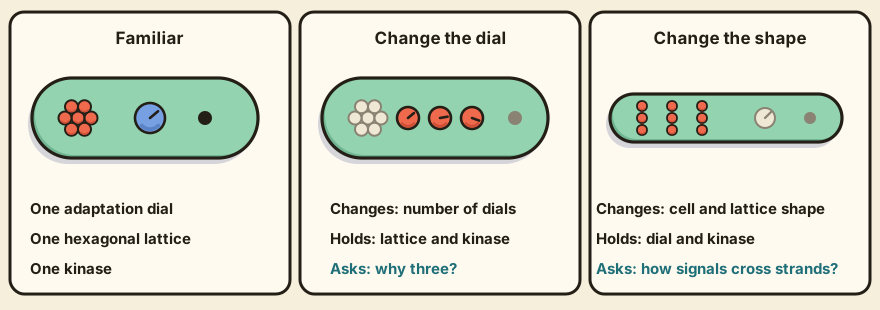
The method has three steps. Pick a familiar solution, change one feature while holding the rest fixed, and say what question the change opens. The question usually comes out as "why does the actual cell do it this way?" The alternative doesn't have to exist yet. It does have to be specific enough that someone could check it against a cell, a model or a test tube - daydreams don't count.
Alternatives nature already tried for us
Escherichia coli is the textbook case for bacterial chemotaxis. Muok, Olsthoorn and Briegel (2024) describe its system in a few lines: five receptor types, a kinase called CheA, and two enzymes, CheR and CheB, that add and remove methyl groups to retune the receptors. That's the adaptation loop described elsewhere on this site. The receptors sit together in a hexagonal lattice. The point of their review is that plenty of other bacteria differ from this picture, and each difference is a ready-made counterfactual, run by evolution for free.
Take adaptation first. Bacillus subtilis has the methylation system, and it has two others besides. One is built from CheC, CheD and a motor protein, and it ties receptor activity to the amount of phosphorylated CheY, the molecule that tells the motor to tumble. The other is CheV, a single protein that binds the receptors and, once phosphorylated, inhibits CheA. observed Genetic experiments summarised in the review indicate that the three systems work together as an ensemble and are not spare copies of one another. The review says plainly that why some bacteria have extra adaptation systems is unknown, and it offers one guess: more chemically varied niches may need finer control. inferred What changes here is the number of adaptation systems. What stays fixed is the job of restoring sensitivity.
What do the extra two buy?
Take shape next. Treponema denticola is 0.2 to 0.5 micrometres wide and up to 20 micrometres long, a thread of a cell, so its membrane is sharply curved. Cryo-electron tomography shows its receptor arrays with a twofold pattern, in strands, where E. coli has a hexagonal one, and its CheA protein has a longer dimerization domain, which the authors suggest may help keep contact with receptors on a curved surface. observed The question is how a signal spreads between neighbouring strands, and the review says that's not yet known. Vibrio cholerae gives a third variation. Its arrays have little CheA and fall apart when the cell is broken open, while E. coli arrays survive. The reviewers suggest this looseness may let the cell swap components as it moves between natural waters and the human gut, and they note that how swapping is controlled is unclear. inferred
The same review also shows the care an imagined alternative needs. One study of E. coli minicells reported a twofold pattern like the one in Treponema. Muok and colleagues re-examined published data and argue that it may be an ordinary hexagonal array seen from a tilted angle. A counterfactual earns its place only after it's been checked against what's there.
Alternatives we could build, if anyone tried
Some alternatives come from design, and then the question shifts from "why did nature do this?" to "would this work?" Macia, Vidiella and Solé (2017) start from associative learning, in which a response first triggered by one signal comes to be triggered by a second signal that was paired with it. Earlier synthetic designs put the whole circuit in one cell, and the authors argue those need many carefully tuned wires that interfere with each other. Their alternative keeps the same logic and moves it. They split the circuit between two engineered cell types that talk through one diffusing signal molecule. One part is a toggle switch, two genes that repress each other and so can sit in either of two states, which records that the two signals arrived together.
In their simulations, the first signal alone gives a response and the second alone gives none. When both arrive together the switch flips, and afterwards the second signal alone gives a response. A pulse of a chemical that blocks one switch gene resets the system. They also scanned two production rates and found four kinds of behaviour: no learning, learning that fades, stable learning, and a system that responds to both signals from the start. modeled Nobody has built this consortium. The authors close by saying that future work should test whether the approach is experimentally feasible, so we don't know whether it would behave in living cells the way it does in the equations.
One more question follows, and the paper doesn't ask it in this form. Do any natural communities spread a memory across different cell types? We don't know.
Where the method is weak, and why we use it anyway
Abramson and Levin (2021) describe the space of possible living systems as astronomically large, because evolved and designed choices can be mixed at every level from DNA to whole organisms. inferred That's the reason for holding most features fixed. It's also a warning. A design that works on paper shows that something is possible, and it doesn't show that the actual solution is worse. Real cells carry a history of selection and accident that a clean alternative leaves out, and we don't know how to weigh that history. Writing down what was held fixed at least lets a reader see what the alternative left to chance.
What you should be able to do after reading
Generate two substantially different alternatives to a familiar cellular solution; identify what each changes and what it holds fixed; articulate the question opened by each.
A quick test: take the adaptation loop. Write one alternative where the single slow dial is replaced by several, and a second where adaptation happens in a different place or on a different timescale. For each, write one sentence on what changed, one on what you held fixed, and one question that a cell, a model or an experiment could answer. H2 asks you to place the alternative in a world with stakes, and H3 asks whether physics allows it.
This leads to
See it at work
References
- Muok, A. R., Olsthoorn, F. A., & Briegel, A. (2024). Unpacking alternative features of the bacterial chemotaxis system. Annual Review of Microbiology, 78, 169-189. doi:10.1146/annurev-micro-032421-110850
- Macia, J., Vidiella, B., & Sole, R. V. (2017). Synthetic associative learning in engineered multicellular consortia. Journal of the Royal Society Interface, 14(129), 20170158. doi:10.1098/rsif.2017.0158
- Abramson, C. I., & Levin, M. (2021). Behaviorist approaches to investigating memory and learning: A primer for synthetic biology and bioengineering. Communicative & Integrative Biology, 14(1), 230-247. doi:10.1080/19420889.2021.2005863