 Cellosophy
Concept A2 · Strand A, Orientation
The cell as the unit of explanation
Read first: Starting from cells to explain minds
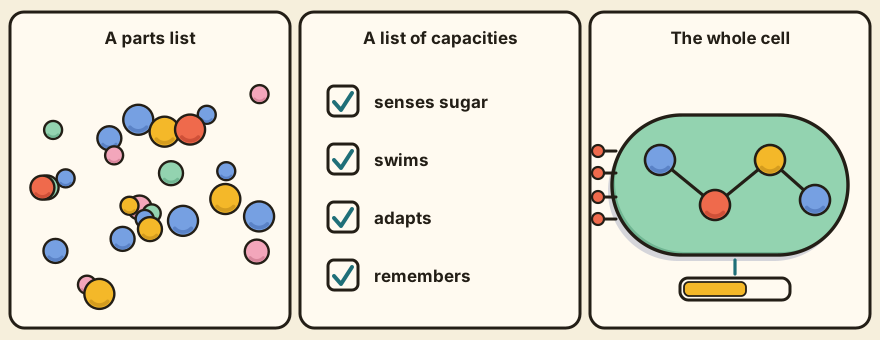
A1 asked what a cell has to get done to stay alive. This page asks a nosier question, which is what exactly we're explaining when we explain a cell. Our answer is the whole cell, the organized unit that senses, keeps itself going and acts. That sounds obvious until you notice how often it goes missing. Two common ways of describing a cell lose the unit, and the three papers below show how it happens.
A parts list with nobody home
Brian Ford (2009) argues that molecular biology, for all its success, has lost sight of the whole cell as an organism. He pictures the genes as "the cell's inventory, rather than its captain." His complaint is that a full inventory doesn't tell you how the cell behaves, any more than a list of transistors tells you what song the radio is playing.
Denis Noble (2011) makes a sharper version of the same point from physiology. He holds that biological function is multi-level, and that significant functions open to natural selection don't exist at the molecular level. observed His example is cardiac rhythm, which he says is integrated at the level of whole cells in the pacemaker region of the heart and doesn't exist as a molecular process. He goes further. DNA, on his view, does nothing on its own, since it has to be activated and interpreted by the rest of the cell, so genes are better seen as passive databases used by the system than as a program that runs it. inferred These are his arguments, drawn from his own field and from the hangover after the human genome project. They're contested, and we haven't checked the other side.
A skills list with no organism attached
The second way to lose the cell is to describe it only through its abilities: it senses, it moves, it adapts, it remembers. It reads like a CV. A1 did something close to this when it borrowed words from cognitive science, so we're not innocent here. The risk is that each ability gets studied as a separate module, as if it belonged to no one in particular.
William Bechtel (2014) shows why that picture breaks down for one of the best-studied cases in biology. In E. coli, the chemical sensors, the signalling proteins and the flagellar motors form a perception and action system that looks at first glance like a reflex. observed Bechtel describes three features that make it more than that. A slow feedback loop resets the receptors, so the system responds to the ratio of the current stimulus to the recent past, and not to its absolute value. The signalling protein CheY gathers input from all five receptor types, so its release depends on the state of the whole network. And the pathway from stimulus to swimming isn't sealed off from the rest of the cell, because other regulators of gene expression and metabolism pick up crosstalk from the same sensors. The adaptation loop page draws the resetting mechanism in detail.
What matters for this page is that the capacity can't be pulled away from the cell it belongs to. Bechtel notes that in bacteria the information processing is often spread through the cell, which makes it hard to say which part does which job. A checklist of abilities has no box for that fact. A description of the whole cell does.
Shells, glass and a torn red alga
Ford's best-known examples are of cells doing something as a whole. Testate amoebae collect grains from their surroundings and lay them down at the cell surface to build a flask-shaped shell, complete with an opening for the pseudopodia. observed Ford cites Verworn's experiments of 1888, in which amoebae given ground coloured glass instead of sand built their shells out of the glass. We haven't read Verworn. Ford also describes a red alga, Antithamnion, in which a cell torn open with a needle gets restored, with neighbouring cells dividing into the gap and the broken wall realigned, as seen in a time-lapse video he examined frame by frame.
Ford reads all this as intelligence and calls the cells ingenious. We don't adopt that word, because it smuggles in a human meaning we haven't earned yet. The examples support something narrower. A single cell can coordinate many parts to do one job, and no list of molecules or abilities says how it pulls that off. inferred
Why we bet on the cell anyway
Noble argues that no level of biological organisation is privileged for causality, and that the very idea of levels is a metaphor. We take him seriously, and he makes our choice look arbitrary. Fair enough.
If no level is privileged, why build a whole site around this one?
Our answer is a practical one. The cell is the smallest unit we know of that keeps itself going in a changing world, so it's the smallest place where a question about sensing, memory or choice has a whole subject to hang on. inferred That's our working choice and not a finding. Strand B takes up what keeps a cell going, and the whole-cell models of strand G put the choice to the test.
We don't know whether the cell is the right unit in every case. Ford thinks the cells of a body are coordinated and still autonomous. Noble thinks higher levels shape the parts below them. Biofilms and tissues raise the same question one floor up, and we're leaving that door open here.
What you should be able to do after reading
Explain why neither a molecular inventory nor a list of cognitive capacities preserves the organism as an explanatory object.
A quick test: choose one capacity from A1, such as sensing food. Write the parts list that supports it, then write what each part would need to know about the others for the capacity to work. The gaps in that second list are the organisation a whole-cell description has to supply, and they're usually bigger than you'd guess.
You need first
This leads to
B1 Scale, diffusion, and life at low Reynolds number
B3 Nonequilibrium maintenance and energetic cost
See it at work
References
- Ford, B. J. (2009). On intelligence in cells: The case for whole cell biology. Interdisciplinary Science Reviews, 34(4), 350-365. doi:10.1179/030801809X12529269201282
- Noble, D. (2011). The aims of systems biology: Between molecules and organisms. Pharmacopsychiatry, 44(Suppl 1), S9-S14. doi:10.1055/s-0031-1271703
- Bechtel, W. (2014). Cognitive biology: Surprising model organisms for cognitive science. Proceedings of the 36th Annual Meeting of the Cognitive Science Society, 158-163. link