 Cellosophy
Concept B4 · Strand B, Life at cell scale
Boundary, metabolism, and self-production
Read first: The cell as the unit of explanation, Nonequilibrium maintenance and energetic cost
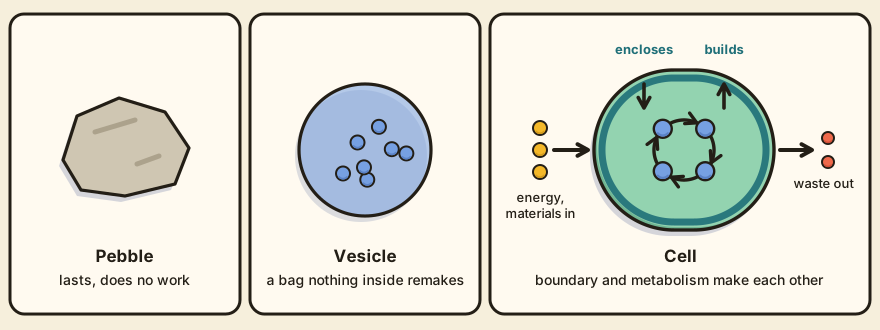
A cell builds its own wall, and the chemistry inside the wall is what does the building. Each needs the other, so there's no honest way to say which came first. We call this loop self-production, and it's the first thing that separates a living cell from the many things that merely last.
Line up three things that will all still be around this afternoon: a pebble, a lipid vesicle and a bacterium. The pebble persists because nothing is happening to it, which is a fine strategy if you're a pebble. A vesicle is a bag of lipid around a droplet of water, and it can hold together for a while, but nothing inside it repairs or replaces its wall. inferred The bacterium is the odd one out, because it persists only while it keeps working; its parts are made and broken down all the time, and the making is what keeps the whole thing in being.
Self-making, said slowly
Humberto Maturana and Francisco Varela gave this loop a name, autopoiesis, Greek for self-making. Di Paolo (2005) gives the definition as Weber and Varela (2002) state it: a network of processes that synthesize and destroy components, where the components continuously regenerate that same network and also make the system a distinguishable unity in the space where it exists. That's a mouthful, and abstract with it. Di Paolo points out that, taken on its own, the wording lets in trivial cases, so the literature has bolted readings onto it. One reading puts the system far from equilibrium and open to matter and energy. Another insists the production be real material in physical space, which means the system has to build a semi-permeable membrane that keeps its metabolism apart from the surrounding medium. inferred These readings are interpretations Di Paolo reports from the autopoiesis literature. None of them is a measurement.
The pebble comes from the philosopher Hans Jonas, whom Di Paolo follows. Jonas described a living thing as a stable form kept up across a constant turnover of its material. Our own picture for it is a fountain: the shape stays while the water moves on. Di Paolo adds that it would stretch the vocabulary to say atoms die or molecules get sick, because such things last by staying what they are and have nothing to lose by changing. A cell is a different animal. Its unit is built and sustained by its own activity, against the physical tendency of everything to even out. inferred That's also why the vesicle is a weaker case. It's a unit, sure, but nothing it does keeps it one.
Two papers, half a loop
Denis Noble (2010) reviews systems biology, and most of his paper is about genes. One passage bears on boundaries. He argues that DNA works as a set of templates for proteins and is no complete program, so a cell leans on structures that DNA doesn't specify. Lipids aren't formed from DNA templates, he writes, so an organism has to inherit what Cavalier-Smith called the membranome, and a fertilized egg arrives with it complete. inferred Noble adds, citing Maynard Smith and Szathmary, that some cellular inheritance, perhaps starting with a lipid-enclosed globule able to divide, almost certainly came before genomes. inferred We haven't checked those sources. What we take away is simple enough: the boundary of a cell is handed down and rebuilt, and the genome doesn't write it out.
Matthew Egbert, Xabier Barandiaran and Ezequiel Di Paolo (2010) wrote down the smallest metabolism they thought still counts. A material M and an energy-rich molecule E react to make a product C and a low-energy waste W, and C catalyzes its own production. Bare bones, but three features survive the trimming, by their account. Matter and energy both flow through the system, and its organization ceases to exist if resources stay absent for long. modeled Their simulated bacterium carries this reaction inside a membrane. As far as we can tell from the methods, that membrane is handed to the model and isn't built by the metabolism. inferred So even the minimal case closes only one half of the loop.
What nobody has settled
Di Paolo says plainly that whether autopoiesis needs real physical stuff is an open question. He cites computer models that show growth and membrane construction, and he argues that dropping physicality lets in trivial cases such as attractor states in cellular automata - patterns on a grid that would count as alive, which is more company than anyone wants. We haven't read those models. We don't know whether a purely formal description is enough, or whether the physics of real membranes and real energy flow does work the definition leaves out.
Has anyone actually watched the loop close?
Not in any paper in our set, as far as we know. We know of no case there of a real or synthetic cell shown remaking its own wall from its own products. The idea organizes most of what we know about cells, and such a cell would be the direct test. Di Paolo himself thinks the definition is missing a piece. Autopoiesis, he says, only separates a unit that holds together from one that falls apart, and it says nothing yet about doing better or worse while it holds together. B5 picks up that thread.
What you should be able to do after reading
Tell a maintained living boundary apart from passive persistence or mere compartmentalization.
A quick test: take a rock, a lipid vesicle and a bacterium. For each, ask what builds the boundary, what replaces it when it wears, and what energy runs that replacement. With the rock and the vesicle, the last two questions should find no answer inside the object. With the bacterium, check whether your answer sends you from the wall to the metabolism and back again, round and round.
You need first
This leads to
B5 Viability and organism-relative normativity
C1 Receptors and signal transduction
D2 Cellular memory substrates and timescales
G4 Synthetic tests of whether a retained state matters for viability
See it at work
References
- Di Paolo, E. A. (2005). Autopoiesis, adaptivity, teleology, agency. Phenomenology and the Cognitive Sciences, 4, 429-452. doi:10.1007/s11097-005-9002-y
- Noble, D. (2010). Biophysics and systems biology. Philosophical Transactions of the Royal Society A, 368, 1125-1139. doi:10.1098/rsta.2009.0245
- Egbert, M. D., Barandiaran, X. E., & Di Paolo, E. A. (2010). A minimal model of metabolism-based chemotaxis. PLOS Computational Biology, 6(12), e1001004. doi:10.1371/journal.pcbi.1001004