 Cellosophy
Concept B5 · Strand B, Life at cell scale
Viability and organism-relative normativity
Read first: Boundary, metabolism, and self-production
A cell can do better or worse, and the yardstick is in its own chemistry. Some conditions keep its self-making going and others push it toward collapse, so the cell's continued existence sets the standard. Nobody outside the cell has to hand that standard down, and stating it takes no claim at all about what the cell feels.
Pass or fail, and nothing in between
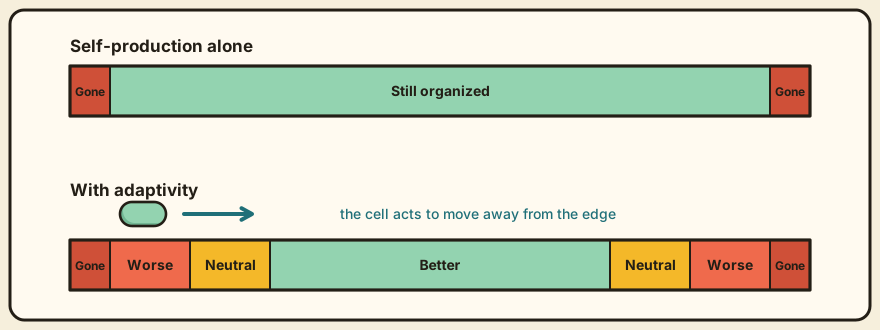
B4 described a cell as a unit that keeps itself going. Ezequiel Di Paolo (2005) asks what that buys the cell in the way of a standard, and his first answer is: not much. A system defined only by making itself is either still organized or no longer organized. He calls this conservation, and he shows how blunt it is with a cliff. A creature balancing on the edge and a creature falling off it both keep their organization right up to the moment they hit the ground, so a theory that counts only organization rates the two as equally good. inferred That's a generous grading scheme.
The range of conditions a cell can tolerate before it loses its organization is its viability set. Di Paolo takes it to be bounded and possibly shifting over time. A cell that survives a range of knocks is simply tough, and toughness alone says nothing about preferring one survivable state to another. Which is awkward for a bacterium swimming up a sugar gradient. If the sugar already at hand is enough to keep it alive, the definition of self-production gives it no reason to want more. inferred
Grading on a curve
Di Paolo's fix is a property he calls adaptivity. A system is adaptive if, in some circumstances, it regulates its own states and its relation to the environment so that, near the edge of viability, it tells apart tendencies that head toward the edge from tendencies that head away, and acts to turn the first kind into the second. Both halves are needed. Monitoring without a response is a smoke alarm with no one home, and a response without monitoring has nothing to steer by. inferred With adaptivity a cell gets more than two grades. Some states are good, some neutral and some bad, though Di Paolo stresses that this doesn't mean there's one best state. He adds that stress, fatigue and illness only become definable once a system has this property, since a strictly conserving system is fine right up to its end.
A toy cell with a taste for C
Matthew Egbert, Xabier Barandiaran and Ezequiel Di Paolo (2010) built a simulation in which a graded norm falls straight out of metabolism. Their protocell runs a minimal metabolism in which a product C catalyzes its own production from a material and an energy source. The chance that the cell tumbles in place instead of running straight is proportional to the concentration of C. When the metabolism hums, C is high and the cell mostly stays put. When it sputters, the cell wanders off. There are no receptors and no signaling pathway here; the cell's own metabolism drives its swimming. modeled
The simulated cells gathered at a source of metabolizable material. When the environment held plenty of an alternative food, they stopped bothering with the source, and the mean distance from it across ten runs of a hundred cells rose from 56.03 to 118.17. When a chemical that blocks one metabolic pathway was added, cells left the region that depended on that pathway and kept gathering where another food was usable. When a metabolic inhibitor was laid out in a gradient, cells moved away from it. modeled The authors point to reports in real bacteria that match these patterns, such as chemotaxis toward a substance vanishing when its metabolism is blocked, and we haven't checked those reports. observed
So what counts as good here is set by the cell's own metabolic rate. The same molecule helps in one condition and does nothing in another. We don't know whether this toy meets Di Paolo's definition of adaptivity, which asks about tendencies near the edge of viability. The model ties behavior to the current level of C, and that may or may not be enough. inferred The authors call it a proof of concept and make no claim that it models any particular bacterium.
Good for, without feeling
Di Paolo argues that you test for a system's own perspective by looking at its organization and its link to viability, and that behavior alone can't settle it. A robot that backs away when shouted at may look scared, and in his view being functionally scared is one thing and being scared is another. He also says plainly that he leaves open whether an artificial system could have this. So the norm on this page is stated in terms of organization and viability. That fits what B4 described, and it needs no word like want or fear.
The wider debate is far from settled. In Di Paolo's account, Weber and Varela treat self-production as already a concern and a point of view, and he thinks that step needs adaptivity. The strict conservation reading of the original theory refuses talk of lacks and breakdowns altogether. Di Paolo also notes that Hans Jonas's move from metabolism to concern leans partly on intuition from outside science.
Does a bacterium's norm come with any experience?
We don't know, and this page doesn't need the answer. We're happy to leave the bacterium's inner life to braver people.
What you should be able to do after reading
Explain how better and worse can be grounded in a cell's continued organization without assuming felt experience.
A quick test: pick one cell behavior, such as swimming up a sugar gradient. Name the internal state the cell has to keep inside limits, and say what the cell does differently as that state nears a limit. Then read your sentences back for words like wants, likes or fears, and swap each for the name of the state or the action. B6 asks how this standard picks out the part of the world that counts for a cell.
You need first
This leads to
B6 The cell-relative environment
F2 Adaptivity, valence, and natural agency
G1 Organism-relative environment, stakes and available action
G4 Synthetic tests of whether a retained state matters for viability
See it at work
References
- Di Paolo, E. A. (2005). Autopoiesis, adaptivity, teleology, agency. Phenomenology and the Cognitive Sciences, 4, 429-452. doi:10.1007/s11097-005-9002-y
- Egbert, M. D., Barandiaran, X. E., & Di Paolo, E. A. (2010). A minimal model of metabolism-based chemotaxis. PLOS Computational Biology, 6(12), e1001004. doi:10.1371/journal.pcbi.1001004