 Cellosophy
Concept G4 · Strand G, Whole-cell program
Synthetic tests of whether a retained state matters for viability
Read first: Boundary, metabolism, and self-production, Viability and organism-relative normativity, Actual and possible: the modal status of a claim
A cell that glows after training has shown that something inside it changed. It hasn't shown that the change matters to the cell. This page lives in the gap between those two claims, and asks how a built circuit could close it.
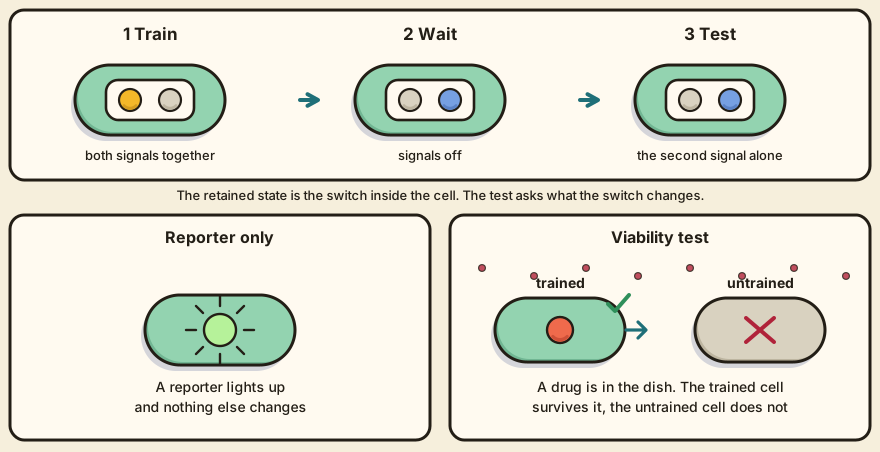
A retained state, and why you'd build one
By a retained state we mean a change in a cell's chemistry that outlasts the input that caused it and alters how the cell answers later. A bacterium that meets two signals together might keep a molecule at a raised level for hours, and that molecule might make the cell respond to a signal it used to ignore. Natural cells rarely let us hand them such a state, or withhold it, while everything else stays the same. A synthetic circuit can. That's why synthetic biologists have designed circuits for the oldest test of memory in the book, associative learning.
Two designs for teaching a cell to associate
Chrisantha Fernando and colleagues (2009) proposed a gene regulatory network for a single cell that links two chemical signals the way Hebb described for neurons. The circuit has two halves. In the first half an input molecule removes a repressor, and together with a background supply of an activator it switches on an output gene, so this signal always works. In the second half there's no background activator, so the second signal alone does nothing. When both signals arrive together, the output made by the first half also drives production of the second half's activator, and that activator decays slowly. Long after the signals have gone, the second signal alone can produce the output. In their simulation the second signal gave no response at 6,000 seconds, was paired with the first at 10,000 seconds, and gave a full response when presented alone 30,000 seconds later. modeled With their parameter values the learned response lasted about 10.5 hours before the activator fell below a threshold, and the circuit behaves as a bistable switch with an on state and an off state. modeled
The model is a set of deterministic equations that describes the average behaviour of a population, with rates chosen to be biologically realistic. The authors report that the behaviour survives changes of up to 25 percent in the parameters. They also sketch how to build one half on two plasmids in E. coli, with a fluorescent protein as the output, and an alternative based on protein kinases. They report no experiment on a built circuit.
Javier Macia, Blai Vidiella and Ricard Sole (2017) kept the goal and moved the wiring. A single-cell circuit needs many interacting parts, and crosstalk between them is a known engineering headache. So they split the work between two engineered cell types - a division of labour, in a dish. One carries a memory switch made of two genes that repress each other, and the other carries the output. A small signal molecule diffuses between them. In simulations using E. coli parameters taken from earlier literature, pairing the two inputs flipped the switch, and afterwards the second input alone produced the fluorescent output. modeled Depending on two production rates, the model gave four kinds of behaviour: no learning, a weak response that fades, lasting learning, and a system that already answered both signals before training. A pulse of the chemical IPTG, which blocks one of the switch proteins, flipped the switch back and erased the association, so the consortium could be trained again. modeled The authors say future work should test whether the design can be built, and they assume the surroundings keep the two cell types together.
Both designs glow, and neither one lives or dies by it
In both papers the readout is a fluorescent protein. A glow tells us the switch flipped. It can't tell us whether the cell is better off. Macia and colleagues remark that the output could instead be a gene that triggers delivery of a therapeutic molecule, which would matter to a patient and still say nothing about the cell's own survival.
Fernando and colleagues do give an argument for why a retained state could matter to a cell. Suppose signal A predicts a resource at one time and signal B predicts it at another, and using the resource needs costly protein synthesis. A cell that could learn the right predictor would make the proteins only after the right signal, and would have an edge over a cell that couldn't. inferred That's their thought experiment, and they measured nothing. They also suggest why the capacity might be absent in nature: the machinery may cost too much, or the environment may offer nothing worth learning.
Does the flipped switch help the cell, or is it a diary nobody reads?
A test of mattering, sketched by us
This section is our own reasoning from the two papers, so read it as a proposal from people who've never built a circuit. A synthetic test of viability would tie the circuit's output to something with a cost or a benefit, such as a gene that lets the cell pump out a drug, or an enzyme the cell needs to use a sugar when other food runs out. Three comparisons would then do the work. Trained and untrained cells go into the same dish. A second group gets the two signals unpaired, because Fernando and colleagues note that sensitization and pseudo-conditioning have to be excluded in any claim of association. A third group carries the circuit and never gets the cue, which measures what the machinery costs in growth. inferred If trained cells beat both control groups under the drug, the retained state matters for survival in that setting. If they don't, the state is a record with no consequence there, and that would be worth knowing too.
Timing needs care. In Fernando's model the memory lasts hours, and a dividing cell dilutes the molecules that carry it, so the test has to be scheduled against the doubling time of the cells. inferred
What we don't know, which is most of it
We don't know whether either circuit works in living cells. Crosstalk, molecular noise and the burden of making extra proteins could each break them, and the two papers model none of these in detail. We don't know whether a retained state of this kind would help a cell in any realistic environment. The missing piece is a tie between the circuit and what keeps the cell alive, and neither design has one yet.
What you should be able to do after reading
Design a synthetic test in which a retained state changes viability-relevant action rather than only a reporter.
A quick test: take Fernando's circuit and name the molecule that holds the memory. Choose one action that molecule could switch on and that would change survival or growth in a defined dish. Then write down the three groups of cells you'd compare, and the result that would show the state doesn't matter.
You need first
B4 Boundary, metabolism, and self-production
This leads to
See it at work
References
- Fernando, C. T., Liekens, A. M. L., Bingle, L. E. H., Beck, C., Lenser, T., Stekel, D. J., & Rowe, J. E. (2009). Molecular circuits for associative learning in single-celled organisms. Journal of the Royal Society Interface, 6, 463-469. doi:10.1098/rsif.2008.0344
- Macia, J., Vidiella, B., & Sole, R. V. (2017). Synthetic associative learning in engineered multicellular consortia. Journal of the Royal Society Interface, 14(129), 20170158. doi:10.1098/rsif.2017.0158