 Cellosophy
Concept G2 · Strand G, Whole-cell program
Actual and possible: the modal status of a claim
Read first: Grading claims by evidence
A claim about a cell has two statuses, and we blur them all the time. One is about the world: does the behavior happen in a real system, or could it only happen? The other is about us: do we know which, or are we still guessing? Keep the two apart and it gets much easier to say what a study has shown and what it has left open.
Cross the two questions and you get four cells. A claim is actually actual when the behavior occurs in a real system and we've shown it. It's possibly actual when we suspect a real system does it but haven't shown it. It's actually possible when we've shown the behavior can happen, say in a model or a lab-made system, and haven't found it in a real one. And it's possibly possible when we aren't yet sure the behavior can happen at all. inferred The four names and the grid are home-made, and the papers below don't use them - blame us for the tongue-twisters.
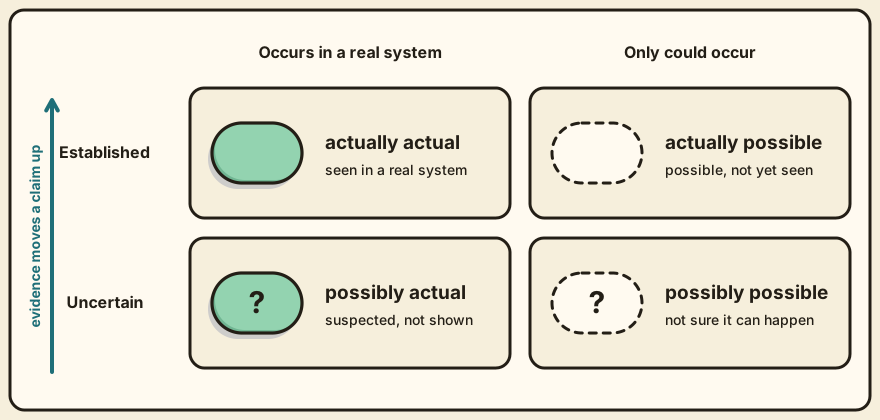
Two questions that like to slide into one
We split them because people slide from one to the other, usually without noticing. A model that makes a behavior possible gets talked about as if the behavior were real. A behavior nobody has seen gets talked about as if it were impossible. Both slips have the same source, which is mixing up what the world is like with how much we happen to know about it.
Does the cell do it, and do we know that it does?
The second half of that question sits close to A4, which grades claims by evidence. There, the tags observed, inferred and modeled say what kind of evidence stands behind a sentence; here, the rows of the grid ask how settled the answer is. A modeled result usually lands in a lower row for a real cell, since a model shows what follows from its assumptions and says little about whether a living cell meets them. inferred Kussell and Leibler's switching model on G1 is a good example. It shows that random switching can beat sensing in its model world, which makes that strategy a modeled possibility, and it takes separate work to show that a given bacterium does it. modeled
Replaying a tape nobody can replay
Stephen Jay Gould thought evolution leans hard on history, and he proposed a thought experiment to match: replay life's tape from an earlier point and see whether anything like today's world shows up. The bad news, he wrote, was that we cannot possibly perform the experiment. Biologists went ahead anyway, on a small scale and mostly with microbes, and Blount, Lenski and Losos (2018) review what they've run since. In a parallel replay experiment, initially identical populations evolve in identical conditions. In a historical difference experiment, populations that have already diverged evolve in the same conditions. observed
Their summary is that outcomes are often repeatable to some degree. Repeatability is higher for overall fitness and lower for the underlying phenotypes and genetic changes, and replicates with similar fitness often differ more once they're tested in other environments. observed In grid terms, a claim like "populations in this environment tend to reach similar fitness" has moved from possibly actual to actually actual for those microbes, because replay turned a hunch into a count. inferred
That's a small promotion. It was also hard won.
One population in twelve, and a taste for citrate
The sharpest case in the review comes from the long-term evolution experiment, which follows twelve populations of E. coli. After more than 31,000 generations, one population evolved the ability to grow aerobically on citrate, which had been sitting in the medium all along as a chelating agent. Over more than 65,000 generations, only that one of the twelve did. observed
The review gives two explanations. One is a single, extremely rare mutation that could have struck anywhere at any time - a lottery ticket, more or less. The other is that several mutations were needed, so history had to build up a background in which the trait could appear. To tell them apart, Blount and colleagues restarted the population from clones frozen at sixteen time points and replayed evolution thousands of times. The citrate trait re-evolved only in populations founded from clones of 20,000 generations or later, which implies that something it needed had arisen by then. observed Later work, described in the review, found a complex history, including a stretch in which the trait was harmful on the genetic background of the time. observed
We read this as a claim moving between cells of the grid. "Citrate growth can evolve in this E. coli lineage" was actually actual the moment it happened. The claim that it was open to any of the twelve populations at any time looked possibly actual, and replay made it less likely, since early clones didn't re-evolve the trait. inferred The review doesn't describe it this way, and the mapping is ours.
What we don't know, and what the grid can't tell us
Blount and colleagues say plainly that it's difficult to quantify how often convergence happens in nature, and that Gould's view of history as the central feature of evolution remains debatable. They also point out that Gould never defined contingency formally and used the word in two senses: dependence on something earlier, and a chance event. So a claim about replay has to say which sense it means. And the experiments are small. Twelve populations is a short list from which to say what would happen in a million.
The grid also doesn't tell you which claims are worth placing. For cells, G1 adds a wrinkle: what a cell can do depends on its own sensors and actions, so a behavior can be actually possible for one organism and possibly possible for another. We come back to that after G1.
What you should be able to do after reading
Place a claim in the actually actual, possibly actual, actually possible, or possibly possible; separately state the system's realization status and the claim's evidential status; revisit organism-relative possibilities after G1.
A quick test: pick a claim from any page in the A or C strands, say "a bacterium compares past and present concentrations." Write one sentence on whether the behavior occurs in a real cell or has only been shown possible. Write a second on how settled that is, and which experiment would move it. Then keep going: G4 asks what a built, synthetic system can add to the answer, and H6 asks how to explore the claims stuck in the lower cells.
You need first
See it at work
References
- Blount, Z. D., Lenski, R. E., & Losos, J. B. (2018). Contingency and determinism in evolution: Replaying life's tape. Science, 362(6415), eaam5979. doi:10.1126/science.aam5979
- Kussell, E., & Leibler, S. (2005). Phenotypic diversity, population growth, and information in fluctuating environments. Science, 309(5743), 2075-2078. doi:10.1126/science.1114383