 Cellosophy
Concept H6 · Strand H, Design
Speculative natural history and discovery
Read first: Designing organisms and their environments together, Constraints, tradeoffs, and realizability, Actual and possible: the modal status of a claim
To describe an organism that nobody has watched much, we have to sort our sentences into what has been seen, what is inferred from its relatives and what is only assumed. The clearest example we found is a review of choanoflagellates, so this page follows it and stops where it stops. We should say up front that no paper we read covers imagined organisms. The method here is borrowed from a real case, which is an odd way to do speculative natural history, but it's what we've got.
A real cell that hardly anyone watches
Choanoflagellates are single-celled swimmers that eat bacteria, and they're the closest living relatives of animals - distant cousins of ours, if you like. Núria Ros-Rocher and Thibaut Brunet (2023) set out to describe the world these cells perceive, what they call the Umwelt. Their problem is the one this page is about. The cells are tiny, their surroundings change quickly and are patchy, and so little is known about their behavior in the wild that, in the authors' word, behavioral research on them remains patchy. Patchy cells in patchy water, patchily studied.
What has been seen, what is borrowed from the relatives, and what are we just assuming?
The review organizes what's known around three things. The first is episodes. A single species, Salpingoeca rosetta, passes through slow and fast swimming forms, chain and rosette colonies, and a settled form that builds a protective cup. That's a lot of costume changes for one species. Before settling, the cell walks across a surface on thin protrusions called filopodia, and the authors list what stimulus triggers settling as an open question. observed
The second is ecology. Fast-swimming S. rosetta moves toward higher oxygen, and microfluidic experiments created the controlled gradients that showed it. observed The cells also move toward a band of prey bacteria, and here the review reports a surprise. The attractant was a drop in pH, from about 8 to 6 or 7, caused by the bacteria's metabolism, and without a pH difference the cells lost the ability to find the bacteria. observed Dinner gave itself away by souring the water.
The third is lineage. Choanoflagellate genomes encode many relatives of animal sensory receptors, including channels that respond to mechanical force, which suggests more senses than anyone has measured. inferred The authors are careful that these are predictions from sequence. None of the mechanosensory families has been tested for function in choanoflagellates, and for the oxygen response they say the mechanism is still unknown.
Write the assumptions where you can see them
Each of these claims carries an assumption, and the review states several of them out loud. It defines behavior as an active, controlled and reversible change in an organism's shape, posture or activity. It describes a response as a receptor detecting a stimulus and a pathway producing an output, and it marks which of those steps are known for each behavior. It also separates what the genome suggests from what has been shown. The line between the two is where an investigator should write down what is being assumed. inferred
Behavior, or just a crowd doing physics?
The review gives three examples of how an investigator separates a real behavior from a physical or population-level effect.
When S. rosetta colonies move toward oxygen, analysis of cell trajectories suggests the cells use run and tumble movement, which the review calls kinesis, and they don't swim directly toward the source. Under pH gradients the same species appears to swim in a directed way, which is taxis proper. observed Two responses in one species can rest on different movement strategies, and it's the trajectories that give the game away.
The rosette colonies raise the population-level question. S. rosetta is as good at chemotaxis in a colony as alone, and the beating of flagella in neighboring cells doesn't seem to synchronize. Kirkegaard and colleagues, as the review cites them, describe the colony as an aggregate random walker, in which each cell acts as it would alone and the colony still moves in the right direction. observed Think of a committee that never meets and still gets somewhere. No coordination between cells has been found, and the authors say the question is little studied.
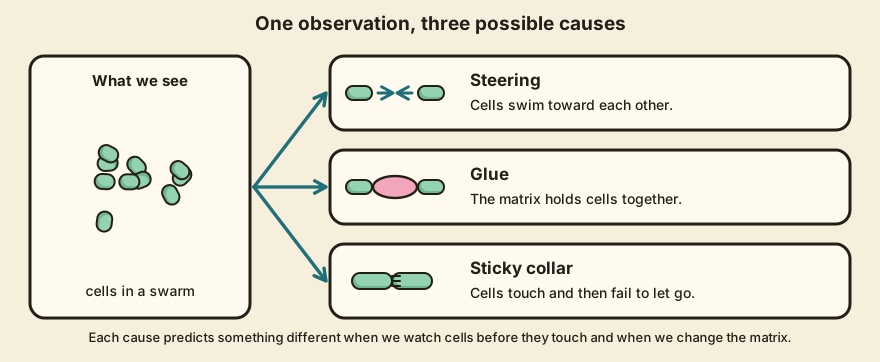
Swarming is the case in the figure. Cells gather into swarms before mating, and a bacterial enzyme triggers it. The review lists three possible explanations: cells steer toward each other, changes in the surrounding matrix hold them together, or a sticky collar prevents them from detaching after chance contact. The authors say future research may help distinguish them. inferred
What we don't know
We don't know how many choanoflagellate behaviors are still undescribed. The review's guess that the known ones are only the tip of the iceberg rests on genome content. Nor can we say how far this method carries over to an organism that has never been seen at all. The review shows the method working on a real organism with a sequenced genome and lab cultures, and a creature that lives only on paper has neither.
What you should be able to do after reading
Describe an unfamiliar organism through episodes, ecology, and lineage; maintain explicit assumptions; propose how an investigator could detect it and distinguish it from a physical or population-level alternative.
A quick test. Choose a cell you know little about, and write one sentence each on its episodes, its surroundings and its relatives. Then pick one behavior you'd expect and write two simpler explanations for it, along with the observation that would tell them apart. Mark each sentence as observed, inferred or assumed. H7 asks you to carry a description like that into a design proposal.
You need first
H2 Designing organisms and their environments together
This leads to
See it at work
References
- Ros-Rocher, N., & Brunet, T. (2023). What is it like to be a choanoflagellate? Sensation, processing and behavior in the closest unicellular relatives of animals. Animal Cognition, 26, 1767-1782. doi:10.1007/s10071-023-01776-z