 Cellosophy
Concept B6 · Strand B, Life at cell scale
The cell-relative environment
Read first: Scale, diffusion, and life at low Reynolds number, Noise and limits of molecular sensing, Viability and organism-relative normativity
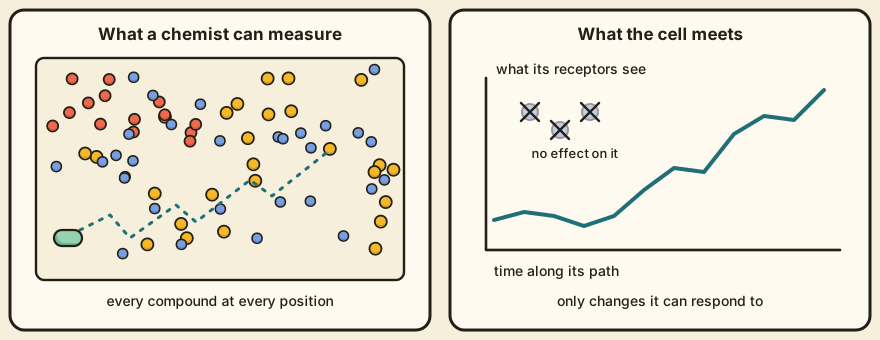
The environment a chemist measures is far bigger than the one a cell lives in. A cell lives in the slice its size, its receptors and its metabolism let it meet, and the rest reaches it only if it changes something the cell does. The old name for this idea is Umwelt, a term from the biologist Jakob von Uexkull for the world as one kind of creature meets it. Grand word, small creature. The cell-sized version has one advantage over the grand one: you can check it against molecules, distances and rates.
Small and slow, so time does the measuring
John Pittenger and Cathy Dent (1988) reviewed what was known about bacterial chemotaxis for psychologists - a kind gesture across a disciplinary fence - and their survey shows how size shapes a cell's world. A bacterium is about a micrometre long. A concentration difference across a body that small is tiny in almost every real gradient, and diffusion quickly flattens the steep ones. So a bacterium can't read a gradient off its own body at a single moment. It reads change in time as it swims, because moving through a gradient turns a difference in space into a difference in what its receptors see. inferred
They cite two kinds of experiment. Macnab and Koshland in 1972 raised attractant concentration almost instantly and found less tumbling, which a body-length comparison couldn't explain. Brown and Berg in 1974 tracked bacteria moving toward a tube where enzymes were changing the attractant level, and runs got longer when the level rose with time. observed We haven't read those papers, so this is as reported by Pittenger and Dent. One consequence follows from their account. A bacterium held still gets no gradient information at all, and the information that matters is the gradient and not the concentration at any one spot. A chemist's table of concentrations at fixed points and a bacterium's stream of changes along its path are two descriptions of the same water.
Why should a cell care about change and shrug at steady levels?
Koshland's model, which they present, gives a reason. An internal regulator is formed and broken down all the time, so at a steady concentration its level settles back to baseline whatever the concentration is. A shift in concentration nudges the level up or down for a little while, and tumbling follows it. modeled Pittenger and Dent rate the evidence for this model as moderate. They also say that when they speak of perception in bacteria they make no claim about experience.
You are what you eat, so you notice what you eat
Size says what can reach a cell, and metabolism says what counts once it gets there. Di Paolo (2005) borrows a definition from Ashby in which a system's environment is the set of outside variables that can affect it and the parameters of outside processes that it affects. Any system has a world in that sense. A thermostat's world contains temperature and no sound. A bacterium differs because some of what it meets is needed for its continued construction. Di Paolo's line for it is hard to beat: bacteria are partly made of sugar, and thermostats are not made of temperature changes. inferred
Egbert and colleagues (2010) push this a long way in a simulation. In their protocell, a compound is an attractant only when it feeds the cell's metabolism at that moment. In one experiment an energy source E drew cells only after they'd picked up a second material M from another region, because without M the cell couldn't use E. In another, cells gathered where the combined effects of two resources and a toxin allowed a working metabolism, and they didn't chase the peak of any single compound. modeled The authors argue that compounds shouldn't be sorted into attractants and repellents by binding properties alone, and that the sorting depends on the cell's metabolism and history.
Real cells drop hints of the same thing. Egbert and colleagues cite Alexandre and Zhulin for the report that chemotaxis is stronger in cells grown on the test sugar. Pittenger and Dent report that E. coli always has receptors for glucose, aspartate and serine, while receptors for maltose, ribose and galactose show up only when the growth medium contains those sugars. observed Both are secondhand here. If they hold, a cell's own history sets which chemicals belong to its world, which is a nice twist on the old line about being what you eat.
Two mechanisms and a missing list
The two papers describe different mechanisms. Pittenger and Dent argue that steering by local concentration would work poorly, and that the gradient is what bacteria use. Egbert and colleagues' simulated cells go by local metabolic state and still collect in rich places, simply by staying put there. The authors say E. coli may use more than one mechanism, and they name fumarate acting on the flagellar motor as a candidate that hasn't been tested. inferred We don't know which mechanism a given bacterium relies on under a given condition.
Even the list of what counts is in dispute. Egbert and colleagues note that Adler found glycerol was heavily metabolized by E. coli yet was no attractant, while Zhulin and colleagues later saw chemotaxis toward similar glycerol levels. They also point out that E. coli has about five kinds of sensor yet responds to about fifty attractants and repellents. Five locks, fifty keys. They suggest the old assumption that chemotaxis ignores metabolism may be part of why that's hard to explain, but they don't show it. How a cell's accessible world gets set is an open question.
What you should be able to do after reading
Describe the difference between the measured environment and the world accessible to a particular cell.
A quick test: pick a compound a chemist can detect in pond water. Ask whether this cell's receptors or metabolism can respond to it, whether at the cell's size and speed it shows up as a change along the path, and whether its effect depends on what the cell has recently taken in. Then write two sentences, one for what the chemist records and one for what the cell meets. G1 asks what's at stake for a cell in the world it meets.
You need first
B1 Scale, diffusion, and life at low Reynolds number
See it at work
References
- Pittenger, J. B., & Dent, C. H. (1988). A mechanism for the direct perception of change: The example of bacterial chemotaxis. Perception, 17(2), 119-133. doi:10.1068/p170119
- Egbert, M. D., Barandiaran, X. E., & Di Paolo, E. A. (2010). A minimal model of metabolism-based chemotaxis. PLOS Computational Biology, 6(12), e1001004. doi:10.1371/journal.pcbi.1001004
- Di Paolo, E. A. (2005). Autopoiesis, adaptivity, teleology, agency. Phenomenology and the Cognitive Sciences, 4, 429-452. doi:10.1007/s11097-005-9002-y