 Cellosophy
Concept G1 · Strand G, Whole-cell program
Organism-relative environment, stakes and available action
Read first: Viability and organism-relative normativity, The cell-relative environment, Sensorimotor behavior in a changing environment
A cell's environment is whatever that cell can detect, whatever matters to it there, and whatever it can do about it. One pond holds one set of molecules. A bacterium and a ciliate swimming in it still live in different environments, because they read different signals, depend on different supplies and have different moves open to them. Same water, two worlds. This page works with that definition and then loosens it, because each of the three papers below pins down only one or two of its parts.
Reading the world off the cell's own receptors
Nobody has put a probe where a gut bacterium swims and recorded what it meets. Clausznitzer and colleagues (2014) asked whether the cell's own receptors could tell us instead. They took dose-response curves from FRET experiments on the E. coli chemotaxis system, which report how receptor signaling activity changes when the amount of attractant (aspartate) changes. They combined these with a physical model of the receptors, an information-theory argument about how much a noisy pathway can pass along, and simulations of swimming cells. Out came a broad range of exponential gradients, which give log-normal stimuli and the fastest drift up the gradient. modeled
It's a clever trick, running the inference backwards from the sensor to the world. It also leans on one assumption, and the authors call it the most important: that the pathway transmits as much information as it can. The model also assumes small Gaussian noise, covers only aspartate sensed through one receptor type (Tar), and describes only fast receptor signaling, leaving out the motor. The authors suggest the gradients could come from local nutrient sources and from neighbours eating the food, which they don't test. We don't know what gradients a gut bacterium meets, because they haven't been measured.
Stakes in the currency of growth
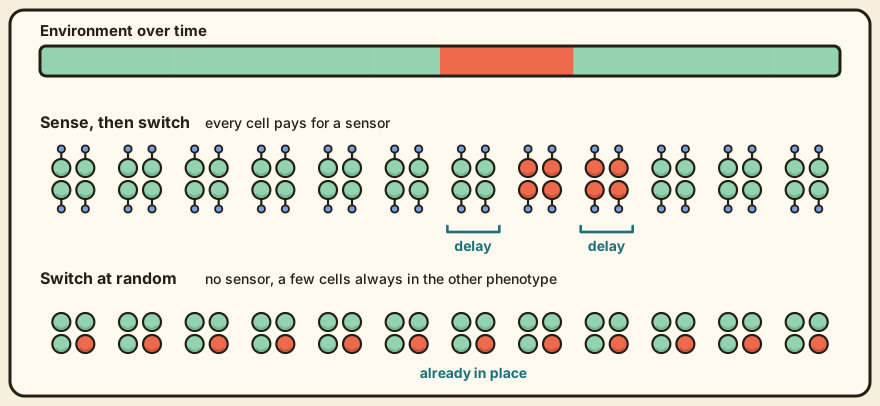
Kussell and Leibler (2005) built a model in which the environment is defined by what it does to growth. A clonal population lives through a sequence of environment types. Each phenotype has its own growth rate in each type, and in every type one phenotype grows fastest. Cells can reach the fast phenotype in two ways. In responsive switching, a sensor detects the environment and cells move to the fast phenotype, at a cost that lowers growth rate. In stochastic switching there's no sensor at all - cells flip between phenotypes at fixed rates, and a small share of the population is always in the phenotype the next environment will need.
The authors derived the long-term growth rate for both. Stochastic switching wins when the environment changes infrequently, and the best rate for switching from phenotype j to phenotype i is the probability that environment i follows environment j, divided by the average duration of j. modeled When change is rare, a well-timed coin flip beats looking. They also found that the more unpredictable the environment is, the more a cell can afford to pay for a sensor. modeled
The model assumes populations large enough for growth to be deterministic, environments that last long enough for the population to settle into its equilibrium mix, a small fixed number of phenotypes and environment types, and constant growth rates and sensing cost. The authors didn't model how switching rates evolve, and they expect real organisms to mix random switching with some direct sensing.
Here the stakes are plain numbers: a growth rate for each phenotype in each environment. Two cells in the same water can face different environments in this sense, because their phenotypes grow at different rates there. inferred That's our reading of the model. The authors don't say it in these words.
Evidence the cell can actually reach
Bowsher and Swain (2014) review how theorists treat cellular decisions. A cell infers the state of its surroundings from signaling that is itself noisy and depends on its history. Mutual information measures how well the input could be inferred from the output on average. To calculate it you need the distribution of signals the cell meets in the wild, and the authors say that for most organisms we know little about that distribution. modeled
They also point out that, if fitness is taken as expected long-term growth rate and with further assumptions, the mutual information between a cue and the environment sets an upper limit on what the cue is worth to the cell. modeled Information has a price ceiling, in other words. They conclude that theory has to be tied to measures of fitness. They mention that bacteria seem to infer broad conditions, such as being in the human gut, from local signals, and so anticipate what comes next. inferred They cite other work for this, and we haven't read it.
Three questions to ask of any episode
We find it useful to treat an episode as a checklist. What evidence reaches the cell, through which molecules and receptors, with how much noise and over what time? What's at stake, meaning what changes in growth or survival if the cell responds well or badly? What actions are open, such as swimming, changing gene expression or doing nothing? inferred
Clausznitzer and colleagues supply the evidence side, Kussell and Leibler supply the stakes and the action, and Bowsher and Swain explain why the evidence side stays hard. None of the three papers follows one real cell through all three parts.
Second-guessing nature
Clausznitzer and colleagues write that a link between information transmission and drift speed, which they find in their model, has recently been questioned for bacterial chemotaxis. Their assumption that the pathway maximizes information is a claim about what evolution did, and a pathway shaped by past environments may not suit the present one. inferred Bowsher and Swain say second-guessing nature is difficult. We agree.
An environment inferred from a cell's signaling is a hypothesis about that cell until someone measures the place itself.
What you should be able to do after reading
Analyze an organism-environment episode in terms of accessible evidence, stakes, and available actions.
A quick test: take E. coli meeting a patch of food. Write one sentence each for the evidence (which signal, which receptor, what noise), the stakes (what happens to growth if it responds well or badly) and the actions (what the motor and the genome can change). Mark each sentence observed, inferred or modeled, and name which paper, if any, would back it. G6 asks how such episodes can be strung together into a cycle of modeling and testing.
See it at work
References
- Clausznitzer, D., Micali, G., Neumann, S., Sourjik, V., & Endres, R. G. (2014). Predicting chemical environments of bacteria from receptor signaling. PLOS Computational Biology, 10(10), e1003870. doi:10.1371/journal.pcbi.1003870
- Kussell, E., & Leibler, S. (2005). Phenotypic diversity, population growth, and information in fluctuating environments. Science, 309(5743), 2075-2078. doi:10.1126/science.1114383
- Bowsher, C. G., & Swain, P. S. (2014). Environmental sensing, information transfer, and cellular decision-making. Current Opinion in Biotechnology, 28, 149-155. doi:10.1016/j.copbio.2014.04.010