 Cellosophy
Concept G6 · Strand G, Whole-cell program
A cumulative cycle of modeling, experiment and rival theory
Read first: Organism-relative environment, stakes and available action, Whole-cell modeling, Rival models and discriminating interventions
One model rarely settles a question about a cell, and neither does one experiment. Progress tends to come from going round a loop several times, each pass starting from a model the last pass changed. This page describes the loop, shows one turn of it in a real minimal-cell model, and says plainly where the loop hasn't yet been run for the questions this site cares about.
Three parts, tied into a loop
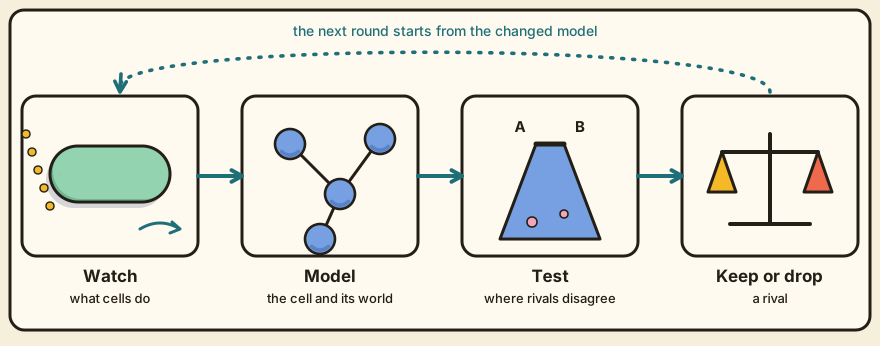
Earlier pages handed us the parts. G1 asks us to describe a cellular episode by its evidence, its stakes and the action taken. G3 and the papers below describe models of the cell. G5 describes how to set rival explanations against each other. The cycle ties them together: an episode raises a question, a model of the cell and its world gives a precise answer, an experiment on which rivals disagree tests the answer, and the outcome changes the model. inferred That joining is our own summary, and none of the three papers states it in this form.
What a whole-cell model is asked to do
Arthur Goldberg and colleagues (2018) set out what a whole-cell model should contain and predict. It should represent every chemical reaction in the cell and the physical processes that shape their rates, they argued, and should predict the behaviour of single cells across a life cycle, including variation between cells of one clone. Each model should describe one well-defined experimental system, and they recommend starting with small, fast-growing cells in defined media. Their workflow runs from gathering data, through designing and simulating the model, to checking the results against experimental measurements, and they say modeling should be tightly coupled with targeted experiments. They list obstacles too. Published models are hard to merge because they rest on different assumptions, so they call for shared tools, version control for models and standards for checking submodels - unglamorous plumbing, in other words. It's a review that proposes principles, and the authors say substantial work remains.
One turn of the wheel in a minimal cell
Zane Thornburg and colleagues (2026) built a model of the minimal bacterium JCVI-syn3A, which has 493 genes and divides about every 105 minutes. Their earlier model treated the cell as a well-mixed bag. The new one places molecules in space and follows the whole cell cycle, including DNA replication, membrane growth and division, in 50 simulated cells that each differ because of chance. modeled
Set the two models side by side and you see the loop in miniature. The old model predicted a doubling time of 97 minutes. The new one predicts 105 minutes, which matches the measured value, and the authors trace the slowdown to lower protein production that leaves the membrane growing more slowly. modeled The new model also made a prediction that the team checked against new sequencing data. It gave a ratio of DNA near the origin of replication to DNA near the end of 1.28, and the team's own genome sequencing of growing cells gave 1.21. observed The model assumed a replication speed of 100 base pairs per second, borrowed from a related bacterium. With the faster speed seen in E. coli it would have predicted a ratio of 1.05, so the sequencing data distinguish between the two assumptions. modeled
The paper is honest about where the new model does worse. Protein abundances agree better with measurements in the old model, which included chains of ribosomes on one message, and the authors take this to mean those chains matter for doubling the proteome. They list what's still missing, including genes transcribed together, the proteins that drive division, and several measurements they'd need to check the model fully.
Those gaps are where the next round starts.
A learned model, and a different road
Charlotte Bunne and colleagues (2024) propose a different kind of virtual cell, a large neural network trained on many kinds of cell measurement instead of written from known reactions. For our purposes their central idea is a loop with people in it. The model would attach confidence values to its predictions, point to the regions where it's least sure, suggest experiments to fill them, and take in the results. They call this a lab-in-the-loop scheme. This is a perspective paper that describes a system to be built, and no such system is shown. The authors say these models may not directly identify mechanisms and could be used to narrow the search for mechanistic hypotheses, and they ask how we'll build trust in the model's fidelity. Thornburg and colleagues, for their part, write that learned virtual cells and their own mechanistic model are complementary.
Where nobody has turned the wheel yet
None of the three papers models a cell learning, choosing, or acting in a changing world. Goldberg and colleagues mention predicting the timing and speed of chemotaxis as one possible use. Syn3A is grown in a fixed medium, so the world around the model cell is fixed too. Running the cycle for the questions of strands C to F would mean adding the cell's surroundings and its actions to the model, and adding rival explanations of the kind G5 describes. inferred
Can a whole-cell model ever hold a cell that has somewhere to go?
We don't know whether whole-cell models can reach that far, or how many rounds it would take.
What you should be able to do after reading
Explain how cellular episodes, world models, experiments, and theoretical rivals can form a cumulative cycle.
A quick test: take the Thornburg example and name which step produced the 97 and 105 minute doubling times, which step produced the sequencing ratio, and what the authors list as the start of the next round. Then name one episode from earlier in the site that could start a cycle of your own, and the rival you'd need to keep alive.
This leads to
See it at work
References
- Goldberg, A. P., Szigeti, B., Chew, Y. H., Sekar, J. A. P., Roth, Y. D., & Karr, J. R. (2018). Emerging whole-cell modeling principles and methods. Current Opinion in Biotechnology, 51, 97-102. doi:10.1016/j.copbio.2017.12.013
- Thornburg, Z. R., Maytin, A., Kwon, J., et al. (2026). Bringing the genetically minimal cell to life on a computer in 4D. Cell, 189(9), 2582-2597. doi:10.1016/j.cell.2026.02.009
- Bunne, C., Roohani, Y., Rosen, Y., et al. (2024). How to build the virtual cell with artificial intelligence: Priorities and opportunities. Cell, 187(25), 7045-7063. doi:10.1016/j.cell.2024.11.015