 Cellosophy
Concept G3 · Strand G, Whole-cell program
Whole-cell modeling
Read first: The cell as the unit of explanation, Sensorimotor behavior in a changing environment, Phenotypic variability, individuality, and lineage
A whole-cell model is an attempt to write down enough of a cell in computer code that the code behaves like the cell. Nobody has built one that includes everything in a cell, and the first examples cover a single small bacterium. We still find the idea useful, because it forces a question that A2 raised: what has to be in the model for the cell to count as a unit that senses, acts and lives on?
A cell in code, gene by gene
Goldberg and colleagues (2018) describe whole-cell models as computational models that aim to predict cell behavior from the genome and the environment by representing the function of each gene, gene product and metabolite. They propose that such a model should represent all the chemical reactions in a cell and the physical processes that set their rates. That's a long shopping list: the sequences and structures of molecules, where things sit inside the cell, the kinetic parameters, and the concentrations inside and outside. modeled
They also say what such a model should predict. The target is the trajectory of single cells over a life cycle, with each simulation standing for one cell drawn from a clonal population whose members differ. That includes the random timing of molecular events, cell shape, growth rate, motility and fate, and variation among cells with the same genome. modeled Two pieces of their advice matter for us. A model should represent one well-defined experimental system, and they recommend starting with small, fast-growing cells in defined media. And research that needs fewer intracellular processes could be served by smaller, focused models - which, for a site about cells that sense and choose, is a relief.
What building one has taught so far
Carrera and Covert (2015) list five uses for whole-cell models. A model can combine datasets that were published separately, show where our knowledge runs out, predict behaviors that cross the usual boundaries between pathways, suggest experiments, and help design modified organisms. Their main example is the whole-cell model of Mycoplasma genitalium, which a team including one of the authors, Covert, built and which they describe in their article. It drew about 1,700 parameters from the literature and was checked against measurements of metabolite concentrations, fluxes, RNA expression, RNA decay and chemical composition. modeled Its results rest on the assumption that the submodels and the literature values are right and complete enough to be joined.
The authors stress that mismatches teach more than matches. When simulated growth rates for gene-disruption strains were set beside measured ones, the gaps led to predictions of kinetic parameters for three enzymes, and these were then confirmed experimentally. observed They report this from other people's papers, and we haven't read those. They also note that kinetic measurements for one enzyme can vary over orders of magnitude, so building a model drags such inconsistencies into the light. Its predictions of emergent behavior, such as a control on the length of the cell cycle, still await experimental tests, they say. modeled
Goldberg and colleagues add that the obstacles are mostly practical, the unglamorous plumbing kind. Data sit in many places with inconsistent names and units, published pathway models rarely merge because they use different assumptions, and no existing simulator handles both rule-based descriptions and submodels that need different simulation methods. inferred That's their assessment of the field in 2018.
A different bet, with a black box in it
Bunne and colleagues (2024), a large group writing a perspective, propose a different route. They want an AI virtual cell, a large neural network trained on data of many kinds that can represent and simulate molecules, cells and tissues across states. Rule-based models, they say, combine assumptions about mechanism with parameters fitted from data, whereas their model would learn patterns from data without written rules. They admit that such a model may not identify mechanisms directly, and describe it as a way to narrow the search for mechanistic hypotheses. They also name a trade-off between predictive performance and interpretability. inferred
It's a proposal. The authors argue that the methods now exist, and we don't know whether it will work, or whether a network that predicts well will help us explain a cell.
Where people disagree about what modeling means
The fight is over what counts as having modeled a cell. Goldberg and colleagues want every gene and reaction written in mechanistic detail. Bunne and colleagues accept a model that's opaque in places, and say so in their Box 1. The first could give explanations but needs data we mostly lack; the second needs less written knowledge and may explain less. inferred
Which kind of model would tell us more about a cell that chooses?
We don't know, since none of the three papers is about sensing or choice as such. The nearest they come is Goldberg and colleagues' mention of motility and fate among the phenotypes a model should predict.
What you should be able to do after reading
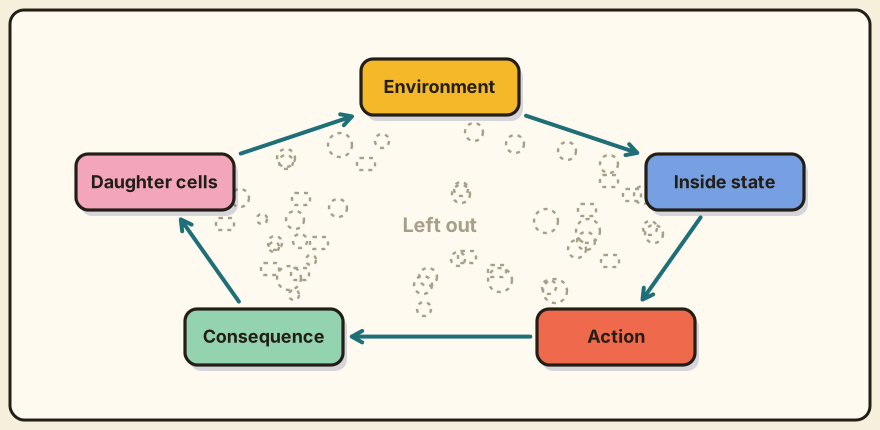
Specify a model that connects environment, internal state, action, consequence, and lineage without pretending to represent everything.
A quick test: pick one cell, say E. coli in a gradient, and write the five parts. Name the chemicals outside that matter, the few internal quantities that change, the action, the effect on growth, and how a daughter cell inherits the state. Then list what you left out, with one sentence on why each omission is safe, following the advice to model one well-defined system. G5 asks how to choose between two such models, G6 describes the cycle of building and testing, and H7 puts the idea to work on design.
You need first
A2 The cell as the unit of explanation
This leads to
G5 Rival models and discriminating interventions
G6 A cumulative cycle of modeling, experiment and rival theory
See it at work
References
- Carrera, J., & Covert, M. W. (2015). Why build whole-cell models?. Trends in Cell Biology, 25(12), 719-722. doi:10.1016/j.tcb.2015.09.004
- Goldberg, A. P., Szigeti, B., Chew, Y. H., Sekar, J. A. P., Roth, Y. D., & Karr, J. R. (2018). Emerging whole-cell modeling principles and methods. Current Opinion in Biotechnology, 51, 97-102. doi:10.1016/j.copbio.2017.12.013
- Bunne, C., Roohani, Y., Rosen, Y., et al. (2024). How to build the virtual cell with artificial intelligence: Priorities and opportunities. Cell, 187(25), 7045-7063. doi:10.1016/j.cell.2024.11.015