 Cellosophy
Concept D6 · Strand D, Memory and learning
Phenotypic variability, individuality, and lineage
Read first: Noise and limits of molecular sensing, Cellular memory substrates and timescales
Genetically identical bacteria in one dish don't all behave alike. The differences might be noise, a lasting trait of one cell, or part of how a population insures itself, and telling these apart takes more than a measurement of spread, which is where most studies have stopped.
B2 explained where the spread starts. When a few copies of a molecule react in a tiny volume, the numbers jump around. Balázsi, van Oudenaarden and Collins (2011) put it plainly: under these conditions noise is unavoidable, and cutting it needs high concentrations or costly feedback loops, so a quiet cell process would be the bigger surprise. We take that as the default. Noise alone hands us a spread of states, and the open question is what else the spread is doing.
When one cell in a clone behaves differently from its sisters, does anyone gain from it?
Personality, for one cell cycle
Maroš Pleška, David Jordan, Zak Frentz, BingKan Xue and Stanislas Leibler (2021) followed single E. coli, one at a time. They put a bacterium alone in a shallow circular chamber 200 micrometres wide, filmed it swimming at 50 frames per second until it divided, and then filmed both daughters until their next division. They did this for 150 families, in two strains and three growth media, and cut each track into 180-second segments, about 8,800 in all. They didn't assume the run-and-tumble model. They described each segment by its spread of speeds and turning rates, and found that two traits captured more than 85 percent of the variety, one tracking run speed and the other tracking the tumbling that run speed didn't explain. observed
Strain and medium, the things a microbiologist usually fusses over, explained under 10 percent of the variance. Differences between individual cells explained 81 percent of the variance in the first trait and 58 percent in the second, and changes within a single cell's life added a smaller but real share. observed Mothers and daughters were positively correlated in every condition, with some differences in strength, and for the speed trait the match faded over the daughter's life. The cells share a genome, so the information has to travel some other way. The authors point out that a daughter inherits about half of its mother's cell contents, membrane structures and regulatory proteins included. inferred Which of these carries the trait, we don't know, and the paper doesn't claim to know.
Now the limits. Doubling times were 49 to 76 minutes, so "individuality" here means persistence over roughly one cell cycle, followed for two generations - a short biography. The cells swam in two dimensions near surfaces, in a constant environment. The authors say the role of such differences in ecology and evolution is unclear. Nothing in the paper shows that the spread helps the population.
No benefit, no strategy
Balázsi and colleagues review cases where the spread seems to do a job. Starve Bacillus subtilis and only a fraction of the clonal population becomes competent to take up DNA. The reported mechanism is a master protein, ComK, that switches on its own gene, so random fluctuations push some cells over a threshold and the positive feedback does the rest. When cells were made longer without changing the average ComK level, which lowered the noise, entry into competence dropped, as reviewed from the work of Süel and others. observed A synthetic circuit with the same average behaviour but less variable competence episodes was reported to cut the population's DNA uptake. observed In yeast, a feedback loop through the protein Gal3p was reported to decide whether a population splits into two groups on galactose, and cutting that loop left just one group. observed All of this is reviewed, and we haven't read the originals.
The review also says why a spread might pay. In a fluctuating environment, a population that always keeps some cells in a stress-resistant state can do better than one that doesn't, and theory has predicted this for years. modeled It's the old advice about eggs and baskets, followed by a clone. The review lists experiments that fit the prediction, such as noise aiding survival in severe stress and a laboratory evolution of bet hedging. observed It adds cautions of its own. A switching strategy can be undercut by mutants that never switch, and for bacterial persistence the review says the underlying network in E. coli is unknown.
There's a catch in the definition. The review calls a fate a "cellular decision" only when it's heritable and functionally important, so its examples can't show by themselves that variability is functional - the conclusion is part of the entry ticket. And "decision" here means a molecular network with feedback, with no deliberation going on in the cell. We'd want the test below before saying more.
What you should be able to do after reading
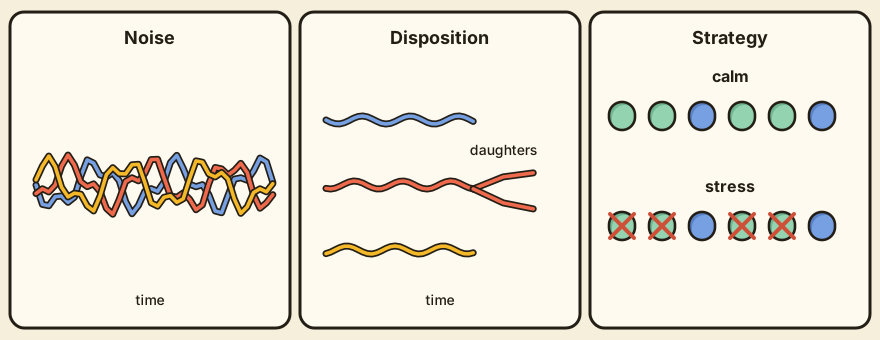
Explain when variability is noise, an individual disposition, or a population-level strategy.
A quick test: say you've measured a spread among identical cells. First, measure the same cells again later. Cells that reshuffle quickly look like noise, and cells that hold their ranks look like a disposition. Second, compare mothers with daughters, which asks whether the rank gets passed on. Third, compare population fitness in a fluctuating environment with and without the spread, for instance by using a circuit that lowers the variability, as in the B. subtilis work reviewed above. Only the third step supports a strategy, and Pleška and colleagues did the first two, for swimming.
E3 asks what happens when many such cells act together.
You need first
See it at work
References
- Pleska, M., Jordan, D., Frentz, Z., Xue, B., & Leibler, S. (2021). Nongenetic individuality, changeability, and inheritance in bacterial behavior. Proceedings of the National Academy of Sciences, 118(13), e2023322118. doi:10.1073/pnas.2023322118
- Balazsi, G., van Oudenaarden, A., & Collins, J. J. (2011). Cellular decision making and biological noise: From microbes to mammals. Cell, 144(6), 910-925. doi:10.1016/j.cell.2011.01.030