 Cellosophy
Concept E3 · Strand E, Collectives
Collective behavior and distributed control
Read first: Quorum sensing and density-dependent action, Phenotypic variability, individuality, and lineage
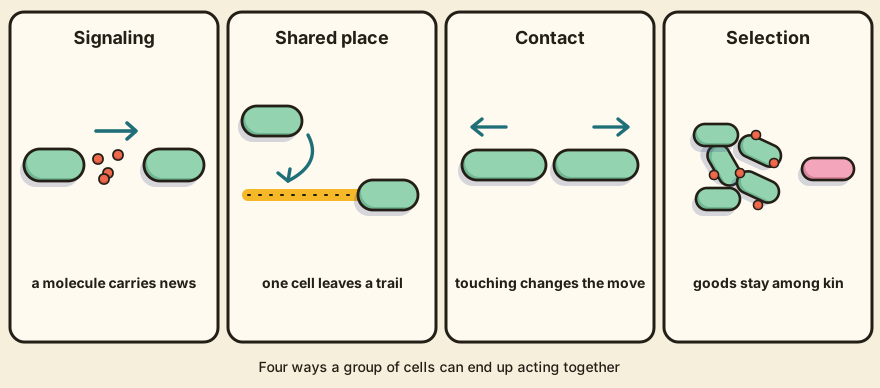
A swarm of bacteria can move as one body, build a tower or light up together, and no cell in the swarm is in charge. Distributed control means the coordination comes out of what each cell does with whatever it meets. We sort the ways that can happen into four routes. The grouping is ours - the review papers below don't state it in this form - and in real colonies the routes overlap.
How does a crowd with no boss end up doing one thing?
Signaling, or news by molecule
Bridges and colleagues (2022) review how bacterial groups decide together. Each cell runs the same signal-processing circuit, and the group state shows up when the chemical conditions line up. In the vibrios, several receptors feed one regulator, and any receptor without its molecule acts as a kinase and keeps the cell in the low-density program. Only when every molecule is present does phosphatase activity win and the high-density program start. They call this a coincidence detector. inferred Their reading is that the cell commits only when density is high and the molecule from kin is present, which keeps shared products from leaking to competitors. It's a committee that needs a unanimous vote, sitting inside one cell.
In V. cholerae biofilms, they report, the molecule CAI-1 builds up first and AI-2 later, and adding extra AI-2 from outside makes the biofilm disperse early. observed No cell in this circuit counts its neighbors. Each cell reads two molecules at its own address, which is the point E2 made about signal level.
A place that carries the message
A second route needs no molecule made for the purpose. Mukherjee and Bassler (2019) review work on S. aureus in channels with crypt-like cavities. Cells in the cavities, shielded from flow, switched on quorum sensing, while cells outside, in steady flow, didn't. observed The genes were the same and the place was different, so the environment handed different programs to identical cells. The reviewers note that flow, topography and heterogeneity often go together. D6 asked how cells with the same genes come to differ, and position in a flow is one answer.
Cells can also change the place for each other. Dinet and colleagues (2021) describe Myxococcus xanthus cells that move by pulling on type IV pili and leave tracks of extracellular polysaccharide behind them. These tracks are thought to funnel cells into streams and tighten cell-to-cell contact, which could give spatial cues over long distances, a process called stigmergy. inferred Think of a footpath across a lawn that nobody planned and everybody follows.
Contact, and waves that only seem to cross
Myxococcus cells also hunt in groups and show waves, called ripples, that cross a prey colony. Dinet and colleagues report that cell tracking shows the waves are an optical effect, because cells reverse direction at the same moment when two waves collide, so the waves seem to pass through each other. observed Mathematical models suggest that a signal passed on head-to-head contact could trigger the reversal, and that the pattern also needs a built-in refractory period during which a cell can't reverse again. modeled What the contact signal is, nobody knows. The C-signal once proposed for the job is now controversial, and Dinet and colleagues describe a system of outer-membrane protein exchange between touching cells, with no evidence yet that it feeds into reversal.
Inside each cell the reversal is run by the Frz pathway and the Mgl polarity proteins. Dinet and colleagues describe a switch in which a cell can reverse only when a refractory timer has run down and a phosphorylated Frz protein is present at the lagging pole, and the whole sequence takes about a minute. observed Mutants in these genes are deficient at rippling, aggregation and fruiting body formation. observed Most of what's known about the circuit's response comes from single cells stimulated with an artificial chemical, isoamyl alcohol, and the natural signals that cause reversals remain unidentified. We know the switch better than the hand that flips it.
Selection, or who keeps the goods
The fourth route is about why a coordinated trait persists at all. Mukherjee and Bassler describe a public goods problem. Quorum sensing often controls costly secreted products that non-producers can also use, and the autoinducer itself can be exploited - freeloading, in plain English. In P. aeruginosa, lasI mutants that can't make the Las molecule still respond to the molecule from wild-type cells and outcompete them in well-mixed cultures. observed On adenosine as the only carbon source the same mutants grow poorly alone, because the LasR receptor is needed to switch on a gene for a nucleoside hydrolase. observed In V. cholerae on chitin, producers of the chitin-digesting enzyme beat non-producers in thick biofilms and under flow, where the digestion products stay near the cells that made them, and didn't beat them in well-mixed liquid. observed Diggle, Crusz and Cámara (2007) add that cooperative signalling can be kept up by kin selection, which means signalling among close relatives, and that it's open to cheats just as in animals.
What we can't yet say
Dinet and colleagues propose that decisions made by single cells underlie the large-scale transitions of Myxococcus, and they say this hypothesis still has to be tested, which will require finding the signals that act on the Frz complex. Their reference list includes a paper by Marshall and Whitworth (2019) whose title asks whether wolf-pack predation is cooperative at all, and we haven't read it. We also don't know how the four routes combine in a natural colony. In V. cholerae the studies reviewed involve signaling, flow and shared products together, and no paper we read weighs the routes against each other. Four is a tidy number, and colonies have never been tidy.
What you should be able to do after reading
Distinguish coordination through signaling, shared environment, physical coupling, and selection.
A quick test: take Myxococcus ripples or a V. cholerae biofilm. For each of the four routes, write one observation that would show it's acting, such as a mutant that can't make the molecule or a channel with the flow removed. Then write what you'd see if that route were missing.
F6 turns to the emergence and diversification of nervous systems.
You need first
This leads to
See it at work
References
- Dinet, C., Michelot, A., Herrou, J., & Mignot, T. (2021). Linking single-cell decisions to collective behaviours in social bacteria. Philosophical Transactions of the Royal Society B, 376(1820), 20190755. doi:10.1098/rstb.2019.0755
- Bridges, A. A., Prentice, J. A., Wingreen, N. S., & Bassler, B. L. (2022). Signal transduction network principles underlying bacterial collective behaviors. Annual Review of Microbiology, 76, 235-257. doi:10.1146/annurev-micro-042922-122020
- Mukherjee, S., & Bassler, B. L. (2019). Bacterial quorum sensing in complex and dynamically changing environments. Nature Reviews Microbiology, 17(6), 371-382. doi:10.1038/s41579-019-0186-5
- Diggle, S. P., Crusz, S. A., & Cámara, M. (2007). Quorum sensing. Current Biology, 17(21), R907-R910. doi:10.1016/j.cub.2007.08.045