 Cellosophy
Concept F6 · Strand F, Cognition debates
The emergence and diversification of nervous systems
Read first: Pre-neural cellular capacities, Collective behavior and distributed control
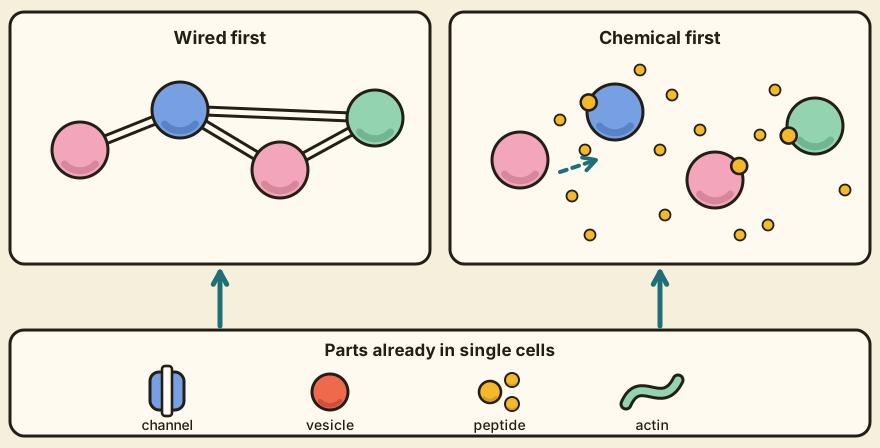
Nervous systems appeared in early animals, and almost every part they were built from was already working in single cells. Nobody much disputes that. The argument is about what it means. One reading stresses continuity, old parts rearranged, the same Lego in a new model. Another stresses innovation, new arrangements of chemistry and wiring that did something the parts hadn't done alone.
Fast cells, long before animals
Kirsty Wan and Gáspár Jékely (2021) reviewed what single-celled eukaryotes can do electrically. They read the phylogenetic evidence as showing that the capacity to propagate action potentials may have been an ancestral eukaryotic trait, present in the last common ancestor of eukaryotes. inferred They report fast responses in living protists. The stalk of the ciliate Vorticella can contract at 8 cm per second, and the arms of some heliozoa can retract within 20 milliseconds. observed They also list five changes during the origin of eukaryotes that they think made fast signalling possible, including a larger set of ion channels and the move of ATP production from the cell membrane into mitochondria, which left the cell membrane free for signalling. inferred They call the link between these changes and better speed and accuracy a conjecture, and so should we.
Building up from the old parts box
Thibaut Brunet and Detlev Arendt (2016) propose that animals inherited a cell that sensed pressure and contracted, and that sensory cells, neurons and muscle cells arose by dividing up its jobs. inferred Arendt (2020) adds a molecular route. In his scenario, early animal cells with a sensory collar and a cilium released peptides and linked sensing to secretion through calcium-driven electrical conduction. Later cells made brief contacts that let one cell address another, which gave what he calls protoneurons. inferred He then lists four molecular events as candidates for the step that turned a protoneuron into a neuron, and he says plainly that the picture is far from complete.
Chemistry first, wires later
Jékely (2021) proposes that the first nervous systems were networks of cells connected by released chemicals, and that synapses came afterwards. His evidence is that peptide signalling is found in every animal group except sponges, where none has yet been identified, and that placozoans, which have no neurons or muscles, still have cells that make peptides. observed His reasoning goes like this. Peptides are small, diffuse easily and can be almost endlessly varied, so a few peptides and receptors can wire a population of cells in many ways - two peptides and two receptors allow eight possible connections. modeled A nervous system by broadcast, more radio than telephone.
Chemical signals have a weakness, and he takes it seriously. A released peptide only reaches cells within a limited distance, so the scheme works poorly in larger bodies, which is the kind of coordination problem E3 raised for collectives without a central controller. He suggests that cells tiled over a surface, then cell projections and finally synapses, got around this, and that synapses may have spread when larger bodies and predation appeared 560 to 550 million years ago. inferred He ends with a list of experiments that could test the idea, such as whether placozoan cells signal with combinations of peptides.
If a peptide can only drift so far, what happens to a body that keeps getting bigger?
Where the new is stressed
Leonid Moroz, Daria Romanova and Andrea Kohn (2021) also start from chemistry. Their working hypothesis is that nervous systems arose from genetically varied secretory cells that signalled by diffusing molecules and had no synapses, and they take placozoans as the closest living picture of that state. They suggest that early transmitters such as nitric oxide, ATP, protons, glutamate and small peptides descend from signals of injury, and that classical transmitters such as acetylcholine, dopamine and serotonin were recruited only in bilaterians. inferred Then they go further and argue that neurons arose more than once. In their view the nervous system, synapses and muscle of ctenophores evolved independently of those in cnidarians and bilaterians. They say this fits either branching order of sponges and ctenophores, and that brain-like centralization may have happened more than twenty times in animal lineages. inferred
The lines between the accounts aren't sharp, and we don't want to draw them sharper than the authors do. Arendt (2020) also allows that neurons arose more than once, because the four molecular events he lists seem to have happened after the ctenophore lineage split off. He suggests that ctenophores built their presynapse and fast spikes independently, yet from the same old protoneuronal modules. inferred
Three open questions and a shaky family tree
The accounts differ on three questions that remain open. One is whether the first signals between cells were chemical drifts or direct contacts. Another is whether neurons arose once or several times, which Colgren and Burkhardt (2022) list as unresolved. The third is whether sponges and placozoans never had neurons or lost them. Moroz and colleagues see no credible evidence of loss, and Brunet and Arendt suggest that cellular sponges lost some electrical excitability together with control of their flagella. The order in which sponges and ctenophores branched is also unsettled, and Arendt marks it as such. All of this is reconstructed from living animals and their genes. Each account is an inference we can't yet test directly.
Our working tool is the parts-first reading, because it lets us ask what each part did in a single cell, which is the question this site keeps asking. That choice is ours. The papers don't decide between the accounts, and we're in no position to decide for them.
What you should be able to do after reading
Compare continuity and innovation accounts of early nervous systems.
A quick test: take one part, such as a calcium channel or a peptide signal, and write what it did in a single cell. Then write what two of the accounts above say it did in early animals, and name one observation that would favour one account over the other. Jékely's list of tests is a good place to look.
This leads to
See it at work
References
- Wan, K. Y., & Jékely, G. (2021). Origins of eukaryotic excitability. Philosophical Transactions of the Royal Society B, 376(1820), 20190758. doi:10.1098/rstb.2019.0758
- Jékely, G. (2021). The chemical brain hypothesis for the origin of nervous systems. Philosophical Transactions of the Royal Society B, 376(1821), 20190761. doi:10.1098/rstb.2019.0761
- Moroz, L. L., Romanova, D. Y., & Kohn, A. B. (2021). Neural versus alternative integrative systems: molecular insights into origins of neurotransmitters. Philosophical Transactions of the Royal Society B, 376(1821), 20190762. doi:10.1098/rstb.2019.0762
- Arendt, D. (2020). The evolutionary assembly of neuronal machinery. Current Biology, 30(10), R603-R616. doi:10.1016/j.cub.2020.04.008
- Brunet, T., & Arendt, D. (2016). From damage response to action potentials: early evolution of neural and contractile modules in stem eukaryotes. Philosophical Transactions of the Royal Society B, 371, 20150043. doi:10.1098/rstb.2015.0043
- Colgren, J., & Burkhardt, P. (2022). The premetazoan ancestry of the synaptic toolkit and appearance of first neurons. Essays in Biochemistry, 66, 781-795. doi:10.1042/EBC20220042