 Cellosophy
Concept F5 · Strand F, Cognition debates
Pre-neural cellular capacities
Read first: Receptors and signal transduction, Molecular motors and cellular action, Cellular memory substrates and timescales
Most of what makes a neuron work is older than neurons. Single-celled eukaryotes already had membranes that fire electrical spikes, vesicles that release their contents when calcium rises, and actin and myosin that squeeze the cell. The three reviews below differ on how these parts came together. None of them says a protist has a neuron.
We call these pre-neural capacities and describe them by what the molecules do. Excitability is a voltage change across a membrane that gets amplified once it passes a threshold, and regulated secretion is the release of stored vesicles on a signal. Contraction is actomyosin pulling on the cell's outer layer. Integration is the combining of several inputs into one response, and it's the one we'll have the most trouble with.
It starts with a wound
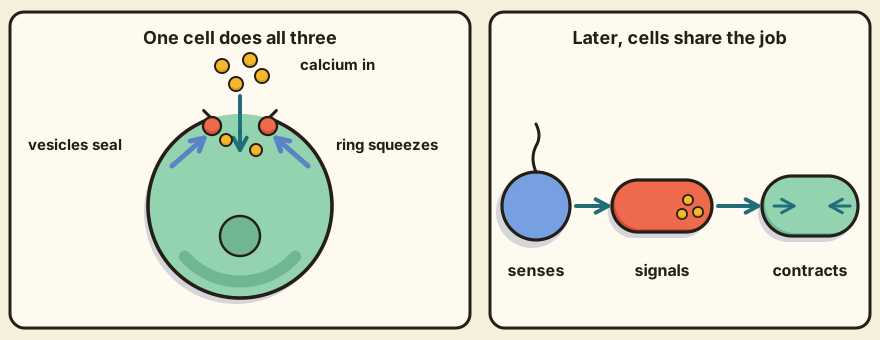
Thibaut Brunet and Detlev Arendt (2016) begin with chemistry. The inside of a cell holds far less calcium than its surroundings, usually about 100,000 times less, and calcium forms insoluble precipitates with phosphate, which matters for cells whose energy currency is phosphate based. observed So a tear in the membrane is dangerous mostly because calcium rushes in. In every eukaryotic cell they discuss, repair starts downstream of that calcium, with an actomyosin ring that contracts around the hole and with vesicles that fuse to patch it. observed The vesicle fusion runs through SNAP-25 and synaptotagmin, which they call a striking parallel to neurotransmitter release.
Their proposal is a bold one. This repair response, in the last common ancestor of eukaryotes, was the first coupling of a voltage change to contraction and secretion, and it later became the functional core of animal nerve and muscle circuits. inferred They add steps in the same spirit. Stretch-sensitive calcium channels would let a cell react before it tore, an actomyosin layer under the membrane would be ready to contract and would also help the cell keep its shape, and a local squeeze under pressure could have been the first escape movement. inferred First aid, then flight - and maybe, much later, thought. They say these are hypotheses, and that the molecules behind the amoeboid escape response are still unknown.
Spikes that may have begun in a cilium
Brunet and Arendt also reason about action potentials. The voltage-gated sodium and calcium channels that make spikes possible have genes in choanoflagellates and several other protist groups, so they probably predate the last common ancestor of eukaryotes. inferred Their evidence points to cilia as the first place spikes were put to use. In the green alga Chlamydomonas a mechanosensitive channel sits at the base of the flagellum and a voltage-gated calcium channel sits near its tip, spikes have been recorded only in the flagellum, and they trigger a fast reversal of beating. observed Across eukaryotes, loss of these channels tracks loss of flagella. observed They name limits too. The effect of calcium on cilia differs between lineages and changes quickly in evolution, which makes the ancestral state hard to reconstruct, and amoebae show only graded potentials and no spikes.
A synapse kit in cells with nothing to connect
Arendt (2020) took the neuron apart into modules, meaning structures with a job of their own that also exist outside neurons and are older than the neuron. Think of it as a parts catalogue for a machine that didn't exist yet. He concludes that the presynapse is a modified version of calcium-regulated secretion. The same release proteins work when gland cells in the pancreas and salivary glands secrete, and choanoflagellates, the closest single-celled relatives of animals, have a set of SNARE and Munc18 proteins that resembles the synaptic one. observed The calcium sensor synaptotagmin, on the other hand, turns up only in animals. Arendt picks out four events that look important for the first true neuron, including the origin of the synapse-specific calcium channel Cav2 and of neuroligin. All four predate the ancestor of placozoans, cnidarians and bilaterians, because the genes are present in the placozoan Trichoplax, which has no neurons. inferred
Jeffrey Colgren and Pawel Burkhardt (2022) extend the list. Genes for voltage-gated calcium channels occur in the choanoflagellate Salpingoeca rosetta, and postsynaptic proteins such as Homer, Shank and CaMKII are older than animals. observed They also report that an enzyme which processes peptide signals works in cilium formation in Chlamydomonas, and that nitric oxide controls collective contraction in colonial choanoflagellates. observed The gap junction proteins and the channel-clustering protein Cast/ELKS have so far been found only in animals, and for most of the other proteins they call the function in unicellular relatives unresolved.
Integration, the thinnest thread
The fourth capacity on our list is the hardest to support. Calcium acts as a shared signal that can gate contraction, secretion and ciliary beating in these cells, so one input can steer more than one output. inferred Brunet and Arendt also describe graded potentials in amoebae and cell-wide spikes in some ciliates and algae. What we didn't find in these papers is a measurement of how a single-celled eukaryote combines several inputs over time, which is the question D2 raised about stored cell states.
How does one cell weigh two signals at once, and has anyone watched it happen?
What nobody has shown yet
Arendt writes that his scenario is far from complete, since it rests almost entirely on comparative data from vertebrates and only a little from early-branching animals, and the cell type he calls a protoneuron is a hypothetical one. Colgren and Burkhardt write that functional work in non-animal relatives is only now becoming possible, so predictions based on homology are mostly untested. Our reading is that a gene's presence outside animals doesn't by itself show the same use. So we don't know how much of the neuron's machinery was working together in a single cell. Our working tool is a plain description of each capacity by its ions, channels, vesicles and motors. We keep the word neuron for animal cells, so that we can ask what each part did in a cell alone. F6 asks how these parts got assembled into nervous systems.
What you should be able to do after reading
Trace how excitability, regulated secretion and contraction predate neurons without calling them neurons, and say what the reviews leave unshown about integration.
A quick test: pick wound repair in a eukaryotic cell, or the flagellar reversal of Chlamydomonas. Describe it in terms of ions, channels, vesicles and motors, with no words borrowed from neurons. Then mark which steps have been measured in single cells and which are inferred from the presence of genes.
This leads to
See it at work
References
- Brunet, T., & Arendt, D. (2016). From damage response to action potentials: early evolution of neural and contractile modules in stem eukaryotes. Philosophical Transactions of the Royal Society B, 371, 20150043. doi:10.1098/rstb.2015.0043
- Arendt, D. (2020). The evolutionary assembly of neuronal machinery. Current Biology, 30(10), R603-R616. doi:10.1016/j.cub.2020.04.008
- Colgren, J., & Burkhardt, P. (2022). The premetazoan ancestry of the synaptic toolkit and appearance of first neurons. Essays in Biochemistry, 66, 781-795. doi:10.1042/EBC20220042