 Cellosophy
Concept D2 · Strand D, Memory and learning
Cellular memory substrates and timescales
Read first: History-dependence versus memory, Boundary, metabolism, and self-production
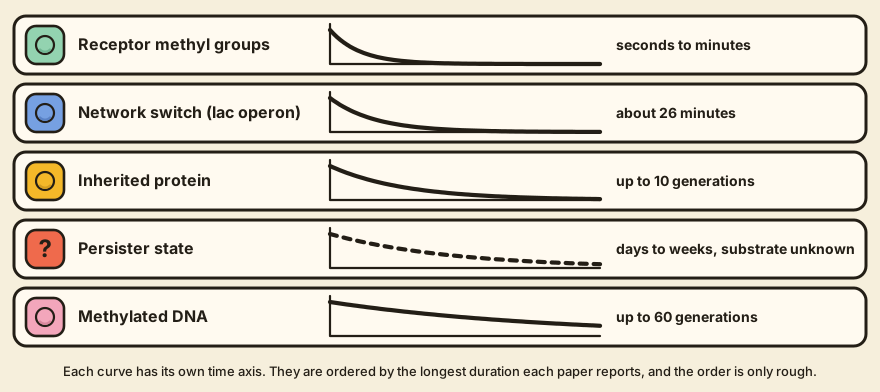
A cell has no notebook, so whatever carries its past has to be a physical state of the cell, and different states hold on for very different lengths of time. A methyl group on a receptor lasts seconds to minutes. A protein inherited from a mother cell can last for several generations. Tolerance to antibiotics acquired in a biofilm has been seen to last four weeks, and nobody yet knows what holds it. This page lines these candidates up side by side, because asking how long a memory lasts and asking what stores it turn out to be one question wearing two hats.
Receptor marks, the fast and pricey end
In E. coli chemotaxis the carrier is the methylation level of the chemoreceptors, added by the enzyme CheR and removed by CheB. Lan and Tu (2016) treat this level as a working memory of recent signals, with an adaptation time of about 10 seconds in their estimate. modeled Scanlon and colleagues (2025) describe the same mechanism as a comparison with conditions a few seconds to minutes earlier. The adaptation loop page shows how the marks get set.
Lan and Tu also put a price on this. In their account, changing a mark can be free, while holding the adapted state steady against noise uses energy all the time - cheap to write, dear to keep. They estimate about 10^3 ATP per second for a cell with about 10^4 receptors, which they put at 5 to 10 percent of the energy a flagellar motor needs at 100 revolutions per second. modeled They report that starved cells adapted more slowly while the accuracy of adaptation hardly changed, as their model predicts. observed We read that in the review and haven't seen the measurement itself.
Proteins and network states, where the clock is the doubling time
Slower memories use what the cell has already made. Scanlon and colleagues describe the lac operon, where lactose lets allolactose bind the repressor and switch on the genes for lactose uptake, and the uptake in turn keeps the inducer inside. After lactose is removed, the on state lingered for 26 minutes in the study they cite. observed Here the stored state is the shape of a feedback loop. The same review says that the stable proteins lactose permease and beta-galactosidase were retained for up to ten generations and shortened the lag before growth on lactose. observed Now the stored state is the abundance of a protein, and its clock is the doubling time, because each division halves what a cell inherits. Memory by dilution.
Wolf and colleagues (2008) found a longer-lasting form in B. subtilis cultures, where after 24 hours the sporulation reporter had settled into one of two levels depending on how the cells had been grown. observed They say that this suggests multistability, and that they didn't identify the feedback loops involved. So the network-state reading is a guess about the substrate, even though the persistence itself is measured.
Metabolic state, the slippery middle
Metabolic state is the hardest substrate to pin down, and this is the thinnest section on the page. Scanlon and colleagues report that E. coli swarming memory lasted for more than four generations after cells had been in high or low iron, and they read this as inheritance of an iron-regulated cell state. inferred They also describe a study in which E. coli persister cells that entered dormancy last were the first to resume growth on a new carbon source, with the effect lasting several days and the mechanism unknown. observed Last to sleep, first to wake. Dormancy is a metabolic state, but neither report shows that the memory is held in metabolism and not in something else, and neither original paper was opened for this page.
Marks on DNA, and what daughters inherit
DNA methylation patterns can be copied to daughter cells, since each daughter inherits half of the parental pattern. Scanlon and colleagues give a span of 1 to 60 generations for epigenetic memory, and the longest case they report is a Pseudomonas aeruginosa strain grown warm, whose restriction enzyme took more than 60 generations to recover its normal activity. observed They also report that commitment to sporulation in B. subtilis was inherited across generations and that the phosphorelay is responsible. observed That the parent's phosphorelay state is what gets passed on is their own speculation. inferred Genome changes such as CRISPR spacers last longer still, and we leave them to D6.
A memory without a known home
Miyaue and colleagues (2018) show how far the substrate question can lag behind the phenomenon. They grew E. coli for 24 hours either in liquid or as a colony biofilm on a membrane, resuspended the cells in fresh nutrient broth with ampicillin, and counted survivors for up to 28 days, with five to seven replicates. observed Biofilm-grown cells stayed far above liquid-grown cells for the whole period. By our reading of the plot, liquid-grown cells had lost several orders of magnitude within a day, while biofilm-grown cells declined slowly to roughly 0.01 percent survival at four weeks. Cells that survived became antibiotic-sensitive again after culture in drug-free medium, which argues against mutants. Four other species showed a similar pattern over seven days, to different degrees.
Their word for this is a memory effect. The readout is survival in continuous antibiotic, and they note that antibiotic-forced dormancy may take part. They report no test of whether tolerance fades in drug-free growth and no knockouts of candidate genes. They suggest that toxin-antitoxin systems may hold the state and that another unknown mechanism may set it. inferred We don't know what the substrate is. A month-long memory with no address is a strange thing to sit with.
What stays open
The papers don't agree on what to count. Scanlon and colleagues include genetic changes, epigenetic marks, inherited proteins and whole microbial communities under one word, while Lan and Tu use it for one methylation level. That's a big tent and a small one.
Can a single account cover a methyl group that lasts seconds and a tolerance that lasts a month?
We don't know. The figure orders the durations only roughly, because some are in seconds, some in generations and some in days, so the figure can't put them on one clock.
What you should be able to do after reading
Compare receptor modification, protein abundance, network state, metabolic state, and lineage inheritance as substrates.
A quick test: pick one reported memory in a bacterium and write down what is stored, how it's written, what erases it and how long it lasts. Then mark which of those four answers the authors measured and which they only suggested. For the Miyaue result, only the duration and the readout were measured.
This leads to
D3 Habituation without neurons
D5 Prediction and adaptive anticipation
See it at work
References
- Lan, G., & Tu, Y. (2016). Information processing in bacteria: memory, computation, and statistical physics. Reports on Progress in Physics, 79, 052601. doi:10.1088/0034-4885/79/5/052601
- Miyaue, S., Suzuki, E., Komiyama, Y., Kondo, Y., Morikawa, M., & Maeda, S. (2018). Bacterial memory of persisters: bacterial persister cells can retain their phenotype for days or weeks after withdrawal from colony-biofilm culture. Frontiers in Microbiology, 9, 1396. doi:10.3389/fmicb.2018.01396
- Scanlon, K., Shanahan, F., Ross, R. P., & Hill, C. (2025). Exploring the concept of bacterial memory. Nature Microbiology, 10(12), 3049-3058. doi:10.1038/s41564-025-02185-3
- Wolf, D. M., Fontaine-Bodin, L., Bischofs, I., Price, G., Keasling, J., & Arkin, A. P. (2008). Memory in microbes: quantifying history-dependent behavior in a bacterium. PLoS ONE, 3(2), e1700. doi:10.1371/journal.pone.0001700