 Cellosophy
Concept D3 · Strand D, Memory and learning
Habituation without neurons
Read first: History-dependence versus memory, Cellular memory substrates and timescales
A cell that stops reacting to something it meets again and again has shown a drop in response, and a drop in response is still some distance from habituation. Habituation is a decline in response to a repeated, harmless stimulus that is specific to that stimulus and that recovers when the stimulus is withheld. The trouble is that plenty of boring things also make a response fall. Fatigue can do it, damage can do it, and so can sensory adaptation at the receptors. This page follows one experiment on a slime mould to see which controls pull those cases apart.
One experiment, one bitter bridge
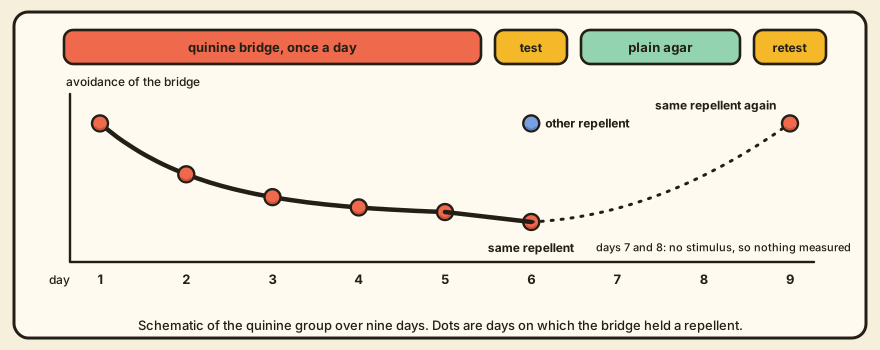
Romain Boisseau, David Vogel and Audrey Dussutour (2016) used plasmodia of the slime mould Physarum polycephalum, a single cell with many nuclei that crawls toward food. Each animal had to cross a small bridge of agar gel to reach a patch of oat-based food. For the experimental groups the bridge held quinine at 4 mM or caffeine at 1 mM, both bitter repellents for this species, and the animals crossed once a day for five days. A control group of 200 crossed plain agar. They photographed the set-ups every 5 minutes and measured how long each animal took to touch the bridge, how long it took to cross, and the size and shape of the leading pseudopod. observed
On day one the quinine group (140 animals) took about 2.5 hours to enter the bridge and 4 hours to cross it, with a thin pseudopod, where controls took about an hour for each. Caffeine animals (70) waited almost 5 hours to enter - a long time to stare at a cup of coffee. Over the next days both groups entered sooner and spread wider, and quinine animals crossed twice as fast, with the decline roughly exponential in the number of exposures. Control animals barely changed. observed
What the controls rule out, and what slips through
On day six the authors offered half the animals the same repellent again and the other half the other repellent. Animals offered the same one avoided it less than naive animals did. Animals offered the other one avoided it as strongly as naive animals. observed That cross test argues against a general wearing out of the sensors or the motor machinery, because a worn-out cell would have responded weakly to both. The daily agar group argues against an effect of the crossing routine itself. After two days on plain agar, the quinine group on day nine looked like it did on day one, and the caffeine group had recovered only in part. observed Recovery argues against permanent damage for quinine. The paper chose doses on the basis of earlier work to avoid harm and reports no viability test, so for caffeine, where recovery was incomplete, damage or slow recovery isn't excluded by this experiment. inferred
The cross test has a limit that the authors partly state. They conclude that the decline sits at the primary sensors and not at a central stage, since it didn't generalize to the other chemical. Grant them that, and follow it one step further. A change at the receptors for one chemical is also specific to that chemical, and it's exactly what sensory adaptation would look like in a single cell. In a cell with no separate nervous system, then, the boundary between ligand-specific adaptation and habituation is blurry. inferred
If the specificity lives at the receptor, what's left to call habituation?
What this experiment didn't test
Neuroscientists list ten hallmarks of habituation, and the experiment covers three of them: the decline, the recovery and the specificity. Dishabituation, where a different strong stimulus restores the response, wasn't tested. Nor was frequency, which should speed habituation, or intensity, since each repellent was used at one dose. Dussutour (2021) notes in her review that potentiation, where later rounds habituate faster, hadn't been explored. Her table lists Physarum as meeting several more criteria, drawing on three papers from her laboratory, and we've read only the one above.
The review also reports that habituated slime moulds cut into pieces stayed habituated and that the state could pass between cells that fused, and that ciliates such as Stentor, whose declining response to touch Jennings first described in 1902, meet most of the criteria tested except dishabituation. observed We didn't read those papers. Still, they hint that the stored state is spread through the cytoplasm, which D2 treats as the question of substrate. A habit you can cut in half and keep twice is an odd sort of habit.
Models of how a cell could pull it off
Lina Eckert and colleagues (2024) asked whether simple chemistry can produce the full list. They modelled small networks in which a response is turned down by a slower memory variable, using cycles of protein modification such as phosphorylation. modeled Such networks gave the decline and recovery easily and were hard to push into frequency sensitivity. Models that managed it needed two memory variables that decay on very different timescales. They conclude that a falling response alone shouldn't count as adequate evidence of habituation. This shows that habituation is chemically possible. It doesn't show that Physarum uses these circuits.
Samuel Gershman (2024) came at it from the other end and asked why a cell should habituate at all. His model treats the response as the probability that a signal exceeds a danger threshold, given a running estimate of the signal and its uncertainty. A cell, on this view, is a small statistician deciding whether to worry. It reproduces the major characteristics of habituation that he lists, and predicts that a repeated signal above threshold should raise the response instead of lowering it. modeled It names no molecule, and a cell would need some stored state to hold such an estimate. inferred
What we don't know
We don't know what stores the change in Physarum, whether the full set of hallmarks holds in any single cell, or whether a recovery time of two days, as seen here, holds for other doses and species.
What you should be able to do after reading
Distinguish habituation from fatigue, sensory adaptation, and damage using controls.
A quick test: take a report of a cell that responds less after repeated exposure and write down the control for each rival. Fatigue is tested by offering a different stimulus that uses the same motor output, sensory adaptation by whether the decline is specific and recovers over a long rest, and damage by whether the response returns and the cell stays viable. Then count which of the ten hallmarks were tested.
This leads to
See it at work
References
- Boisseau, R. P., Vogel, D., & Dussutour, A. (2016). Habituation in non-neural organisms: evidence from slime moulds. Proceedings of the Royal Society B, 283(1829), 20160446. doi:10.1098/rspb.2016.0446
- Dussutour, A. (2021). Learning in single cell organisms. Biochemical and Biophysical Research Communications, advance online publication. doi:10.1016/j.bbrc.2021.02.018
- Eckert, L., Vidal-Saez, M. S., Zhao, Z., Garcia-Ojalvo, J., Martinez-Corral, R., & Gunawardena, J. (2024). Biochemically plausible models of habituation for single-cell learning. Current Biology, 34(24), 5646-5658. doi:10.1016/j.cub.2024.10.041
- Gershman, S. J. (2024). Habituation as optimal filtering. iScience, 27, 110523. doi:10.1016/j.isci.2024.110523