 Cellosophy
Concept D4 · Strand D, Memory and learning
Associative learning and its controls
Read first: History-dependence versus memory, Habituation without neurons
A single cell has shown associative learning only if the pairing of two stimuli did the work, and for most cells nobody has shown that. One recent experiment on a large ciliate gets closer than most.
In animals the standard example is Pavlov's: a bell sounds before food arrives, and after enough repetitions the bell alone makes a dog salivate. The usual neural account says the synapse between a "bell" neuron and a "food" neuron strengthens when both are active. A single cell has no synapses, so if it does anything similar it needs another trick. No bell, no dog, no neurons - just one cell and a lot of careful bookkeeping on our side.
What counts, and what does a good impression of it
In the language of animal learning, the cue is the conditioned stimulus, the event that already causes a response is the unconditioned stimulus, and the new response to the cue is the conditioned response. The learning is associative when it depends on the relation between the two, so the cue has to predict the other event. Simpler things can raise a response without any relation being learned. Sensitization is a general rise in reactivity after a strong stimulus, and it would raise the response to anything. Pseudoconditioning is the same effect when the strong stimulus happens to land near the cue in time. Habituation, the subject of D3, is a decline with repetition that can bend a learning curve out of shape.
A dish of cells adds two more impostors. The culture can change during training, for example when food left behind alters what the cells do. The cells counted at the end may also differ from the ones we started with, because some died, swam off or were excluded. We call these carryover and selection. inferred The list is our summary of arguments in the papers below.
An old experiment and its critics
Gershman, Balbi, Gallistel and Gunawardena (2021) revisit the work of Beatrice Gelber, who trained the ciliate Paramecium aurelia in the 1950s. They report that she swabbed a wire with bacteria and dipped it into a culture for 15 seconds, over repeated trials. On later tests with a clean wire, the trained animals clung to it in greater numbers than before training and than untrained animals did, while animals given the wire without bacteria showed no change. observed We haven't read Gelber's papers.
The critics make the best teaching case, so it's worth slowing down. Donald Jensen argued that the culture had changed, since bacteria left near the wire could draw the animals to it with no change in the animals. Gelber answered that she stirred the dish between trials. Katz and Deterline replicated her result but found that stirring right after training erased it. Gershman and colleagues read that differently: stirring spreads the food through the dish and breaks the link between wire and food, and in animals a broken link suppresses conditioned responding even when the number of pairings stays the same. inferred Stirring might also disturb the animals, as McConnell pointed out at the time, so the result doesn't settle the matter. The reviewers conclude that Gelber's work, though limited, convincingly showed conditioning in Paramecium, and that people on both sides seem to have judged the evidence by what they already believed. Scientists, it turns out, also respond to cues they were trained on.
A modern try on Stentor
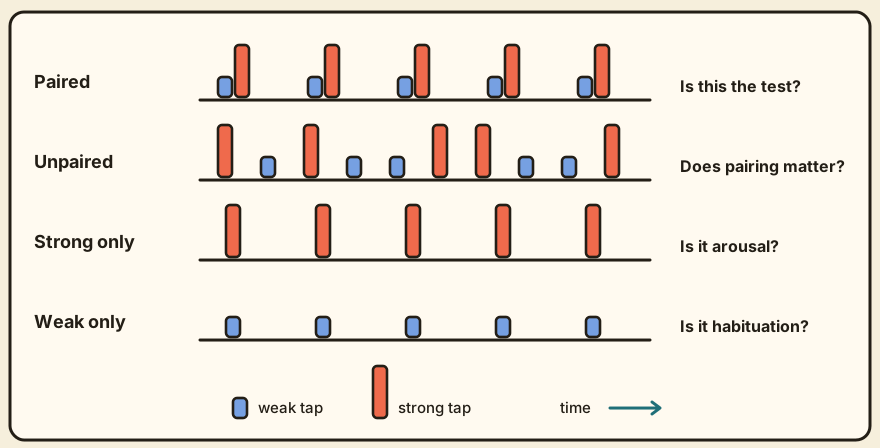
Nhi Doan, Austen Theroux, Tejas Ramdas and Samuel Gershman (2026) tried again with Stentor coeruleus, a trumpet-shaped ciliate about a millimetre long. This is a preprint that hasn't been peer reviewed. A solenoid taps the dish, and the cell contracts when tapped. In the main experiment a weak tap came one second before a strong tap, sixty times. The fraction of cells contracting to the weak tap rose over the first few pairings, with a fitted peak near the third stimulus, and then fell. observed When a weak tap was followed by another weak tap, the response only declined.
The authors ran three controls against sensitization. A single strong tap placed among weak taps didn't raise the next weak response, and neither did three strong taps in a row. Cells pre-habituated to weak taps, whose first response in the pairing phase was less than half the usual, still showed the rise. observed With a long gap between pairs (590 seconds) the rise didn't appear. A small model in which the strong-tap response boosts the weak-tap response while both habituate fits the rise and fall, and the authors call it a proof of concept. modeled
Some controls are missing. We couldn't find a group that received the same number of weak and strong taps in an unrelated order, or with the strong tap first, which is the usual way to separate pairing from mere exposure. We also found no statement that the people scoring contractions were blind to condition. Cells were chosen by hand, excluding any that detached, divided or touched neighbours. The cue and the strong stimulus are the same kind of tap, the weak tap already makes some cells contract, and the enhancement is brief. They conclude that Stentor appears capable of associative learning.
Is this a cell learning that one tap predicts another, or a cell that's simply been stirred up?
We read the data as promising and the interpretation as open. inferred
A circuit on paper
Chrisantha Fernando and colleagues (2009) asked what molecules a single cell would need. Their design has two input molecules, and each relieves repression of a transcription factor that acts as a "weight". The weight for the unconditioned input is present at a low background level, so that input alone switches on an output gene. The weight for the cue starts at zero, so the cue alone does nothing. When both inputs arrive together, the output protein is made, and it feeds back to switch on the cue's weight. That weight breaks down slowly, so for hours afterward the cue alone switches on the output. In their simulation, with rate constants the authors chose, the learned response lasted about 10.5 hours and then faded, which they liken to extinction. modeled Pavlov in a plasmid, on paper.
They propose a plasmid version for E. coli, which as far as the paper shows hasn't been built. The model is deterministic, so it describes an average over cells. A circuit that learns on paper shows what's possible, and no cell has been shown to use one.
What we don't know
We don't know whether any single cell has passed every control above, or whether the Stentor result holds up in another laboratory. We don't know what molecules carry the memory in Stentor or Paramecium.
What you should be able to do after reading
Design an experiment separating association from sensitization, selection, and environmental carryover.
A quick test: write down five groups of cells for a stimulus pair of your choice. They are paired, unpaired with the same number of both stimuli, cue only, strong stimulus only, and a truly random group. Beside each, name the rival explanation it removes. Then add a wash between trials and a count of every cell that started, including those that left. D5 asks the same question about responses that evolution may have fixed in place.
This leads to
See it at work
References
- Gershman, S. J., Balbi, P. E. M., Gallistel, C. R., & Gunawardena, J. (2021). Reconsidering the evidence for learning in single cells. eLife, 10, e61907. doi:10.7554/eLife.61907 · free full text
- Doan, N., Theroux, A., Ramdas, T., & Gershman, S. J. (2026). Associative learning in the protozoan Stentor coeruleus. bioRxiv preprint (not peer reviewed). doi:10.64898/2026.02.25.708045 · free full text
- Fernando, C. T., Liekens, A. M. L., Bingle, L. E. H., Beck, C., Lenser, T., Stekel, D. J., & Rowe, J. E. (2009). Molecular circuits for associative learning in single-celled organisms. Journal of the Royal Society Interface, 6, 463-469. doi:10.1098/rsif.2008.0344