 Cellosophy
Concept D5 · Strand D, Memory and learning
Prediction and adaptive anticipation
Read first: Cellular memory substrates and timescales, Associative learning and its controls
A bacterium that turns on maltose genes when it meets lactose is acting as if maltose is on its way. The experiments say selection in the gut built that habit over many generations, and we have no evidence that any one cell learned it.
That distinction is what this page is about. A response can get a cell ready for a later condition in two ways. Either the cell picked up the link between cue and outcome during its own life, which is what D4 was asking about, or the link was written into its regulatory network by selection acting on its ancestors. In a single experiment the two look identical. Reverse the link and they come apart.
Did this cell learn that lactose means maltose, or was it born knowing?
Lactose now, maltose later
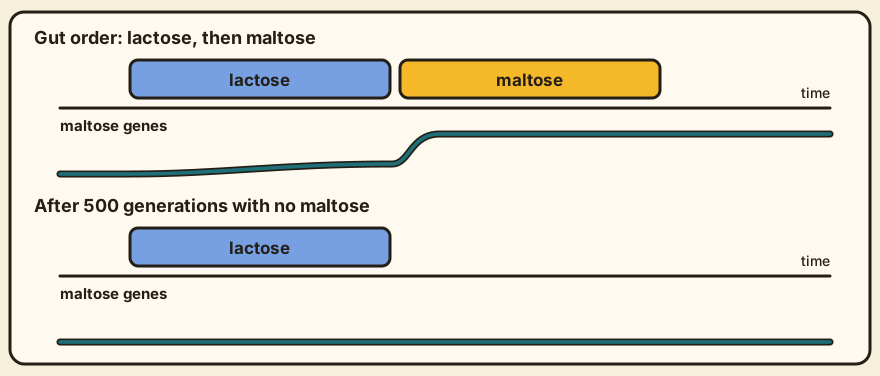
Amir Mitchell, Yitzhak Pilpel and colleagues (2009) worked with E. coli and baker's yeast, starting from a simple idea: a regulatory network could carry the usual order of events in its wiring. Their E. coli case is sugar. Along the gut, they state, lactose comes before maltose. They fused a fluorescent reporter to the promoters of the maltose genes and found that lactose switched them on, weakly. It doesn't run the other way round, since the lactose genes didn't respond to maltose. observed
Next came the payoff. Cells grown on lactose and then moved to maltose grew better than cells that skipped the lactose, by a small margin (P = 0.02). Cells grown first on maltose gained nothing on lactose, and galactose or sucrose couldn't stand in for lactose. observed So the order of exposure matters, and the cue is specific. Then the clever bit. Earlier work had grown three independent E. coli lines for 500 generations on lactose with no maltose, and the team looked again. In all three the maltose genes barely responded to lactose, though they still responded to maltose itself, and the growth advantage was gone. observed The authors read this as selection stripping out a costly preparation that no longer pays - use it or lose it, at the scale of a lineage. inferred Yeast showed a similar asymmetry. Mild heat or ethanol protected cells against a later oxidative stress more strongly than the reverse order did, which matches the order of events in wine fermentation. observed
Their rule of thumb is a cost and benefit balance. Preparing early pays when the chance that the second event follows, times its benefit, is bigger than the cost of preparing. That's a model equation, and the paper gives no measured values for it. modeled Hence a caution. The fitness gain is small, the strains are lab strains, and the claim about what happens in the gut is borrowed from other papers.
Networks that guess, in silicon and in glass
Ilias Tagkopoulos, Yir-Chung Liu and Saeed Tavazoie (2008) began in the computer. They simulated populations of small biochemical networks evolving under signals that carried delayed information about food. Networks that responded at the right time were selected, and the winners used internal states that tracked the environment, which the authors call internal representations. modeled Then they turned to real cells, by way of microarrays. In E. coli a rise in temperature and a fall in oxygen both repressed aerobic respiration genes, even with oxygen present, and the two responses correlated across the genome (r = 0.39). That's the order a cell meets on its way into the gut. observed Then they flipped the world. They evolved E. coli for 42 cycles in an environment where oxygen rose 40 minutes after temperature rose, the reverse of the gut pattern, and the correlation between the two responses fell, for example from 0.39 to 0.06 at a late time point. observed
The authors call the original coupling "associative learning". Fernando and colleagues (2009) object, and we think fairly. The mechanism depends on evolution and on relations that stay fixed between lifetimes, so it can evolve responses, and it can't learn a new contingency within a lifetime. We side with the narrower reading. Learning is a word that's easy to spend and hard to earn. The authors themselves grant that some other, unknown ecological structure could explain the correlation. inferred
Counting days without a calendar
Maria Luisa Jabbur, Benjamin Bratton and Carl Johnson (2024) tried a longer cue. They kept the cyanobacterium Synechococcus elongatus for eight cycles of short days, equinox or long days, and then dropped it into ice-cold medium. After short days, survival was about two to three times higher. The advantage needed an intact circadian clock gene set (kaiABC), took about four cycles to build, spanned roughly three generations, and came with more unsaturated membrane lipids and altered gene expression. observed Mutants without the clock showed no day-length effect, and changing light intensity didn't remove it, which argues against a simple light-exposure story. observed
Whether this is a learned correlation, we can't say. Short days normally come before cold, and the cells seem to count cycles. The authors propose that the system evolved out of stress pathways that were already there. We found no experiment in which the usual link between short days and cold was reversed. After the cues stopped, survival differences weren't statistically significant at 24 hours, so how long the memory lasts is unclear. inferred
What you should be able to do after reading
Work out whether a response rests on a cue-outcome correlation that was learned within a lifetime or fixed by evolution, and specify a cue-reversal test.
A quick test: pick a cue and an outcome, say short days and cold, and write down two versions of the reversal. In the first, you train a single culture with the usual order for a few cycles, then flip the order and ask whether the response fades within hours. In the second, you keep lineages for hundreds of generations in the flipped order and ask whether the response is lost, as it was in the lactose lines. Add a control cue that never predicted the outcome, to check specificity. Fast fading points to a state the cell can reset, and slow loss points to selection.
Which one you see tells you whether to thank the cell or its ancestors' funerals.
You need first
This leads to
See it at work
References
- Mitchell, A., Romano, G. H., Groisman, B., Yona, A., Dekel, E., Kupiec, M., Dahan, O., & Pilpel, Y. (2009). Adaptive prediction of environmental changes by microorganisms. Nature, 460(7252), 220-224. doi:10.1038/nature08112
- Tagkopoulos, I., Liu, Y.-C., & Tavazoie, S. (2008). Predictive behavior within microbial genetic networks. Science, 320(5881), 1313-1317. doi:10.1126/science.1154456
- Jabbur, M. L., Bratton, B. P., & Johnson, C. H. (2024). Bacteria can anticipate the seasons: Photoperiodism in cyanobacteria. Science, 385(6713), 1105-1111. doi:10.1126/science.ado8588
- Fernando, C. T., Liekens, A. M. L., Bingle, L. E. H., Beck, C., Lenser, T., Stekel, D. J., & Rowe, J. E. (2009). Molecular circuits for associative learning in single-celled organisms. Journal of the Royal Society Interface, 6, 463-469. doi:10.1098/rsif.2008.0344