 Cellosophy
Concept D1 · Strand D, Memory and learning
History-dependence versus memory
Read first: Adaptation and integral feedback, Levels and kinds of explanation
A bacterium that behaves differently today because of where it was yesterday has shown us history-dependence, and that alone doesn't show that it remembers anything. The two words blur easily, and a lot of excitement lives in the blur. On this site, history-dependence is the plain observation that a cell's response to a condition depends on the conditions it met before. Memory is the narrower claim that a stored state inside the cell carries the past forward and changes later behavior in a way an experiment can test. inferred That split is our working choice, and other authors draw the line elsewhere.
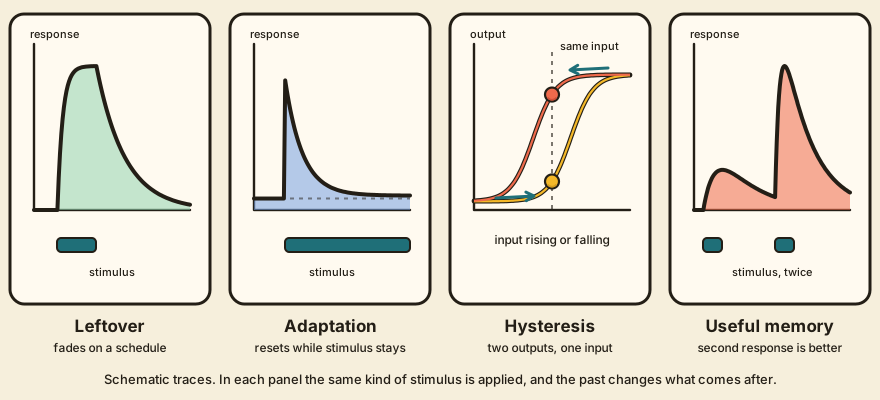
Four ways the past can matter, and only one of them asks for a test
Start with a leftover. Scanlon and colleagues (2025), in a Perspective in Nature Microbiology, describe the lac operon of E. coli after lactose is taken away. Allolactose, a metabolite of lactose, stays bound to the repressor for a while, so the operon keeps being transcribed, and they report that this lingering response lasted 26 minutes before it began to decline. observed We haven't read the experiment behind that number, which they take from earlier work. The leftover then thins out through growth and breakdown. If lactose comes back within that window the cell answers sooner, and a decaying molecule is enough to explain it - no filing cabinet required.
Adaptation is the second case. In chemotaxis, receptors of E. coli gain and lose methyl groups so that the output of the pathway returns to its set point whatever the background level, and the adaptation loop page shows how. Scanlon and colleagues point out that this lets the cell compare the present with a few seconds to minutes earlier. Lan and Tu (2016) go further and call the methylation level a working memory that the pathway uses to compute the direction of a gradient. modeled An adaptation experiment alone can't say whether that deserves the word memory, because its readout is the response sinking back to baseline. Still, the response to a second step does depend on the methylation level left by the first, and that dependence is the sense in which the pathway reads its own stored state. inferred
Hysteresis is the third. Scanlon and colleagues define it as a system whose output depends on its history as well as its current input, and a bistable switch that can sit in either of two stable states at the same input is its simplest form. Think of a light switch, which stays where you last left it. For a whole community they describe mice fed a high-fat diet and then normal chow, in which only 45 percent of gut bacterial taxa had returned to their earlier levels after the weight came back down, and the mice regained weight faster on the next high-fat diet. observed That's a community, and we didn't open the original study.
Functional memory is the fourth, and it's the one that asks for a test. Scanlon and colleagues describe work on Lactococcus lactis grown first in cellobiose and then moved to a mixture of glucose and cellobiose. Cells from the cellobiose culture switched to cellobiose sooner after the glucose ran out, and the effect was larger when the starting glucose was low, so that fewer divisions had happened before the switch. observed The proposed reason is that cellobiose transporters made earlier get shared out among daughter cells and diluted with each division. inferred That dependence on the number of divisions is just what a leftover protein would predict, which makes the explanation checkable. Good explanations stick their necks out.
Telling them apart by experiment, in bits
Wolf and colleagues (2008) built a design for the question that applies to any of the four. They put identical samples through several different pasts, move all of them into one common condition, and then ask how well the past can be guessed from what the cells do next. The more the guess improves, the more history-dependence there is, and they measure it in bits. It's a detective's method more than a biochemist's.
Their test organism was Bacillus subtilis, engineered with fluorescent reporters for commitment to sporulation and for synthesis of the protease subtilisin. The ten pasts were growth in rich or poorer medium to one of five densities. All cultures were then moved into a starvation medium and followed for 24 hours, with three replicate cultures per past. observed The authors estimate that the early response, over the first 11 hours, carried 1.96 bits of the 3.32 bits needed to tell all ten pasts apart in the sporulation reporter, and 1.49 and 1 bits in the protease reporter and in growth. They estimate between 0.7 and 1 bit in the last three hours, where each reporter settled into one of two levels. observed Early on, the medium could be read off perfectly, and the density reached could be read off only for cells grown in the rich medium.
Several things limit this. The readings are for whole cultures, so a mixture of cell states would look the same as one shared state. The authors write that unseen variables and uncontrolled inputs probably make their numbers underestimates. The ten pasts differ in more than the intended variable, since cells in different media and at different densities also differ in leftover nutrients and metabolic stores, and the authors say so. They didn't look for a mechanism or follow the cultures past 24 hours. Their own sentence is that they don't yet know whether the effect is evolved and useful or incidental.
Where people disagree, and where we land
Wolf and colleagues state that they take a potentially controversial view, that history-dependent behavior, short or long term and controlled or incidental, reflects a form of memory. That's a generous reading, and there's something to it. Under our narrower use of the word, though, their result is history-dependence with a number attached, and the step to memory needs a mechanism and a later benefit that they didn't test. Scanlon and colleagues take a similar broad line, and add that how bacteria use memory in decisions is still poorly understood.
How much of the history-dependence in cells was selected for, and how much is chemistry that can't help leaving a trail?
We don't know.
What you should be able to do after reading
Give cases of mere persistence, adaptation, hysteresis, and functional memory and distinguish them experimentally.
A quick test: take any report of bacterial memory and write down what the cells met before, what they met after, and what was measured. Then check whether the authors varied the gap, because a leftover molecule fades on a schedule set by its breakdown and dilution, while a switched state can outlast it. Then check whether they showed a later benefit or only a difference. D2 asks which physical states carry the past.
References
- Wolf, D. M., Fontaine-Bodin, L., Bischofs, I., Price, G., Keasling, J., & Arkin, A. P. (2008). Memory in microbes: quantifying history-dependent behavior in a bacterium. PLoS ONE, 3(2), e1700. doi:10.1371/journal.pone.0001700
- Scanlon, K., Shanahan, F., Ross, R. P., & Hill, C. (2025). Exploring the concept of bacterial memory. Nature Microbiology, 10(12), 3049-3058. doi:10.1038/s41564-025-02185-3
- Lan, G., & Tu, Y. (2016). Information processing in bacteria: memory, computation, and statistical physics. Reports on Progress in Physics, 79, 052601. doi:10.1088/0034-4885/79/5/052601