 Cellosophy
Concept F1 · Strand F, Cognition debates
Competing criteria for minimal cognition
Read first: Levels and kinds of explanation, Sensorimotor behavior in a changing environment, History-dependence versus memory
Nobody agrees on where cognition begins, and the clearest place to watch the disagreement is a single bacterium swimming toward sugar. Each published criterion draws its line somewhere else, so the same cell counts as a cognizer under some of them and as a very good chemical machine under others.
The cell in question is Escherichia coli. observed It swims in straight runs that can last a few seconds, then tumbles for roughly a tenth of a second, which turns it by about 60 degrees on average. When the attractant level is rising it tumbles less often, and the random walk tilts toward food (van Duijn, Keijzer and Franken, 2006). observed Two signaling pathways do the work. A fast one acts in milliseconds and a slower one, which adds and removes methyl groups on the receptors, works over seconds to minutes, so the receptors carry a short record of recent conditions. None of the papers below disputes any of that. The fight is over what to call it.
If everyone agrees on every molecule, what exactly are they arguing about?
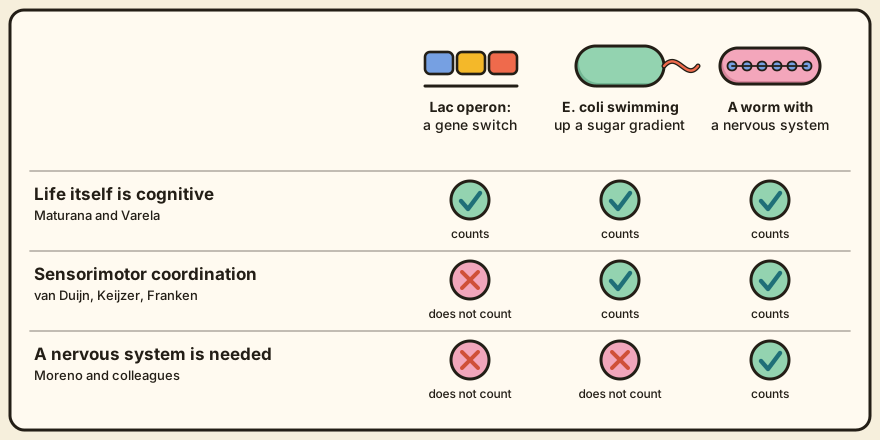
Three lines through one bacterium
The widest line comes from Humberto Maturana and Francisco Varela. They held that every self-producing living system is cognitive, because it keeps its own organization going while it deals with changing surroundings (as described by van Duijn and colleagues). That puts the bacterium inside, and it puts the lac operon inside too, since a gene switch is part of a living cell. Critics say this stretches the word until it's no use. Van Duijn and colleagues quote di Primio and co-authors: "Seeing cognition everywhere is virtually equivalent to seeing it nowhere in particular." inferred That's an argument about usefulness, and no experiment on a cell can check it.
The narrowest line comes from Moreno and collaborators. They treat cognition as a bounded part of biology that needs a nervous system, because a nervous system gives an organism a fast pattern of sensing and moving that's cut loose from slower metabolism. On their reading, a bacterial flagellum turning is still a modification of metabolic paths. The bacterium sits outside, in the company of the lac operon.
The middle line is the one van Duijn, Keijzer and Franken (2006) defend. They put the start of minimal cognition at sensorimotor coordination, and they reason from the two bacterial cases. When the lac operon switches on lactose digestion, the cell changes its own set of chemical reactions, which they call metabolic adaptation. Chemotaxis changes the cell's position in the medium, so the environment is altered at a larger physical scale, which they call a second-order process relative to metabolism. inferred This is their philosophical argument built on well-studied molecular facts. They add that they don't claim bacteria are cognizers in the human sense - nobody is asking a bacterium to do the crossword. Their question is what the biological conditions for cognition are, and they ask it without a brain getting in the way.
More lines through the same cell
Pamela Lyon (2015) starts from a general definition of biological cognition as the set of mechanisms an organism uses to acquire, process, store and act on information. She lists eight capacities that she says bacteria share with animals: sensing, valence, behavior, memory, learning, anticipation, signal integration and communication. observed She reviews the microbiology for each capacity, and we took the list from her summary box without checking the underlying experiments. She also says plainly that cognition is a polysemic term, defined broadly or narrowly according to each investigator's intuitions, and that arguments over bacteria often stall on a request for definitions.
Fermín Fulda (2017) agrees that bacteria are purposive and takes chemotaxis as an example. Then he pulls agency apart from cognition. On his account bacteria are adaptive agents that respond to what their conditions afford them, and they aren't cognitive agents, because cognition involves responsiveness to rational norms and something like beliefs and inferences, and a cell with two modes of swimming has too small a repertoire for that. Run or tumble is a short menu. He calls the minimal-cognition approach of van Duijn and Lyon "revisionist" and argues that it still treats cognition as the primary notion. inferred This is a philosophical argument too. Its premise, that cognition requires something like propositional attitudes, is one that Lyon and van Duijn don't accept.
Fred Keijzer (2021) steps back from the whole contest. He argues that the cognitive sciences have stayed tied to common-sense judgments about which systems have minds, and that this makes the target of study unstable. His proposal is to cut the link between mind and cognition, treat cognition as a changeable scientific concept, and tie it to a material domain, namely living systems and the tools they use to keep their metabolism going. He doesn't offer a definition of cognition. He proposes a research domain and expects the concept to be revised as the domain gets studied, which is a map drawn in pencil on purpose.
One word, five jobs
The positions use the word for different jobs. For Maturana and Varela it names a property of life, and for Moreno and colleagues a kind of mechanism. Van Duijn and colleagues mean a kind of organization, sensing and moving in coordination. Fulda means a kind of explanation, the kind that cites reasons. Keijzer uses it as a label for a field of study. inferred That's our reading, and it's why more experiments on E. coli won't settle the matter. Two researchers can agree on every molecule and still disagree about where the word applies.
Our working line, held loosely
We don't know where the line belongs, and we don't know of any measurement that would show it. For this site we use Lyon's definition as a working tool, because it lets us ask the same question of a bacterium and of an animal, and we expect to revise it. Picking a definition of cognition for a website is a bit like a panchayat voting on when the monsoon will come, so we keep an umbrella handy. Several of the criteria also lean on memory, so the line between memory and plain history-dependence on the D1 page matters here.
What you should be able to do after reading
Apply at least three definitions to the same case and explain why they disagree.
A quick test: take E. coli swimming up a sugar gradient and run it through the criteria of Maturana and Varela, of Moreno and colleagues, and of van Duijn and colleagues, writing a yes or a no for each. Then add Fulda's distinction and say whether the cell is an agent, a cognizer, both or neither. For each disagreement, name what the word is being used to do.
F2 looks at the agency side of this argument, and F3 asks whether cognition needs inner states that stand for things.
You need first
A3 Levels and kinds of explanation
This leads to
F2 Adaptivity, valence, and natural agency
See it at work
References
- van Duijn, M., Keijzer, F., & Franken, D. (2006). Principles of minimal cognition: Casting cognition as sensorimotor coordination. Adaptive Behavior, 14(2), 157-170. doi:10.1177/105971230601400207
- Lyon, P. (2015). The cognitive cell: Bacterial behavior reconsidered. Frontiers in Microbiology, 6, 264. doi:10.3389/fmicb.2015.00264
- Keijzer, F. (2021). Demarcating cognition: the cognitive life sciences. Synthese, 198(Suppl 1), S137-S157. doi:10.1007/s11229-020-02797-8 · free full text
- Fulda, F. C. (2017). Natural agency: The case of bacterial cognition. Journal of the American Philosophical Association, 1-22. doi:10.1017/apa.2017.5