 Cellosophy
Concept F4 · Strand F, Cognition debates
Cognition, subjectivity, sentience, and consciousness
Read first: Competing criteria for minimal cognition, Adaptivity, valence, and natural agency
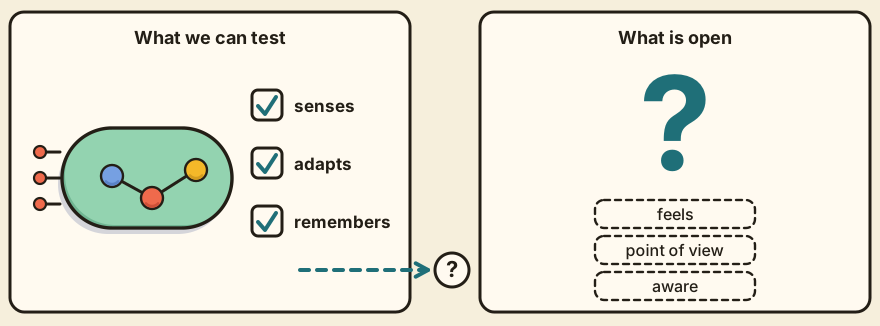
A bacterium swimming up a sugar gradient does something we can describe fully with receptors, a resetting loop and motors, and nobody knows whether it feels anything while it does it. This page lives in the space between what a cell does and what, if anything, it's like to be that cell. We'll use four words. The three papers below show how easily they slide into one another.
Cognition, in the sense of A1, is the adaptive use of information about the surroundings. Sentience is the capacity to feel, which Evan Thompson (2022) takes to include a quality of pleasantness or unpleasantness. Subjectivity means having a point of view, a place from which the world matters to someone. Consciousness is awareness, and it's the slipperiest of the four, because some writers use it for feeling and others for being able to know that you feel. We keep the words apart for a plain reason: evidence for one of them may not carry over to the next.
Life and feeling, born on the same day
František Baluška and Arthur Reber (2019) argue that sentience arrived with the first cells. They describe a prokaryote that finds nutrients as having a feeling of satisfaction, and one that wanders into too much salt as having a negative state that sends it back toward a milder place it remembers. Their main reasoning is evolutionary. A cell with no inner registering of good and bad, they say, would need every adaptive behaviour written into its DNA with no sense behind it, and they judge that less likely than sentience showing up along with life. inferred They reject Daniel Dennett's reading of such cells as competent without comprehension, because in their view it adds nothing to a list of what prokaryotes can do.
They also offer three places to look for a physical basis - excitable membranes, the vibrating cytoskeleton and flexible proteins with quasi-crystal properties - and they say it's an empirical question whether any of these is involved. Part of their evidence is that anaesthetics which switch off consciousness in people also stop responses in animals, plants and some single-celled organisms. observed Thompson reports a reply from Draguhn, Mallatt and Robinson (2020), who point out that anaesthetics affect behaviour in many ways, so a loss of response need not mean a loss of feeling. We haven't read that reply.
A missing step in the middle
Thompson (2022) asks whether the enactive view of life implies that all life is sentient. On that view, set out by Maturana, Varela and Di Paolo, a cell is a self-producing network that keeps itself within the edge of its viability, so it responds to conditions as good or bad for it. Thompson calls this sense-making. He gives the view its due. He grants that a plausible case can be made for linking sense-making to feeling, and he describes how Hans Jonas tied metabolism under threat to a kind of concern for continuing, and how Weber and Varela later wrote of a subjective dimension even in the simplest organisms.
His objection is that nobody supplies the step in between.
Why couldn't there be agents that respond to conditions as good or bad for survival without feeling anything at all?
That's his question, and Jonas, Weber and Varela don't answer it. He reads Lynn Margulis's claim that every cell is conscious as either a conviction or a use of the word that makes it mean responsiveness. He puts Baluška and Reber through the same test. The evidence for bacteria is behavioural and structural, and an inference to the best explanation needs a reason why feeling explains it better than behaviour without feeling does. inferred This is philosophical analysis of what follows from what, and it settles nothing by measurement.
Thompson is just as careful with the opposite view, that only animals feel. He says the three reasons he gave for it in 2007 no longer seem compelling to him, and he concludes that the case for it is also inconclusive. He also sets out a different argument, that we can only recognise life through our own feeling of being alive. If you accept it, it would justify extending feeling to all life. He says plainly that this isn't a scientific argument, and he leaves the scientific questions open.
Godfrey-Smith draws two cartoons
Peter Godfrey-Smith (2016) treats a self-producing cell, with a boundary, a metabolism and traffic with its surroundings, as subject-like in a first and minimal sense. He then asks how cognition might relate to experience in a richer sense, and he sketches two pictures. In one, experience is simply cognition seen from the inside, so it thins out gradually in simpler organisms. In the other, only some cognitive capacities have an experienced side, so there would be a threshold and then a long sliver. inferred He calls both cartoons and expects the truth to lie somewhere between them.
He suggests that some old capacities may be the relevant ones, such as keeping track of the sensory effects of your own movement, and the internal handling of valence in reward and learning. He also notes that it's tempting to treat cognition as graded and experience as yes or no, and that this habit may be misleading. On which picture is right, he writes that he doesn't know. We like him for that.
What we don't know, in both directions
We don't know whether any single cell feels. We have no agreed test, and the three papers disagree about what would count as one: Baluška and Reber read sensing and flexible behaviour as showing feeling, Thompson says that step hasn't been argued, and Godfrey-Smith says the link between cognition and experience could take more than one shape. We also don't know that bacteria lack feeling. The question stays open both ways.
What we use as a working tool is a division of labour among the words. Cognition, defined as in A1, is what we can test in a cell. Sentience, subjectivity and consciousness are left as open questions that the evidence on this site doesn't settle - we're a website, after all, and the problem of consciousness has outlasted better institutions. F1 compares the criteria for cognition, and F2 looks at valence and agency, which is where the bridge toward feeling usually gets built.
What you should be able to do after reading
Show why evidence for one category does not automatically establish the others.
A quick test: take chemotaxis in E. coli and list what has been observed, such as sensing a gradient, adapting and steering. For each of the four words, say what the observations support without any extra assumption, and then write down the extra assumption you'd need to reach each remaining word. Compare your assumptions with how Baluška and Reber, Thompson and Godfrey-Smith each make or decline that step.
You need first
This leads to
See it at work
References
- Baluška, F., & Reber, A. (2019). Sentience and consciousness in single cells: How the first minds emerged in unicellular species. BioEssays, 41, 1800229. doi:10.1002/bies.201800229
- Thompson, E. (2022). Could all life be sentient?. Journal of Consciousness Studies, 29(3-4), 229-265. doi:10.53765/20512201.29.3.229
- Godfrey-Smith, P. (2016). Individuality, subjectivity, and minimal cognition. Biology & Philosophy, 31(6), 775-796. doi:10.1007/s10539-016-9543-1