 Cellosophy
Concept F2 · Strand F, Cognition debates
Adaptivity, valence, and natural agency
Read first: Viability and organism-relative normativity, Sensorimotor behavior in a changing environment, Competing criteria for minimal cognition
A bacterium swimming up a sugar gradient can be described in two ways, and both are true. In one, the sugar acts on the cell: molecules bind receptors and the signal passes through the cell to the motor. In the other, the cell acts on its own position, and so changes what sugar it meets next. Ezequiel Di Paolo (2005) argued that the second description picks out something the first one can't, and that the difference matters for what we mean by behavior, value and agency.
That's a lot to hang on one swimming cell. Let's see if it holds.
When self-production runs out of things to say
Di Paolo starts from autopoiesis, the theory that a living system is a network of processes that keeps producing its own parts and its own boundary. Weber and Varela (2002) had proposed that such a system already has a point of view on the world, because encounters that help or harm its self-production matter to it. Di Paolo grants that the idea is promising. Then he finds a gap in it. inferred This is a conceptual argument, and no experiment stands behind it.
The gap is in how the theory treats encounters. In the original formulation a system either keeps its organization or disintegrates, and an encounter that perturbs the system without destroying it is called structural coupling. Di Paolo points out that this hands you only an all-or-nothing norm. Balancing on the edge of a cliff and falling off the edge both conserve the organization - only the landing is bad. So a bacterium sitting in a sugar concentration that already keeps it alive is, by that definition, no better off in a higher concentration, and autopoiesis alone gives it no reason to swim uphill.
If the cell is already alive and fed, why should it bother to swim anywhere?
Adaptivity, or steering the coupling you can't escape
His remedy is adaptivity. In his definition, a system is adaptive when it can regulate its own states and its relation to the environment so that, near the boundary of what it can survive, it tells apart tendencies that approach the boundary from tendencies that recede from it, and acts to turn the first kind into the second. That's a mouthful. It comes down to two things held together, self-monitoring and a fitting response. Either one alone fails, because monitoring with no response is useless, and a response with no monitoring is disconnected from any state of the system. He argues that this gives a graded norm, with good, neutral and bad ways of staying alive, and that's where talk of valence, in the sense of attraction and rejection, finally gets a physical footing. inferred
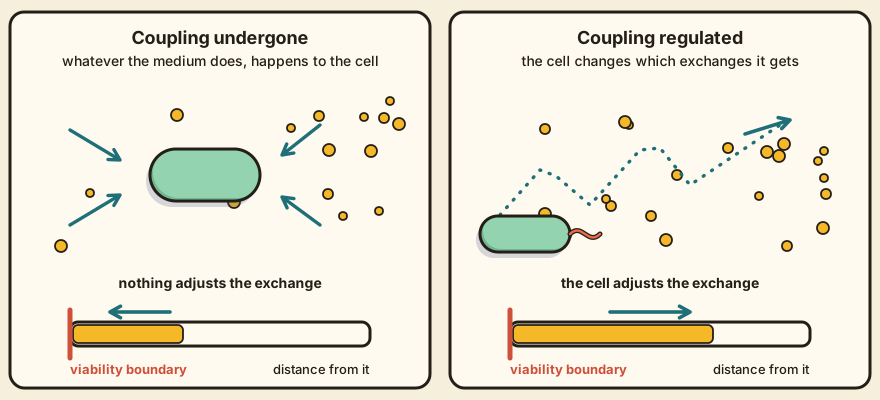
The same move gives him an account of behavior. Structural coupling, he says, is an ongoing happening, the outcome of every non-lethal encounter. Only the regulation of that coupling deserves the name behavior, because the organism does it and doesn't merely undergo it. He puts the contrast as suffering an exchange against controlling and selecting which exchanges to suffer. Not a bad job description for a bacterium. A system that regulates its coupling for the sake of its own viability is, in his terms, an agent. He adds a warning: a feedback loop on its own, such as a closed sensorimotor circuit, can look purposive without generating its own norm, because the norm in that case comes from outside. inferred
Putting chemotaxis on the stand
The case fits the definition in some ways. The cell's tumble rate shifts with recent conditions, through a fast signaling pathway and a slower methylation pathway (van Duijn, Keijzer and Franken, 2006). observed The structural coupling is the binding of attractant to receptors, which happens to the cell whatever it does. The regulated part is the tilt in tumbling frequency, which changes where the cell goes.
Whether it meets Di Paolo's full definition is murkier. His definition asks for a response that depends on how near the cell's states are to its viability boundary. The chemotaxis pathway, as the papers we read describe it, reads out the recent change in receptor occupancy. None of them shows whether its output also depends on the cell's own energetic state. inferred We don't know whether it does in the sense Di Paolo needs. To say, we'd need the pathway's output measured against the cell's internal condition.
Same bacterium, a different kind of agent
Fermín Fulda (2017) also treats bacteria as agents, by a different road, and he takes aim at the enactive tradition that Di Paolo's paper belongs to. His claim is that bacteria are adaptive agents and not cognitive agents. For him, agency is the gross capacity of an organism to bias its repertoire according to what its conditions afford for reaching its goals. Glucose affords food to a bacterium that can digest it, and the bacterium swims toward it because it's edible. Fulda says this kind of agency can't be defined by internal mechanism, only by the pattern of the whole organism-environment system, and that it doesn't need cognition. inferred
His criticism comes in two parts. Accounts built on self-maintaining, autonomous systems, he argues, collapse into mechanism, because they define goals as effects of self-maintenance. Enactivism, which he links to Di Paolo (2005) among others, adds sense-making on top, and Fulda finds that this rests on a first-person starting point, taken from Hans Jonas, that sits uneasily with scientific naturalism. Di Paolo himself notes that Jonas's step from metabolism to concern rests partly on intuition, and he proposes a back-and-forth between science and experience as the remedy. Whether that remedy is enough is part of what the two authors disagree about.
They also differ on where agency lives. Di Paolo says that checking for it means looking into the organization of the system, its self-generated structure of sense-making. Fulda says agency is defined by ecological pattern and not by inner workings. Inside the cell or out in the world - the two of them give agency different addresses. We use Di Paolo's distinction between undergoing and regulating coupling as a working tool, because it tells us what to look for in a cell. Whether agent is the right word for what we find, we don't take a side.
What you should be able to do after reading
Explain the difference between structural coupling and the regulation of structural coupling, then test it on chemotaxis.
A quick test: describe one tumble-frequency change twice, first as something that happens to the cell and then as something the cell does. Then write down what you'd have to measure to show that the cell's response depends on how close its states are to its viability boundary, for example by starving it or adding a toxin while the gradient stays fixed. That experiment is our suggestion and doesn't come from a published paper. F4 takes up the next question, which is what, if anything, such a norm has to do with experience.
You need first
B5 Viability and organism-relative normativity
This leads to
See it at work
References
- Di Paolo, E. A. (2005). Autopoiesis, adaptivity, teleology, agency. Phenomenology and the Cognitive Sciences, 4, 429-452. doi:10.1007/s11097-005-9002-y
- Fulda, F. C. (2017). Natural agency: The case of bacterial cognition. Journal of the American Philosophical Association, 1-22. doi:10.1017/apa.2017.5
- van Duijn, M., Keijzer, F., & Franken, D. (2006). Principles of minimal cognition: Casting cognition as sensorimotor coordination. Adaptive Behavior, 14(2), 157-170. doi:10.1177/105971230601400207