 Cellosophy
Concept F3 · Strand F, Cognition debates
Representation, computation, and dynamical alternatives
Read first: Information, gain, and dynamic range, Competing criteria for minimal cognition
We say a bacterium remembers the sugar level and computes the gradient, and nobody blinks. Then comes a third verb, represents, and the fight starts. The first two verbs have measurements behind them. The third asks whether a state inside the cell stands for something outside it, and the answer depends on what we ask of the word.
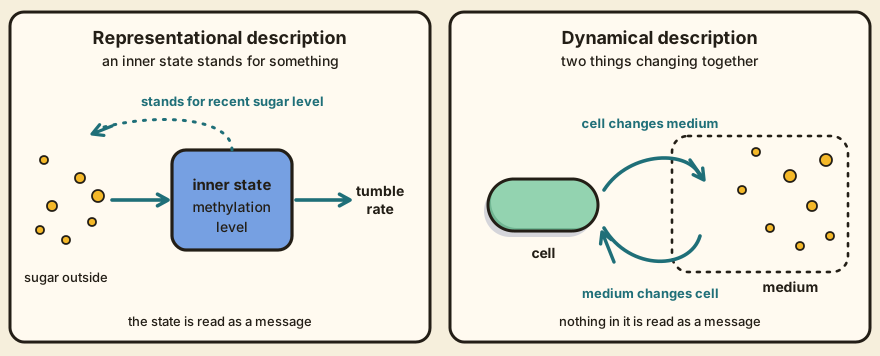
The test case is the adapted state of the chemotaxis pathway in E. coli. When a cell sits in a steady attractant level, the methylation level of its receptors settles to a value that balances that level, and the receptors drift back to their resting activity. Lan and Tu (2016) write the standard model as two equations: receptor activity depends on the ligand level and on the methylation level, and the methylation level changes at a rate that depends on activity. modeled The form of the second equation was reverse-engineered from measurements of how cells respond to ramps of attractant, so the model stands on experiments. Both of the descriptions below fit these equations. inferred
The cell as a small, specialized computer
Lan and Tu say that at the adapted state the methylation level "provides a measure (an internal representation)" of the external stimulus. At low frequencies, they say, the pathway computes the time derivative of the signal, because the methylation variable has time to record the stimulus. modeled In a loose sense, they add, the pathway can be called a probabilistic Turing machine, with the ligand level laid out as a tape, the receptors as a reading head and the methylation level as the machine's state. Turing in a bacterium - we'd be lying if we said we didn't enjoy that. The cell is under no pressure to be a general-purpose computer, though, and the task here is specific, which is to compute the gradient. And the adapted state isn't free. They report that it's held away from equilibrium by a continuing methylation-demethylation cycle, and that there's a tradeoff between the power spent and how fast and accurately the cell adapts. modeled
Tecumseh Fitch (2021) widens the claim from one pathway to cells in general. He argues that any cell, whether in liver, kidney or brain, is a complex computer at the genetic and molecular level, and he cites the lac operon as an if-then circuit going back to Jacob and Monod. He lists at least five stores of information in a cell, among them protein phosphorylation, gene transcription and cell shape, and gives order-of-magnitude estimates for their capacity and cost, including about one ATP for a one-bit methylation event. modeled His purpose is to account for the evolution of neural computation and its energy cost, and he doesn't discuss representation at all. A stronger version of the view is reported by Fulda (2017), who quotes Perkins and Swain describing the chemotaxis network as performing real-time inference about the state of its environment. We haven't read that paper.
Lan and Tu also mark a limit. Information-theory measures such as mutual information show how tightly an output depends on an input, and they don't reveal the mechanism, nor which information matters to the organism. That bears on the case for representation, because a strong dependence between a state and the world is a correlation, and a representation is usually taken to need more than that. inferred
The cell and its medium, changing together
Van Duijn, Keijzer and Franken (2006) read the same pathway another way. They call the methylation pathway a molecular form of memory and describe the receptors' methyl level as carrying information about conditions a few seconds earlier. Then comes the turn: an understanding built only in computational terms would be incomplete, because chemotaxis can only be fully understood as situated in the cell's surroundings. Minimal cognition, on their account, is a reciprocity between organism and environment that is meaningless if viewed at a single moment. Di Paolo (2005) reports that autopoietic theory goes further and concludes that cognizers can't make use of internal representations. inferred
Lachlan Walmsley (2020) presents radical enactivism, the position held by Daniel Hutto and Erik Myin, which treats cognition as dynamic, extensive and non-representational. He takes that position as given. His question is whether modelers working in that spirit may still build mechanistic models. He argues that they may, and he builds the case on an agent-based model of the slime mold Physarum, a single cell that forms networks without a brain. In that model, particle-like agents stand for units of the cell's gel and sol and follow simple rules for sensing and moving. modeled For explanations of this radical kind, Walmsley notes, model components can't be read as mental representations except under rare conditions, when the agent has been raised in a linguistic community with norms of truth. inferred A slime mold raised in a linguistic community is a novel we'd like to read, but it isn't on the shelf yet.
Two camps, maybe three meanings
The two camps may not mean the same thing by the word. Lan and Tu use "representation" for a measure of the stimulus held in an internal variable. Walmsley's radical enactivists use it for contentful states of the kind that need a language community. inferred If that's right, part of the dispute is about the word, and the other part is about whether a bare internal measure deserves to be called by it. Walmsley's own use of "represent" for the model's parts shows a third sense, a scientist's model standing for a cell.
What would the cell have to do differently for "represents" to earn its keep?
We don't know of an experiment that separates the two descriptions of E. coli. Both give the same equations and the same swimming. A discriminating test would first need a criterion for representation fixed in advance, and then a case where the representational description predicts something the dynamical one doesn't. One candidate, which is our suggestion and doesn't come from these papers, is a state that is consulted for something other than the current coupling, such as a second downstream process reading the same variable. None of the papers we read reports such a case. For now we use "computation" and "inner state" as working tools, because they let us ask about energy and accuracy. "Represents" stays open.
What you should be able to do after reading
Construct representational and nonrepresentational accounts of one behavior and propose a discriminating test.
A quick test: write two paragraphs about the adapted methylation level, one that says what it stands for and one that describes only the coupled change of cell and medium. Underline every claim that shows up in only one paragraph. If you find none, say what extra evidence would have to exist for one of them to need a claim the other lacks.
This leads to
See it at work
References
- Lan, G., & Tu, Y. (2016). Information processing in bacteria: memory, computation, and statistical physics. Reports on Progress in Physics, 79, 052601. doi:10.1088/0034-4885/79/5/052601
- Fitch, W. T. (2021). Information and the single cell. Current Opinion in Neurobiology, 71, 150-157. doi:10.1016/j.conb.2021.10.004
- van Duijn, M., Keijzer, F., & Franken, D. (2006). Principles of minimal cognition: Casting cognition as sensorimotor coordination. Adaptive Behavior, 14(2), 157-170. doi:10.1177/105971230601400207
- Walmsley, L. D. (2020). Lessons from a virtual slime: Marginal mechanisms, minimal cognition and radical enactivism. Adaptive Behavior, 28(6), 453-464. doi:10.1177/1059712318824544
- Di Paolo, E. A. (2005). Autopoiesis, adaptivity, teleology, agency. Phenomenology and the Cognitive Sciences, 4, 429-452. doi:10.1007/s11097-005-9002-y