 Cellosophy
Concept C6 · Strand C, Sensing and action
Information, gain, and dynamic range
Read first: Noise and limits of molecular sensing, Receptors and signal transduction, Adaptation and integral feedback
A signaling pathway is a measuring device, and three numbers tell you how good it is. Gain says how steeply the output rises when the input changes a little. Dynamic range says over how many inputs the output keeps responding at all. Information, counted in bits, says how many different inputs the cell could tell apart once noise has had its say. Each number answers its own question, and a pathway can ace one while flunking another.
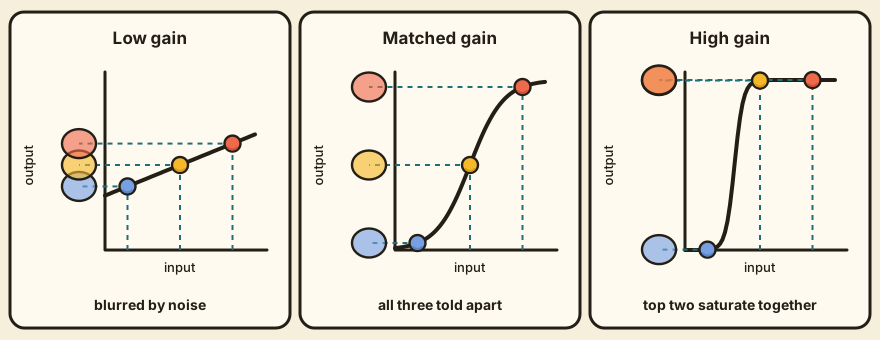
One curve, three questions, and the noise none of them mention
Take the dose-response curve of a receptor, with the concentration of attractant along one axis and the receptor's activity up the other. Gain is the slope of that curve at a given input. Dynamic range is the stretch of the input axis where the slope is clearly above zero, because below it the receptors are mostly off and above it they're saturated. Micali and Endres (2016) note that a steep curve gives amplification but lets large inputs saturate the response, while low gain shrinks the span of outputs. modeled Steep is good until it isn't.
Neither number says a word about noise, and noise is what actually limits a cell. Rhee, Cheong and Levchenko (2012) point out that identical cells given the same stimulus give a spread of responses. If the spread for a weak stimulus overlaps the spread for a strong one, a cell that lands in the overlap can't tell which stimulus it met. modeled Mutual information measures how much that overlap costs. Their primer uses a phone call: a friend reports a fair coin flip, which holds 1 bit, and if the line garbles 25 percent of the reports, only 0.19 bits get through. A fair die holds 2.59 bits, so a channel with two possible outputs can never carry it fully - you can't fit six faces through a yes-or-no door.
The most information a pathway can carry, over every input distribution one might try, is its channel capacity. You can estimate it from inputs and outputs alone, without knowing anything about the mechanism, which is either a blessing or a warning depending on your temperament.
Bits that someone has actually measured
The review reports two examples. Tkacik and colleagues used earlier data from Gregor and colleagues, who measured the transcription factors bicoid and hunchback in many fruit fly embryos at once. They estimated that 1.5 ± 0.2 bits of positional information pass from one protein to the other. One bit is enough to say front half or back half, so the channel is wide enough for that decision. observed
The second is the authors' own work on the inflammatory signal TNF. Each of two downstream pathways, to NF-kB and to ATF-2, carries about 0.9 bits about the TNF concentration, and the two together carry about 1.0 bit. The capacity at the TNF receptor is already only about 1.25 bits. observed Since later steps can only lose information, they conclude that the receptor is an early bottleneck. inferred The narrowest point of the pipe sits right at the front door.
Gain and range in a swimming bacterium
Micali and Endres (2016) review how Escherichia coli handles all three. They report that adaptation lets the cell measure relative changes instead of absolute levels, and that precise adaptation together with amplification by cooperative receptors lets the cell chemotax over a wide range of concentrations. observed This is where C5 comes in. Adaptation slides the working range along the concentration axis as the background changes, like a camera that keeps resetting its exposure.
Clausznitzer and colleagues (2014) analyzed FRET measurements of receptor activity in cells adapted to backgrounds from zero to 2 millimolar of the attractant MeAsp. The step needed to produce a small fixed response grew in proportion to the background. For a response of 8 percent of the adapted activity, the fitted slope was 0.054, which means a step of about 5 percent of the background. observed Psychologists will recognize the shape: it's Weber's law, in a bacterium.
They then assumed that the pathway has been shaped to transmit as much information as possible, and used the measured noise to work backward to the gradients a cell should meet. The prediction was broad distributions of exponential gradients. They also found that in their model, maximizing information maximizes the speed at which cells drift up a gradient. modeled Nobody has measured the gradients in the gut, so this is untested.
The far end of the pathway sets a limit too. Micali and Endres note that a single flagellar motor switches between clockwise and counterclockwise rotation with a Hill coefficient of up to 20, which is a very steep curve. That steepness may cap the information passed on at about one bit. They also note that E. coli has several motors, which might average out the switching noise. inferred
What the numbers can't settle
Capacity is a ceiling, and a ceiling says little about how a room gets used. Rhee and colleagues note that the natural frequency of each stimulus is usually unknown, so a capacity measured with a laboratory set of inputs doesn't tell us how many bits the cell moves in daily life. They also warn against reading much into the input distribution that maximizes information, since many give nearly the same value.
Estimates can mislead in both directions. A small data sample biases the measured information upward, while experimental noise pushes the measured capacity downward. For a single input and a single output, Rhee and colleagues suggest at least about 20 responses for each distinct stimulus.
A bit also comes with no meaning attached. In this accounting the identity of a state is irrelevant, so 1.5 bits in a fly embryo and in a bacterium are the same quantity whatever the cell does with them. Performance enters only when we know the decision. For the fly it's a single front-or-back choice. For chemotaxis, Rhee and colleagues describe a model by Andrews and Iglesias in which an amoeba that keeps its heading needs less information about the gradient than one that doesn't. modeled
Has E. coli been tuned to squeeze the most bits out of its world?
We don't know, and neither does anyone else yet. Micali and Endres say "The debate has just started." In Clausznitzer's model, high information and fast drift go together, so measurements of the pathway alone may not tell them apart. Micali and Endres add that in theory information has an energy price, and that responding to a step costs about a tenth of what the cell spends holding its steady state. modeled
What you should be able to do after reading
Interpret what information measures do and don't establish about organismal performance.
A quick test: suppose a paper reports that a pathway has a capacity of 1.0 bit. Write down which decision the cell makes with it and whether one bit is enough for that decision. Then list what you'd still want to know before saying the cell performs well, such as the natural stimulus distribution and whether a later step loses more. C7 puts gain and range to work in a swimming cell, where bits finally have to pay rent.
This leads to
C7 Sensorimotor behavior in a changing environment
See it at work
References
- Rhee, A., Cheong, R., & Levchenko, A. (2012). The application of information theory to biochemical signaling systems. Physical Biology, 9(4), 045011. doi:10.1088/1478-3975/9/4/045011
- Micali, G., & Endres, R. G. (2016). Bacterial chemotaxis: information processing, thermodynamics, and behavior. Current Opinion in Microbiology, 30, 8-15. doi:10.1016/j.mib.2015.12.001
- Clausznitzer, D., Micali, G., Neumann, S., Sourjik, V., & Endres, R. G. (2014). Predicting chemical environments of bacteria from receptor signaling. PLOS Computational Biology, 10(10), e1003870. doi:10.1371/journal.pcbi.1003870