 Cellosophy
Concept E2 · Strand E, Collectives
Quorum sensing and density-dependent action
Read first: Signal, cue, by-product, and communication, Information, gain, and dynamic range
Quorum sensing lets a bacterium switch genes on once a chemical that it and its neighbors release has built up past a threshold. It's usually described as a head count. That shortcut works in a well-stirred test tube and fails in many of the places bacteria actually live, and the reasons tell us a good deal about what the cell is measuring.
If the cells aren't counting each other, what exactly are they counting?
One circuit, taken apart slowly
Miller and Bassler (2001) review the circuits in detail. The best studied is the light system of Vibrio fischeri, which lives at very high density in the light organs of animals such as the squid Euprymna scolopes. The LuxI protein makes a small acylated homoserine lactone. The molecule diffuses freely across the cell membrane, so its concentration outside matches its concentration inside. At low density the genes for light and for LuxI are read at a low basal rate and little molecule gets made. As the culture grows the molecule piles up until the LuxR protein binds it, which unmasks the DNA-binding domain of LuxR. The LuxR complex then binds the promoter of the luxICDABE operon and switches it on, and both molecule production and light rise steeply. observed That's a positive feedback loop, because hearing the molecule makes the cell say it louder.
The same complex also represses the luxR gene, a negative loop that Miller and Bassler describe as compensating for the positive one - an accelerator with a brake bolted on. observed They predict that the light organ is the only niche where the molecule piles up enough to act as a signal, since the host's organ holds the cells and the molecule together. inferred The squid, on this reading, supplies the room in which the conversation can be heard.
Pseudomonas aeruginosa has two such pairs, LasI with LasR and RhlI with RhlR, and the Las complex switches on both its own synthase gene and the rhlR gene. The Las molecule also blocks the Rhl molecule from binding RhlR, which Miller and Bassler read as a way of making the two systems start in order. inferred Mutants lacking lasI stop biofilm growth at the microcolony stage, and adding the Las molecule restores a normal biofilm. observed
Not every circuit is built the same way. Bridges and colleagues (2022) report that the V. harveyi and V. cholerae circuits contain only indirect positive loops, in which two master regulators repress each other, and they read the scarcity of positive feedback as a sign that noise reduction is favored over sensitivity. inferred
Counting heads in a river
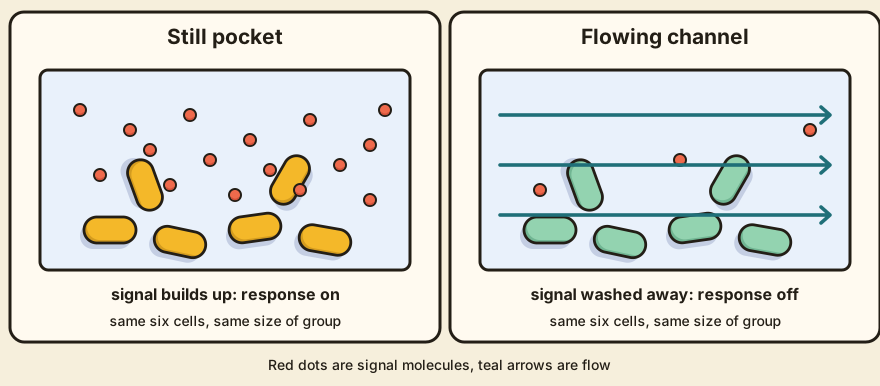
Mukherjee and Bassler (2019) point out that most of what we know came from well-mixed pure cultures, where concentration and cell number rise together. That's the test tube, and most of the world doesn't look like one. In nature the molecule can be swept away, trapped or slowed. Fluid flow removes autoinducers by advection, and the review reports that the amount of biomass needed to start quorum sensing rises as the flow rate rises. observed That's the left and right of Figure 1.
The effects can run against intuition. In V. cholerae and Staphylococcus aureus, quorum sensing represses biofilm formation, so washing the molecule away lifts the repression, and the studies they cite found more biofilm under flow than without it. observed In a microfluidic channel a S. aureus reporter was fully repressed under steady flow, rose in a straight line without flow, and rose in steps when flow came and went. observed In a channel about 0.3 meters long, quorum sensing was repressed near the inlet and strongly on near the outlet, and P. aeruginosa in such a channel was motile upstream and formed biofilm downstream. observed Same genes, same channel, two ways of life, sorted by where a cell happens to sit. Cells inside crypt-like cavities that shield them from flow switched on while cells outside didn't. observed
Distance and thickness matter too. In a viscous medium made to mimic cystic fibrosis sputum, P. aeruginosa clusters of about 2,000 cells failed to communicate with other clusters, while clusters of more than 5,000 cells did so across hundreds of micrometers. observed The reasonable reading, which the authors state, is that a diffusion-limited molecule has to reach a higher concentration to be heard farther away. inferred
So the cell is detecting the concentration of a molecule at its own address, and that depends on how many cells make it, how fast it leaves and how fast it's replaced. Density is one cause of that concentration. E1 noted that Williams and colleagues call this diffusion sensing.
Neighbors who don't get the memo
The textbook picture has every cell switching together, like a stadium doing the wave. Mukherjee and Bassler review cases where they don't. In Pseudomonas putida microcolonies only a subset of cells makes autoinducer, and the producers don't induce their neighbors. observed In P. aeruginosa confined in tiny volumes, a LasR reporter turned on with as few as one to three cells present, yet not every cell in the volume lit up. observed Current models explain this with a bistable circuit in which synthase production is repressed below a threshold and boosted above it, plus noise in the synthase gene. modeled The authors say the mechanisms aren't defined in most cases. D6 asks how identical cells come to differ, and this is one setting for that question.
What we don't know yet
We don't know how quorum sensing behaves under fluctuating flow in clinical or industrial settings, because Mukherjee and Bassler say further study is needed there. We don't know whether the bet-hedging models of heterogeneity are right, since they say follow-up experiments are necessary. And we don't know how common the strong positive loop of V. fischeri is, since the vibrios lack it. Between release and detection the molecule is at the mercy of physics that changes from place to place.
What you should be able to do after reading
Explain signal production, reception, feedback, and environmental transport without treating density as directly measured.
A quick test: draw the V. fischeri circuit with its production step, its receptor step, the positive loop and the negative loop. Then put the cells in a channel with steady flow and write what happens to the concentration of the molecule, and what the cells' gene expression now tells you about their number. If your answer still says the cells counted each other, go back to the river.
E3 asks how groups act together when quorum sensing is only one of the routes.
You need first
This leads to
See it at work
References
- Miller, M. B., & Bassler, B. L. (2001). Quorum sensing in bacteria. Annual Review of Microbiology, 55, 165-199. doi:10.1146/annurev.micro.55.1.165
- Mukherjee, S., & Bassler, B. L. (2019). Bacterial quorum sensing in complex and dynamically changing environments. Nature Reviews Microbiology, 17(6), 371-382. doi:10.1038/s41579-019-0186-5
- Bridges, A. A., Prentice, J. A., Wingreen, N. S., & Bassler, B. L. (2022). Signal transduction network principles underlying bacterial collective behaviors. Annual Review of Microbiology, 76, 235-257. doi:10.1146/annurev-micro-042922-122020