 Cellosophy
Concept E1 · Strand E, Collectives
Signal, cue, by-product, and communication
Read first: Receptors and signal transduction, Levels and kinds of explanation
A bacterium releases a molecule, a neighbor changes what it does, and it's tempting to call the molecule a signal and the exchange communication. Those two words make a claim about why the molecule exists and who gains from it, and chemistry alone can't settle that. The claim needs evidence of its own.
The best-worked case is a small marine bacterium. Schauder and Bassler (2001) reviewed how bacteria release, detect and respond to molecules they call autoinducers, and they describe the whole business in the vocabulary of language. In Vibrio fischeri, which lives in the light organs of some animals, the LuxI protein makes an acylated homoserine lactone that diffuses freely across the cell membrane. At high cell number the molecule reaches a concentration at which the LuxR protein binds it and switches on the genes for light. observed Engebrecht and Silverman worked out that circuit, and Schauder and Bassler report similar pairs in over 25 Gram-negative species.
Who is talking to whom here, and does anyone mean it?
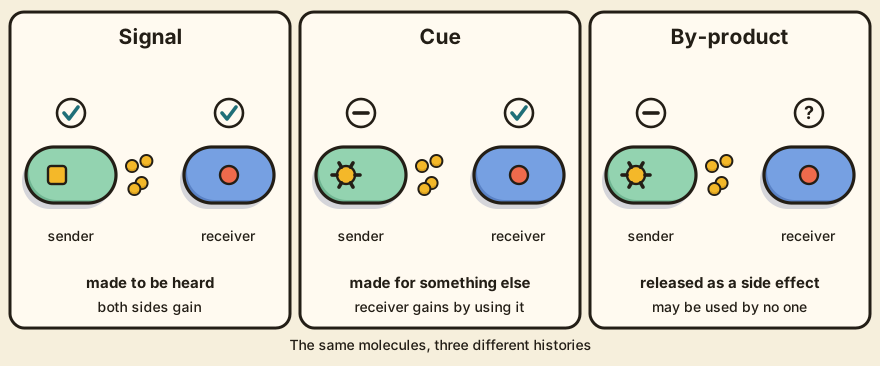
One molecule, three possible pasts
A molecule that crosses from one cell to another can have at least three histories. Diggle, Crusz and Cámara (2007) give a two-part test for a true signal: it should benefit the receiver to respond, and the response should benefit the producer. If only the receiver gains, the molecule is a cue, something a receiver may use to guide a later action. If the producer gains and the receiver is harmed, the receiver has been coerced, and that also falls short of true signalling. inferred That's their argument, and they say that working out which kind of interaction a given system shows is one of the challenges for the field. A by-product is a third case. The molecule is released because of something else the cell is doing - exhaust, more or less - and whether anyone uses it is a separate question.
Sorting an interaction this way takes two kinds of evidence. The mechanistic kind tells you what the molecule is, which enzyme makes it, which receptor binds it and what changes in the receiver. The evolutionary kind tells you why the trait is there, which means asking what each side gains and whether selection has shaped the production, the response, or both. A3 drew the same line between how something works and why it exists. Schauder and Bassler's review is full of the first kind of evidence and offers mostly plausible arguments for the second.
AI-2, a lingua franca or a leak
The sharpest example is autoinducer-2, or AI-2. Schauder and Bassler report that Vibrio harveyi makes two autoinducers, an acyl homoserine lactone called AI-1 and a second molecule, AI-2, whose synthesis depends on the enzyme LuxS. Using reporter strains that respond to only one of the two, they found that many species produce AI-2 activity and very few produce AI-1 activity. observed They propose that AI-1 serves for talk within a species and AI-2 for talk between species. inferred Call it bacterial Esperanto, if you like. The chemistry behind the proposal is solid. Purified E. coli Pfs enzyme combined with LuxS from five different bacteria gave AI-2 of identical specific activity, which suggests AI-2 is the same molecule in every species. observed
The same chemistry raises the by-product question. LuxS belongs to the activated methyl cycle, a pathway that clears away a toxic leftover of the cell's methylation reactions and recycles homocysteine - housekeeping, in other words. Williams and colleagues (2007) describe LuxS forming DPD, the precursor of AI-2, as a by-product of that cycle, at one molecule per methylation event. observed Schauder and Bassler themselves suggest that the original job of AI-2 may have been to regulate some general metabolic process, and that this may still be so in many species. inferred
Williams and colleagues add that most studies of AI-2 signalling had offered only indirect or incomplete evidence, because deleting luxS upsets metabolism as well as AI-2 production. You can't switch off the voice without also switching off the plumbing. They report that AI-2 made from synthetic DPD didn't restore biofilm formation in a Salmonella typhimurium luxS mutant, while putting luxS back under its own promoter did. observed They also report two studies of E. coli that disagree. One found data consistent with LuxS as a metabolic enzyme and not with AI-2 as a true signal in strain W3110, and the other proposed that AI-2 changes biofilm and motility in strain MG1655. In their words, terms such as communication and signal molecule have often been "used uncritically."
So for most species we don't know whether AI-2 is a signal, a cue or a by-product. The answer may differ from one species to the next.
The molecule also tells you where you are
Williams and colleagues raise one more complication. They suggest that quorum sensing is better seen as a special case of diffusion sensing, an idea they credit to Rosemary Redfield, because the amount of molecule in the surroundings depends on how fast it's made and lost where the cell sits. They cite a single Staphylococcus aureus cell, trapped in an endosome of a human cell, that switched to the quorate state. observed A quorum of one. E2 takes this up. For now it shows that a molecule can be a good signal for the producer and still tell the receiver about the place, so the three categories describe history and leave open what the receiver learns.
Other parties get in on the act too. Schauder and Bassler describe a Bacillus subtilis enzyme, AiiA, that inactivates the homoserine lactone of the plant bacterium Erwinia carotovora. observed Some listeners eavesdrop, and this one cuts the line.
What you should be able to do after reading
Classify an interaction and identify the evolutionary and mechanistic evidence required for communication.
A quick test: pick the V. fischeri molecule or AI-2. Write down the mechanistic evidence you'd want, such as the synthase, the receptor, and a response that disappears when the synthase is deleted and comes back when the molecule is added back. Then write down the evolutionary evidence: who gains from producing it, who gains from responding, and whether selection keeps either one in place. Say which of the three categories you can defend and what's still missing.
E2 asks what quorum sensing actually measures, once we know the molecule is a signal.
This leads to
See it at work
References
- Schauder, S., & Bassler, B. L. (2001). The languages of bacteria. Genes & Development, 15(12), 1468-1480. doi:10.1101/gad.899601
- Williams, P., Winzer, K., Chan, W. C., & Cámara, M. (2007). Look who's talking: communication and quorum sensing in the bacterial world. Philosophical Transactions of the Royal Society B, 362(1483), 1119-1134. doi:10.1098/rstb.2007.2039
- Diggle, S. P., Crusz, S. A., & Cámara, M. (2007). Quorum sensing. Current Biology, 17(21), R907-R910. doi:10.1016/j.cub.2007.08.045