 Cellosophy
Concept A3 · Strand A, Orientation
Levels and kinds of explanation
Read first: Starting from cells to explain minds
A single sentence about a cell can carry five different claims at once, and much of the shouting over whether cells have minds comes from treating them as one. Take "this bacterium chooses the richer sugar." It says something about what the cell was seen to do, something about how its parts do it, something about what that does for the cell, something about how the trait came to exist, and, through the word "chooses", something about what sort of process this is. Each of those gets checked in a different way, and each can be wrong while the others stand. We use this split as a working tool, and the five labels are ours. Neither paper below lists them in this form. inferred
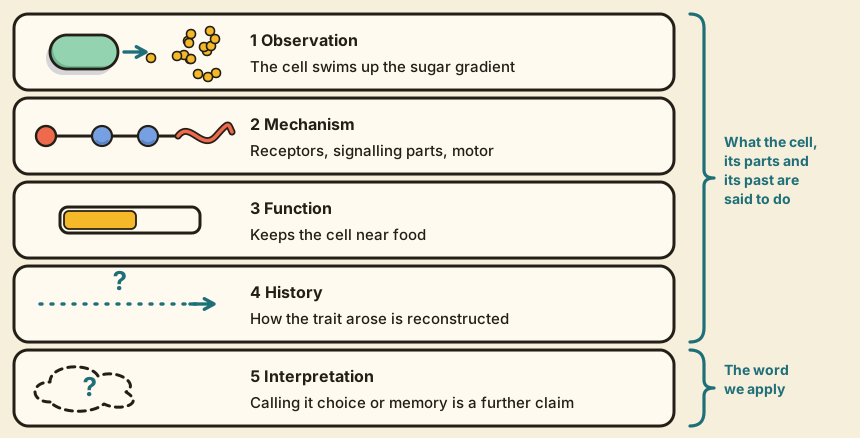
One sentence, five suspects
Observation reports what the cell did, as someone measured it. Mechanism names the parts and the energy that make the behaviour happen. Function says what the behaviour does for the cell's survival and growth. Evolutionary history says how the trait came to exist, and since nobody was around to watch, it's reconstructed from other evidence. Interpretation says that all of this counts as perception, memory or choice.
The first four layers can be tested on the cell in front of us, or on its relatives. The fifth asks us to apply a word. And a word can be applied more or less generously without anyone running a new measurement.
Why the top floor wobbles
Fred Keijzer (2021) asks why the cognitive sciences have never settled what their subject is, which is a slightly embarrassing question for a whole field. His answer is that people have mostly let intuition decide where cognition is present. He points to Turing's test, which lets an ordinary person judge whether answers sound like thought and sets aside what the system is made of. Intuition also pulls two ways, he says. We tend to see minds in almost anything that moves or talks, and careful philosophical rules then push back, but those rules don't agree with each other. In his chart running from bacteria to humans, only humans make the cut everywhere. inferred That's his argument from the literature, and it's a philosophical one.
He gives us a tool for seeing what goes wrong. If the concept comes first, we ask whether a bacterium that uses a molecular memory to orient itself "really" has memory, and if the answer is no, the bacterium gets shown the door. If the cell comes first, the bacterium's behaviour is the fixed point and our idea of memory has to stretch or change to fit it. Keijzer says cognitive science has leaned hard on the first direction, which lets awkward cases be swept aside instead of changing the concept. His proposal is to cut the link between mind and cognition and tie cognition to living systems, using features such as sensing, memory and decision making as practical signals that something deserves study. He adds that if the word "cognition" is too much to ask of a bacterium, other words would do and the proposal would still stand. We like a philosopher who's willing to give up the word to keep the idea.
We don't know whether his proposal is the right repair. It does keep the first four layers in view while we argue about the fifth.
Same facts, different verdicts
Peter Godfrey-Smith (2016) shows the fifth layer sliding around while the first four stay put. He starts from two cases in E. coli. The lac operon is a control system that makes an enzyme only when a particular food source is around, and chemotaxis controls the cell's swimming in relation to where the chemicals are. observed Both are described in his paper as adjusting the cell to where resources are.
Marc van Duijn, Fred Keijzer and Daan Franken, as he reports them, call minimal cognition sensorimotor coordination. The control must adapt the organism to the distribution of resources, and its output must be motion. By that rule chemotaxis counts and the lac operon doesn't, because the lac operon is, in their words, still part of the metabolic organization. Alvaro Moreno and his collaborators draw the line much later, at nervous systems, since a nervous system is partly decoupled from the rest of metabolism. inferred These are definitions and arguments. The observations underneath them are shared by everyone at the table.
Godfrey-Smith himself finds that pressing on either proposal turns up "a lot of relevant-looking steps" and no clean split, so he suggests we worry less about which step counts as the start of cognition. He lines the steps up by evolutionary history, which is our fourth layer. Self-producing, bounded cells that sense and respond come first. Multicellularity follows, which he says has arisen perhaps a few dozen times and may be as much as 2 billion years old, and nervous systems come later still. He calls the paper exploratory. inferred The dates and the order are reconstructions from other work, and we haven't checked them.
Where the line goes, if there is one
We don't know where a line between metabolism and cognition belongs, or whether there's one at all. Keijzer would spread cognitive questions across all living systems, Moreno would put them near nervous systems, and Godfrey-Smith would lay them out in a series of steps that needs no single border. They agree on a good deal of the biology and still end up in different places, which suggests the disagreement lives mostly in the fifth layer. inferred
When we say a cell "remembers", which layer is doing the work?
For this site that gives us a plain habit. When a page says a cell "remembers" or "chooses", we try to name which of the four other layers is carrying the weight, and we leave the fifth open for you.
What you should be able to do after reading
Separate observation, mechanism, function, evolutionary history and cognitive interpretation in one case.
A quick test: pick the lac operon or chemotaxis and write one sentence for each of the five layers. Mark which sentences could be checked by an experiment on this cell today, which lean on a reconstruction of the past, and which lean on a choice of words. Then ask what would change in the first four if someone preferred a different word for the fifth. Probably nothing, which is the point. A4 asks how well each of those sentences is supported.
You need first
This leads to
D1 History-dependence versus memory
E1 Signal, cue, by-product, and communication
See it at work
References
- Keijzer, F. (2021). Demarcating cognition: the cognitive life sciences. Synthese, 198(Suppl 1), S137-S157. doi:10.1007/s11229-020-02797-8 · free full text
- Godfrey-Smith, P. (2016). Individuality, subjectivity, and minimal cognition. Biology & Philosophy, 31(6), 775-796. doi:10.1007/s10539-016-9543-1