 Cellosophy
Concept A1 · Strand A, Orientation
Starting from cells to explain minds
Most accounts of the mind start with a brain and work their way down. The cell shows up late, as a part: a neuron that fires, a synapse that strengthens. We're going to run the film backwards. We take one cell, usually a bacterium or a single-celled eukaryote, ask what it has to get done to stay alive, and then look at how much of what we call cognition turns up in that work.
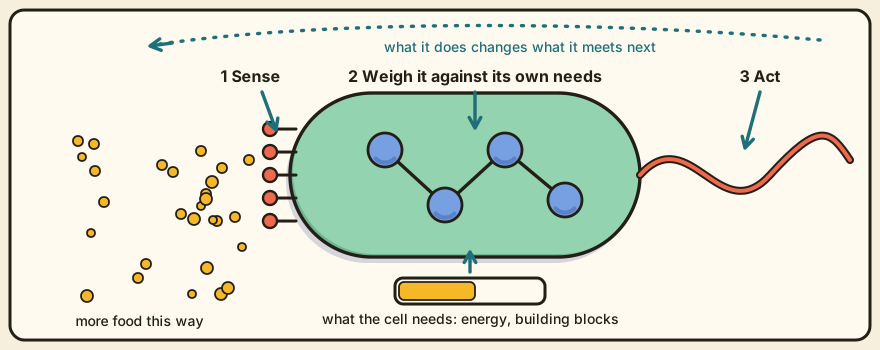
The reason to start there is short. Every cell lives in surroundings that keep changing, and it has to keep itself going in them anyway. A bacterium that can't tell where the food is, or can't change course when the food runs out, doesn't last long - nature isn't sentimental about these things. So a cell needs some way to pick up what's happening around it, some way to take its own condition into account, and some way to act. observed Single bacteria do migrate toward beneficial targets and away from noxious ones (Baluška and Levin, 2016).
A definition that forgets to mention the brain
Pamela Lyon (2020) has squeezed the idea into one sentence. Cognition, she writes, is made up of "sensory and other information-processing mechanisms an organism has for becoming familiar with, valuing, and interacting productively with features of its environment in order to meet existential needs, the most basic of which are survival/persistence, growth/thriving, and reproduction." Read it twice and you'll notice what's missing. There's no brain in it and no neuron either. It names a job, and every living thing has that job.
Lyon adds a comparison we like a lot. Cognition, on her account, is like respiration: it's there from single-celled life all the way up to blue whales, and for a similar reason, because staying alive requires it. She also argues that cognition is more like pregnancy than like a dial. You either have it or you don't, which makes "minimal cognition" a misleading phrase for a bacterium. inferred That's her argument from how the word gets used in biology and cognitive science. Nobody measured it.
Baluška and Levin (2016) walk down a similar functional road. They use "cognition" for the whole set of mechanisms that underlie information acquisition, storage, processing and use, at any level of organisation. They say plainly that they're leaving aside the hard problem of consciousness and any claim about symbolic representation, which is a sensible thing to leave at the door.
Swap the birthday for a trace
Take memory. In everyday talk it means remembering your aunt's birthday. Baluška and Levin define it more narrowly, as an experience-dependent change in a system's internal structure, specific to a stimulus, that alters how the system responds to stimuli later on. Nothing in that wording needs a neuron. And the cellular question gets concrete fast:
Does the cell's past leave a physical trace in it that changes what it does next?
Their review reports cases where the answer looks like yes. observed Budding yeast carry macromolecular assemblies, called mnemons, that encode earlier environmental conditions, and ciliates show learning and a form of memory that survives the loss of nuclei and part of the cytoplasm. We haven't checked the original experiments, so treat these as reported findings.
Now take choice. A cell doesn't stand outside its situation like a shopper in a supermarket aisle and pick. Lyon points out that information from the surroundings only means something relative to the state of the system receiving it, and that system is never a passive recipient. The same signal can call for different handling when the cell is starving and when it's well fed. Her example is the Pho regulon of bacteria, a signal-transduction network linked to switches such as aerobic versus anaerobic respiration, antibiotic resistance and biofilm formation. observed One network ties several of these lifestyle switches to the cell's condition. One mechanism of this kind, where a cell resets its own receptors, is drawn on the adaptation loop page.
The rule that keeps all this honest is simple to state and annoying to follow: say what the molecules and the energy are doing. "Weighing a signal against needs" is shorthand for a physical process in which the cell's internal state changes how the same input gets handled. Here's a test we use. If a sentence about a cell would sound strange with a rock swapped in, it's probably describing something that matters to the cell, and that's the part worth explaining. inferred
Where the experts part ways
This page doesn't settle what counts as cognition, and we'd be suspicious of any page that claimed to. Brancazio and colleagues (2020), introducing a special issue on the topic, lay out a field with several starting points. The phrase "minimal cognition" goes back to Randall Beer's work in the 1990s. The autopoietic tradition of Maturana and Varela holds that every living system is cognitive. Van Duijn and colleagues start from sensorimotor coordination, and they compare the lac operon with chemotaxis to show a difference between regulating genes and sensing and steering. Barandiaran and Moreno argue that cognition has to be tied to a nervous system. Lyon, in other work, defines cognition as the capacity to flexibly generate complex behaviour.
Brancazio and colleagues write that a consensus on what cognition is, let alone where it emerges, is unlikely any time soon. We agree. We don't know where the right line sits either, and we're not going to pretend a website can find it when a whole special issue couldn't. We use Lyon's definition as a working tool because it lets us ask the same question of a bacterium and of an animal, and we fully expect to revise it.
What you should be able to do after reading
Reframe a familiar cognitive capacity as a cellular problem without anthropomorphic projection.
A quick test: pick memory, attention or choice. Write down what a cell would physically need in order to do it, which molecules, what energy source and which boundary. Then go through each sentence looking for words borrowed from human experience, and swap them for a description of what the parts actually do. If you want to keep going, A2 asks what makes the cell a fair unit for this kind of explanation, and A3 asks what kind of explanation we're giving in the first place.
You need first
See it at work
References
- Lyon, P. (2020). Of what is 'minimal cognition' the half-baked version?. Adaptive Behavior, 28(6), 407-424. doi:10.1177/1059712319871360
- Brancazio, N., Segundo-Ortin, M., & McGivern, P. (2020). Approaching minimal cognition: Introduction to the special issue. Adaptive Behavior, 28(6), 401-405. doi:10.1177/1059712319891620
- Baluška, F., & Levin, M. (2016). On having no head: Cognition throughout biological systems. Frontiers in Psychology, 7, 902. doi:10.3389/fpsyg.2016.00902