 Cellosophy
Concept C5 · Strand C, Sensing and action
Adaptation: how a cell learns to ignore a steady signal
Read first: Receptors and signal transduction, Temporal comparison
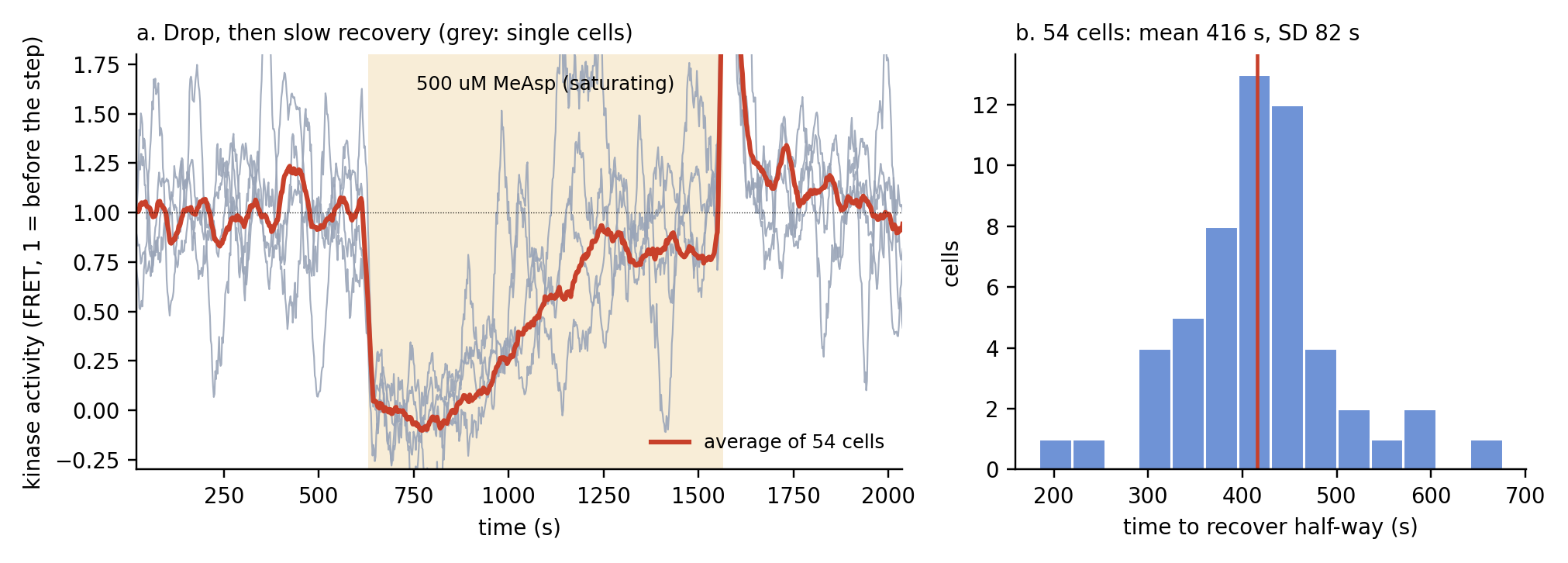
Put a little aspartate, or the lab attractant MeAsp, in front of an Escherichia coli cell and it reacts within seconds. The kinase CheA, which sits behind the receptors, goes quiet, and the cell swims straight on instead of tumbling. Keegstra and colleagues watched this happen in single cells with a fluorescent reporter (2017): the average signal "rapidly fell to zero" after a saturating dose. If the story stopped there the cell would be stuck, because a kinase that stays silent can't tell it whether things are still getting better. So over the next several minutes the activity creeps back to close to where it started, even though the attractant hasn't gone anywhere.
That return is called adaptation. It's the first idea in this site's map of how cells sense - a grand map, by our modest standards - and it's a neat bit of engineering done with methyl groups.
What the cell does fast, and what it does slow
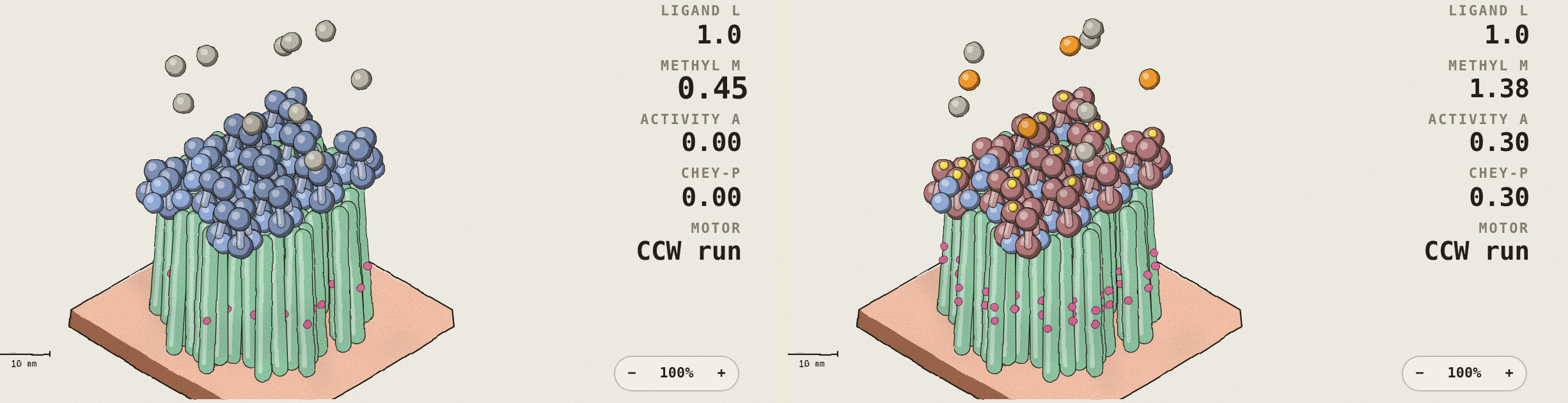
Receptors in the membrane sit in clusters along with CheA and its partner CheW. When attractant binds a receptor, CheA activity drops. CheA normally phosphorylates a small messenger, CheY, and the phosphorylated form (CheY-P) pushes the flagellar motor toward tumbling, which means a quiet kinase gives less CheY-P and longer smooth runs. All of this is quick. Yi and colleagues (2000) put CheY phosphorylation on a scale of milliseconds and receptor methylation on a scale of minutes.
The slow part is the part we care about. Two enzymes tune each receptor. CheR adds methyl groups to it, which pushes the receptor toward its active state and raises kinase activity. CheB takes methyl groups off, and it works mainly on receptors that are active. Once attractant has silenced the kinase, CheB has little to chew on while CheR carries on adding methyl groups, so activity climbs back. Sourjik and Wingreen (2012) add a second effect in their review: more methylation also lowers the receptor's effective affinity for the attractant, so the receptor resets its working range, and the cell can respond to a further rise even in a higher background.
Why the return is exact, and why an engineer would nod
Engineers have a standard trick for making a system settle on exactly one value, and they call it integral feedback. The controller keeps a running total of how far the output has strayed from its target and pushes against that total. While any gap remains, the total keeps growing, so the system can't come to rest anywhere except at the target. It's first-semester control theory.
A bacterium runs it with enzymes.
Yi and colleagues (2000) showed that the receptor model of Barkai and Leibler contains exactly this structure. The methylation level plays the part of the running total. It rises at a rate set by CheR and falls at a rate proportional to receptor activity, so it can only stop changing when activity equals a fixed ratio of the two enzyme rates. That ratio doesn't involve the amount of attractant, which is why activity returns to the same level whatever the dose modeled. They went further and argued that any mechanism giving perfect adaptation that holds up under changes in its parameters must be equivalent to integral feedback modeled.
The result rests on a short list of assumptions, and the authors are upfront about them. CheB must act only on active receptors, and the enzyme rates mustn't depend on whether a receptor has attractant bound, among others. If CheB acted just as readily on inactive receptors, their calculated adaptation precision (activity after adapting divided by activity before, with 1 meaning perfect) fell to 0.22. If it acted on inactive receptors a hundred times less, precision stayed at 0.93. So the loop tolerates small leaks. Large ones sink it.
Why a cell bothers to stop noticing
A swimming cell wants to know whether the chemical around it is getting better or worse, and the absolute level matters much less.
Why would a cell go to all this trouble to stop noticing what's in front of it?
Adaptation turns a receptor that reports level into one that reports change. Each time the background shifts, methylation shifts with it and the receptors go back to a sensitive state, which is why the cell can keep responding over a very wide range of background concentrations (Bi and Sourjik, 2018, attribute this range largely to methylation-dependent adaptation) inferred. The same reset is what makes it possible to compare "now" with "a little while ago". The cell never stores a number for the past. It has an adjustable baseline - a goalpost it moves itself - and a signal is whatever departs from that baseline. Temporal comparison (C4), which you met first on this map, asks why a cell compares at all. Adaptation is how the comparison gets done.
The reset has a price, paid in time. After a large step, recovery takes several minutes, as the 416-second figure below shows, and during that stretch the receptors aren't at their baseline.
What experiments show, and where they get messy
Cells without CheR can't adapt. Alon and colleagues (1999) deleted cheR and found that the cells didn't tumble and couldn't adapt. Putting cheR back on a plasmid restored tumbling observed.
The precision holds while the speed wanders. The same group raised and lowered CheR about a hundredfold with an inducer. Steady-state tumbling and adaptation time changed a lot. The precision of adaptation, measured as the ratio of tumbling before and after a saturating dose of aspartate, didn't change with CheR level, and in wild-type cells it was 0.98 ± 0.05 observed. That's what a built-in structural property predicts, and it's what fine-tuning of rate constants doesn't predict.
Single cells are messier than the average. Keegstra and colleagues (2017) followed 54 wild-type cells through a saturating 500 micromolar MeAsp step. Half-way recovery took 416 ± 83 seconds (mean ± SD), the resting activity varied from cell to cell (coefficient of variation 0.23), and the adaptation precision, measured on kinase activity, averaged 0.79 ± 0.32 observed. Figure 2 plots their published source data. The two studies measured different outputs under different conditions, so we shouldn't set the numbers side by side too tightly. Even so, the single-cell picture is that adaptation is mostly complete, sometimes not, and that cells differ in how complete it is. Averages flatter.
At the extremes the loop runs out of room. Lan and Tu (2016) review models in which adaptation becomes imperfect when the receptors are pushed to the ends of their range, which they put down to boundary effects, and they connect this to old observations of imperfect adaptation after very large steps modeled.
Try it yourself, at an impatient speed
In the live chemotaxis figure, press Add attractant and watch the activity reading fall and then climb back while the methylation reading rises. Switch the mutant to no CheR and activity stays low, as in the cells Alon and colleagues studied. Switch to no CheB and methyl groups can only be added, so the loop can't bring activity down again. The figure is a toy model with one honest caveat: it adapts in seconds so that you can watch it, about 200 times faster than the 416 seconds measured in real cells. We're impatient, and we suspect you are too.
A loose end that points toward memory
During those minutes, the methylation level is a record of recent stimulation. The cell carries a trace of its recent past in the state of its receptors. Whether that deserves the word memory, or only history-dependence, is the subject of D1 on this map. A second open question comes straight out of Figure 2. The papers above don't tell us whether the differences between cells are noise that a population averages away or something a population gains from, and we don't know either, so we leave it open.
A cell that resets itself on purpose is carrying its past somewhere.
References
- Alon, U., Surette, M. G., Barkai, N., & Leibler, S. (1999). Robustness in bacterial chemotaxis. Nature, 397, 168-171. doi:10.1038/16483
- Bi, S., & Sourjik, V. (2018). Stimulus sensing and signal processing in bacterial chemotaxis. Current Opinion in Microbiology, 45, 22-29. doi:10.1016/j.mib.2018.02.002
- Keegstra, J. M., Kamino, K., Anquez, F., Lazova, M. D., Emonet, T., & Shimizu, T. S. (2017). Phenotypic diversity and temporal variability in a bacterial signaling network revealed by single-cell FRET. eLife, 6, e27455. doi:10.7554/eLife.27455 · free full text
- Lan, G., & Tu, Y. (2016). Information processing in bacteria: memory, computation, and statistical physics. Reports on Progress in Physics, 79, 052601. doi:10.1088/0034-4885/79/5/052601
- Sourjik, V., & Wingreen, N. S. (2012). Responding to chemical gradients: bacterial chemotaxis. Current Opinion in Cell Biology, 24, 262-268. doi:10.1016/j.ceb.2011.11.008
- Yi, T.-M., Huang, Y., Simon, M. I., & Doyle, J. (2000). Robust perfect adaptation in bacterial chemotaxis through integral feedback control. PNAS, 97, 4649-4653. doi:10.1073/pnas.97.9.4649