 Cellosophy
Concept B2 · Strand B, Life at cell scale
Noise and limits of molecular sensing
Read first: Scale, diffusion, and life at low Reynolds number
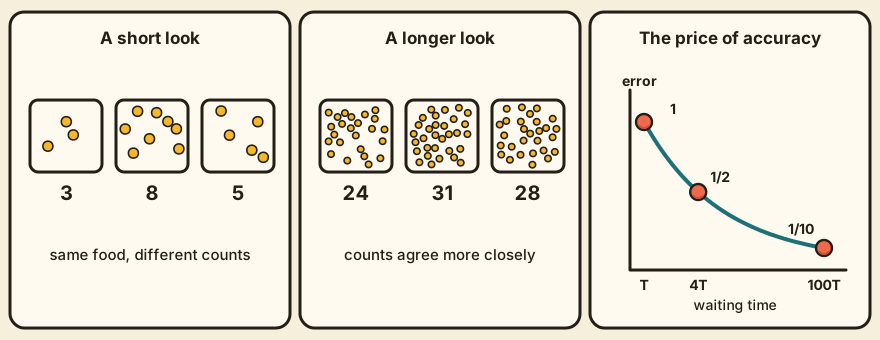
A cell that wants to know how much food is nearby has to count molecules, and molecules don't keep appointments. They wander in by diffusion, so two equally long looks at the same concentration give different counts. This page is about what that randomness costs a cell, and how long a cell has to wait before it can trust what it's counted.
Howard Berg and Edward Purcell (1977) started from the cleanest case they could think of. Picture a perfect instrument that counts every molecule inside a sphere the size of a bacterium, at every instant - a census-taker with no lunch break. A single count with an average of N molecules is uncertain by about one part in the square root of N. Counting again only helps once diffusion has swapped out the molecules in the sample, so the number of useful counts grows in proportion to the waiting time. The upshot is that the fractional error in the concentration falls as one over the square root of the product of waiting time, cell radius, diffusion constant and concentration. modeled For a 1 micrometer sphere, a small molecule and a concentration of one millionth molar, they estimate that 1 percent accuracy takes about 0.01 seconds. At a thousand times lower concentration, the same accuracy takes about a thousand times longer, and settling for 10 percent error instead cuts the wait a hundredfold.
Receptors, or how to count without a bucket
A real cell doesn't count inside a sphere of water. It counts molecules that bind receptors on its surface, and Berg and Purcell asked how many receptors that takes. A molecule that bumps into the surface tends to wander around next to it and hit it again and again, which gives it many chances to find a receptor. With binding sites about 10 angstroms in radius on a cell 1 micrometer in radius, about 3,000 receptors capture half the maximum intake a fully absorbing cell could get, and they cover under a thousandth of the surface. modeled That's a lot of catching for very little real estate.
More receptors add little. Repeat visits by the same molecule tell the cell nothing new, because diffusing molecules have no memory. Only molecules that are new to the receptors count, and the error is set by how many of those arrive during the look. For E. coli they worked out that comparing receptor occupancy over about one second would be enough to detect the gradients that cells were known to follow, and that waiting five seconds would be too slow. They concluded that the chemotaxis machinery looks close to the best possible design. inferred
Pieter Rein ten Wolde and colleagues (2016) reviewed the field and report that the exact receptor correlation time, and so the exact prefactor in the error, has been argued over. The expression of Berg and Purcell and the one derived by Bialek and Setayeshgar differ by a factor of one over twice one minus the fraction of receptors occupied. The review also shows that the cell's own signaling network adds noise to the very signal it's trying to clean up, which is a bit like a hearing aid that hums. In a network that sits at thermodynamic equilibrium, the accuracy can't beat what the receptors alone allow. Only a network driven away from equilibrium can average over time while keeping its own noise down, and the review estimates that storing the state of one receptor in a push-pull cycle costs at least four times the thermal energy. modeled
The champion counter turns out to be sloppy
Does E. coli actually work at the limit?
For decades the answer was believed to be yes. Henry Mattingly, Keita Kamino, Thierry Emonet, Benjamin Machta and colleagues (2026) tested it head on. They asked how accurately a cell could estimate the rate of change of the logarithm of the concentration, which is the signal that matters for climbing a gradient, first from the arrivals of molecules at the receptors and then from the activity of the kinase CheA that the receptors control. They measured the kinase activity in single living cells with a fluorescence energy transfer method, and they measured swimming in three background levels of the attractant aspartate. The typical cell captured at least two orders of magnitude less information than the arrival limit allows. observed The noise in the cell's own kinase activity, which fluctuates on a timescale of about ten seconds, is much bigger than the noise from molecule arrivals over the range they could observe. They conclude that the bottleneck is internal signal processing, and that molecule arrival isn't what holds the cell back. inferred
The authors also say why Berg and Purcell's conclusion may have led people astray. Berg and Purcell asked whether a cell could detect the change in concentration over a single run, and found that measured runs were slightly longer than the minimum required. Mattingly and colleagues point out that a cell doesn't need a threshold of accuracy on every run, because its displacement adds up over many runs and it climbs on average even when single decisions are poor. inferred A drunk walking home still gets home, if the street tilts the right way. They also note that the dense clusters of receptors seen across bacteria sit oddly with a counting limit, since a counting limit would favor spreading the receptors out. In steeper gradients the ratio they measure rises to about one tenth. A few cells in the population come about five times closer to the limit than the typical cell, and they still fall short of it.
We don't know why E. coli leaves so much information on the table. Mattingly and colleagues list possibilities and test none of them. A wide dynamic range, adaptation to the steep gradients of a migrating population, and the cost of more accuracy are all in the running. Their result concerns one laboratory strain, one attractant and shallow gradients, and it doesn't show that the old formula is wrong, since the two studies measure different things. Why build a fine instrument and then read it so roughly? That one's open.
What you should be able to do after reading
Explain why molecular arrival produces uncertainty and derive a qualitative speed-accuracy tradeoff.
A quick test: suppose a cell expects 100 independent molecule arrivals in a given look, and the error is one part in the square root of the count. Say what the error is, then say how long the cell must look to cut the error by a factor of three. Then say what the cell gives up if its run is shorter than that.
You need first
References
- Berg, H. C., & Purcell, E. M. (1977). Physics of chemoreception. Biophysical Journal, 20(2), 193-219. doi:10.1016/S0006-3495(77)85544-6
- ten Wolde, P. R., Becker, N. B., Ouldridge, T. E., & Mugler, A. (2016). Fundamental limits to cellular sensing. Journal of Statistical Physics, 162, 1395-1424. doi:10.1007/s10955-015-1440-5
- Mattingly, H. H., Kamino, K., Ong, J., Kottou, R., Emonet, T., & Machta, B. B. (2026). E. coli chemosensing accuracy is not limited by stochastic molecule arrivals. Nature Physics, 22(1), 123-130. doi:10.1038/s41567-025-03111-4