 Cellosophy
Concept C2 · Strand C, Sensing and action
Molecular motors and cellular action
Read first: Scale, diffusion, and life at low Reynolds number, Nonequilibrium maintenance and energetic cost
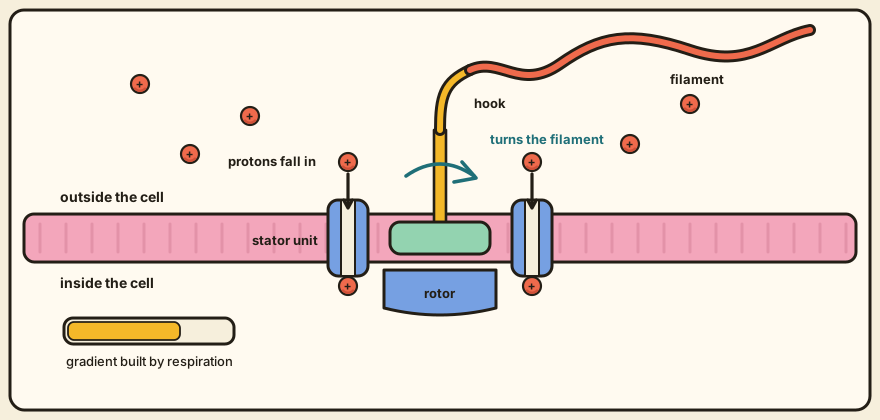
The motor that spins a bacterium's propeller runs on protons, and the cell pays for every turn out of the electrical and chemical gradient it keeps across its membrane. This page follows the energy from that gradient to a turning filament in Escherichia coli. Then it asks the accountant's question: what does the whole cell pay for the arrangement?
Swimming in syrup, with a corkscrew
At the size of a bacterium, viscosity runs the show and inertia counts for almost nothing. Berg (2000) gives the Reynolds number as below 10 to the minus 4, so a flagellum gets its thrust from viscous drag. Stop pushing and you stop, more or less on the spot. A thin rod dragged slantwise through syrup slides off to one side, which G. I. Taylor showed with falling cylinders, and a helical filament turned by a motor behaves like a series of slanted rods that push the cell forward. observed The motor at the base of each filament is about 45 nm across and is put together from about 20 different kinds of part (Berg, 2003).
Running on protons
The standard currency of the cell is ATP, so you'd expect a motor to spend it. This one doesn't. Berg (2003) reports that the flagellar motors of E. coli and Salmonella are powered by protons moving down an electrochemical gradient and not by ATP, with other ions ruled out. observed The work a proton can do in crossing the membrane is the protonmotive force, which Berg puts near 170 millivolts for cells grown at pH 7. Some marine bacteria use sodium ions instead. In the marine bacterium Vibrio alginolyticus, motors driven by a large sodium gradient spun at up to 1,700 turns per second. In E. coli, motors wired to an outside voltage turned at a speed proportional to the applied potential over the physiological range. observed Santiveri and colleagues (2020) note that, apart from the rotary ATPases, this stator family is the only known motor that does mechanical work from an ion gradient and not from ATP.
The gradient itself is built by respiration in cells growing with oxygen (Berg, 2000). Which makes the motor one more customer at the same counter the rest of the cell draws on - our inference from Berg's description, not his words. inferred
From a trickle of ions to a twist
The torque comes from a ring of stator units fixed in the cell wall, each made of the proteins MotA and MotB, which form a channel for protons and push on the rotor. In the resurrection experiments Berg describes, a paralysed motor was repaired by supplying a working gene, and its speed rose in equal steps up to eight levels, never nine. That suggests up to eight units that each add the same torque. observed The count of proteins in each unit has been revised. Berg (2003) gave four MotA and two MotB, and the cryo-electron microscopy structures of Santiveri and colleagues (2020), at about 3 angstroms, show a dimer of MotB surrounded by a pentamer of MotA. They propose that protonation changes the shape of the unit so that MotB turns the surrounding MotA, which engages the rotor. modeled A wheel turning inside a wheel, if they're right.
Direction is set in the rotor. No known stator mutation affects switching alone, and the signalling protein CheY with phosphate binds to a rotor protein, FliM, which flips the ring between clockwise and counterclockwise (Santiveri et al., 2020; Berg, 2003). inferred Counterclockwise turning gathers the filaments into a bundle for a run, and clockwise turning breaks the bundle up for a tumble (Berg, 2000).
The bill, with a hole in it
Berg (2003) works out a rough bill for one motor. At 10 turns per second, with a torque of 4,600 pN nm and about 1,200 protons per turn, the proton flux is 12,000 per second and the power in is about 2,000 electron volts per second. The mechanical power out is close to what the protons supply, so the efficiency comes out near 90 percent and could be 1. modeled The 1,200 protons per turn is the weak link, though. It was measured in Streptococcus, the only organism where proton flux has been measured, because that bacterium can be starved and then energised artificially, and Berg writes that the flux hasn't been measured in E. coli. At the top speed in those experiments, 65 turns per second, the current through one motor was about 0.012 picoamperes, a hundred times smaller than a single nerve channel (Berg, 2003). observed
Running the motors is one cost, and building them is another. Lisevich and colleagues (2025), citing earlier work, put the motility apparatus, mostly the filaments, at 2 to 8 percent of the protein E. coli makes, depending on growth conditions. They gave a strain adjustable flagellar genes and found that swimming speed rose with expression and then levelled off near the wild-type level, while the number of filaments kept climbing, and so did the growth cost, measured against a strain without flagella. observed Their data showed motors turning near 220 turns per second whatever the number of filaments. observed Their model blames drag for the plateau, since past a certain number of filaments the extra thrust is cancelled by extra viscous drag. modeled In rich medium, wild-type cells sat near the plateau, which the authors read as E. coli maximizing motility up to the physical limit while dodging further cost. inferred Enough propellers, and not one more.
What share of a cell's energy budget do the turning motors use? We don't know. None of the papers we read gives that number.
Known parts, unknown workings
Berg ends his 2003 review by admitting that we know a great deal about the motor's structure and assembly but don't really understand how it works. It's an honest place to stop. Guo and Liu (2022) credit recent cryo-electron microscopy and tomography with new structural detail, and the 2020 stator structures gave a concrete model. We don't know whether that model has since been tested beyond the structures, because the papers we read stop in 2022.
What you should be able to do after reading
Connect chemical or electrochemical energy to mechanical action, and pick out the costs to the whole cell.
A quick test: start with a proton outside the cell and write the path it takes to turn the filament, naming the proteins it passes. Then list two costs the cell pays, one for running the motor and one for building it, and say which of the two the papers above put a number on. C3 shows how the cell uses the switch between the two directions of rotation.
You need first
References
- Berg, H. C. (2003). The rotary motor of bacterial flagella. Annual Review of Biochemistry, 72, 19-54. doi:10.1146/annurev.biochem.72.121801.161737
- Berg, H. C. (2000). Motile behavior of bacteria. Physics Today, 53(1), 24-29. doi:10.1063/1.882934
- Santiveri, M., Roa-Eguiara, A., Kuhne, C., Wadhwa, N., Hu, H., Berg, H. C., Erhardt, M., & Taylor, N. M. I. (2020). Structure and function of stator units of the bacterial flagellar motor. Cell, 183(1), 244-257. doi:10.1016/j.cell.2020.08.016
- Guo, S., & Liu, J. (2022). The bacterial flagellar motor: insights into torque generation, rotational switching, and mechanosensing. Frontiers in Microbiology, 13, 911114. doi:10.3389/fmicb.2022.911114
- Lisevich, I., Colin, R., Yang, H. Y., Ni, B., & Sourjik, V. (2025). Physics of swimming and its fitness cost determine strategies of bacterial investment in flagellar motility. Nature Communications, 16, 1731. doi:10.1038/s41467-025-56980-x