 Cellosophy
Concept B3 · Strand B, Life at cell scale
Nonequilibrium maintenance and energetic cost
Read first: The cell as the unit of explanation, Scale, diffusion, and life at low Reynolds number
A living cell is a standing argument with the second law. It holds chemical concentrations and spatial order that would dissolve if left alone, and holding them takes a steady supply of energy. This page asks what that means for the cell as a unit, and then what it implies for the sensing and swimming of B1 and B2.
Aidan Brown and David Sivak (2020), in a review of the theory of molecular machines, open with the physics. Order can't persist at equilibrium, where the second law favors maximum disorder, so a cell has to be held out of equilibrium. It does this with molecular machines, protein complexes that convert one store of free energy into another. ATP synthase uses protons running down their gradient to make ATP. The bacterial flagellar motor uses the same kind of gradient to turn. Pumps, polymerases and kinesin use the energy stored in ATP to move ions, copy sequences and haul cargo. observed It's a busy little factory floor. We apply all of this to the whole cell, the unit chosen in A2.
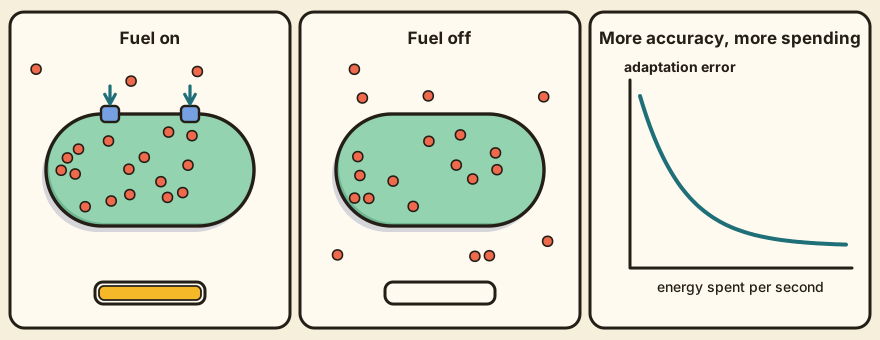
Even standing still has a bill
A cell that merely stays as it is still spends. Ganhui Lan, Yuhai Tu and colleagues (2012) studied adaptation, the process by which a sensory system returns to a resting level after a change in the stimulus, as in the E. coli chemotaxis system. They noted that adaptation needs a negative feedback loop in which the output changes a slower controlling variable, and that such a loop breaks detailed balance, which every equilibrium system obeys. From this they concluded that adaptation always dissipates energy, and that the energy is needed to hold the adapted state steady against noise, rather than to respond to any single stimulus. modeled Think of it as rent, paid whether or not anything happens. In their model of the E. coli receptor, the adaptation error falls roughly exponentially as the power dissipated rises, and it also depends on how fast the cell adapts, which gives the energy-speed-accuracy relation. modeled
They checked one prediction on living cells. Cells starved in a medium with no energy source adapted to a standard stimulus more and more slowly, with the half-time rising from about 130 seconds to about 410 seconds over seven hours, while the accuracy stayed near 95 percent. observed A hungry cell, in other words, gets slow and stays careful. That's the pattern the model predicts if a cell with less fuel gives up speed and hangs on to accuracy, and we read it as consistent with the model and nothing stronger. The review by Lan and Tu (2016) estimates that holding the memory in the receptors of one cell costs roughly a thousand ATP molecules a second, which they put at 5 to 10 percent of the energy needed to drive a flagellar motor turning at 100 hertz. modeled
Knowing costs, swimming costs, and nobody agrees how much
Pieter Rein ten Wolde and colleagues (2016) tie this back to B2. A signaling network at equilibrium can sense, so energy isn't strictly needed for sensing, but its accuracy is capped by the number of receptors. A network driven out of equilibrium can store the receptor's state over time and average it, which lifts the cap, and the review states that doing so reliably takes at least four times the thermal energy per stored state. modeled So bare sensing at equilibrium can be done for free, and accurate information processing has a price.
Is there any free lunch in a cell?
Equilibrium sensing comes close to one, as we just saw, but most of the menu has prices on it. Brown and Sivak describe a similar trade in copying machines. Because the parts are soft, a copying enzyme can only tell a right letter from a wrong one by a small energy difference, and cycles that spend free energy, called kinetic proofreading, lower the chance of picking the wrong one. The measured error rate in DNA replication is between one in ten billion and one in a hundred million. modeled The theory is the review's and the error rates are measurements it quotes.
The cost of moving is murkier. Purcell (1977) calculated that a bacterium swimming at 30 micrometers a second spends a small fraction of its energy budget, which is why he thought the efficiency of the flagellum hardly matters. Paul Schavemaker and Michael Lynch (2022) did the accounting again. They added up the ATP needed to build a flagellum from its proteins, about 232 million ATP for one E. coli flagellum and about 788 million for the 3.4 per cell, and the ATP needed to rotate it, using the number of protons each motor passes per turn. For a cell dividing every hour they get 5.0 percent of the whole-cell budget for building the flagella and 5.2 percent for turning them if the motors run continuously at 200 hertz. inferred The operating figure is an estimate built from other people's measurements.
Those numbers don't sit well together. Schavemaker and Lynch cite an earlier estimate of 0.1 percent for operating cost and another of 3.4 percent, and say they can't tell how the 0.1 percent was arrived at. Their own operating cost is also 3.8 times larger than the maintenance cost estimated for the entire cell, which is awkward - a part costing more than the whole. They put it down to cells not rotating all the time, or to the maintenance figure coming from cells that weren't swimming. Across about 200 species the relative construction cost of flagella has a median near 3 to 4 percent, with a very wide spread. We don't know how much a typical E. coli spends on swimming. It may be anywhere from a fraction of a percent to a few percent, and we'd rather say that plainly than pick a number we can't defend.
What you should be able to do after reading
Explain why a living cell must continually expend energy and why accurate information processing can't be cost-free in practice.
A quick test: describe the cell in Figure 1 with the fuel supply cut. Say which quantity relaxes and what it relaxes toward. Then explain why a cell in the middle of the adaptation experiment, with half its fuel, can still adapt accurately but not quickly. Say which part of your answer comes from a measurement and which from a model. If you can't tell, that's worth noticing too.
You need first
See it at work
References
- Brown, A. I., & Sivak, D. A. (2020). Theory of nonequilibrium free energy transduction by molecular machines. Chemical Reviews, 120(1), 434-459. doi:10.1021/acs.chemrev.9b00254
- Lan, G., Sartori, P., Neumann, S., Sourjik, V., & Tu, Y. (2012). The energy-speed-accuracy trade-off in sensory adaptation. Nature Physics, 8(5), 422-428. doi:10.1038/nphys2276
- Lan, G., & Tu, Y. (2016). Information processing in bacteria: memory, computation, and statistical physics. Reports on Progress in Physics, 79, 052601. doi:10.1088/0034-4885/79/5/052601
- ten Wolde, P. R., Becker, N. B., Ouldridge, T. E., & Mugler, A. (2016). Fundamental limits to cellular sensing. Journal of Statistical Physics, 162, 1395-1424. doi:10.1007/s10955-015-1440-5
- Schavemaker, P. E., & Lynch, M. (2022). Flagellar energy costs across the tree of life. eLife, 11, e77266. doi:10.7554/eLife.77266 · free full text
- Purcell, E. M. (1977). Life at low Reynolds number. American Journal of Physics, 45(1), 3-11. doi:10.1119/1.10903