 Cellosophy
Pattern · module scale
Signaling pathway: a short relay from receptors to motor
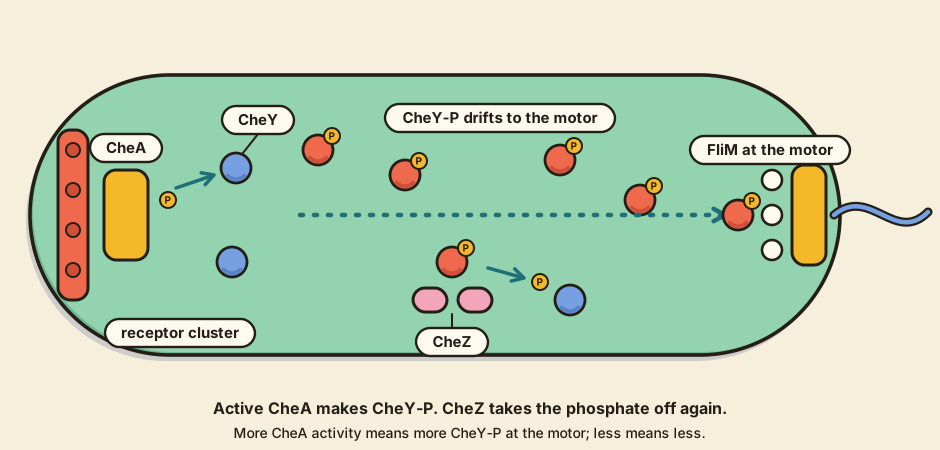
Somebody has to carry the news from a bacterium's receptors to its flagellar motors, and in Escherichia coli that's a short relay. An active kinase called CheA hands a phosphate group to a small protein, CheY. Phosphorylated CheY (CheY-P) wanders through the cytoplasm to the motor, and a phosphatase called CheZ strips the phosphate off again. The amount of CheY-P at any moment is the message the motor reads. It can be rewritten within about a second, because the old message is erased almost as fast as the new one is written. Think whiteboard.
The problem: news has to travel, then go stale
The receptors sit in a cluster, and the motors sit elsewhere on the cell. Whatever the receptors learn has to cross the cytoplasm before it can change how the cell swims. Falke and colleagues (1997) point out that CheY, unlike its relative CheB that works on the receptors themselves, has to diffuse from the receptor cluster to a distant motor. observed So the message has to be small enough to move and cheap enough to make.
It also has to be short-lived. According to Falke and colleagues, a swimming cell has to notice a change and alter its signal on a timescale of about one second, and they note that response regulators in slower two-component pathways can stay phosphorylated for an hour or longer. observed A message that lingered that long would tell the motor about the past, and a swimmer needs to know about now. Yesterday's newspaper is no help in traffic.
How it works: write, carry, erase
CheA is a histidine kinase. It uses ATP to put a phosphate on one of its own histidines, and it does this more when receptors are empty or bound to a repellent and less when they're bound to an attractant (Falke et al., 1997). observed That's the input to the relay, and the receptor cluster page tells how it's controlled.
CheY waits on a docking site of CheA until the phosphate lands on an aspartate of CheY, which changes the shape of the whole protein. Phosphorylated, CheY holds on to CheA less tightly, so it drifts off. It also binds the motor protein FliM more tightly than unphosphorylated CheY does, and sticking to FliM raises the chance that the motor turns clockwise, which makes the cell tumble (Falke et al., 1997). observed The motor then does its own part, described on the flagellar motor page.
CheZ is what keeps the message short. Left alone, phosphorylated CheY loses its phosphate with a half-life that Falke and colleagues put at under 10 seconds and Wadhams and Armitage (2004) put at about 20 seconds, so the sources don't quite agree. With CheZ present the half-life falls to about 200 milliseconds, a drop of roughly a hundredfold, according to Wadhams and Armitage. observed Cells that lack CheZ tumble all the time because CheY-P piles up (Wadhams and Armitage, 2004). observed An eraser, it turns out, matters as much as the pen.
The numbers of molecules matter for how this behaves. Falke and colleagues list about 8,000 CheY, 20,000 CheZ and 4,000 CheA per cell, in a table that gathers earlier measurements. Sourjik and Wingreen (2012) give the same figure for CheY and put the receptors at about 15,000. observed The messenger pool is therefore about twice the size of the kinase pool.
How fast does the message actually move?
Sourjik and Berg (2002) released caged attractant or repellent inside living cells with a flash and followed, by fluorescence energy transfer, how much CheY-P was bound to FliM. After attractant the binding fell exponentially at about 2 per second, which is a time constant near half a second. After repellent it rose at about 20 per second. observed The two directions aren't equally fast, and we don't know why. One guess is that the fall is set by how quickly CheZ drains the pool, while the rise is set by how quickly active CheA fills it. inferred
What's still open: a sibling, an eraser and some noise
The relay has a sibling. The same active CheA also phosphorylates CheB, and CheZ doesn't act on phosphorylated CheB, which loses its phosphate quickly by itself (Falke et al., 1997). observed That branch feeds the adaptation loop, whose page follows what CheB does to the receptors.
We don't fully know how CheZ works. Falke and colleagues left open whether it attacks the phosphate directly or nudges CheY into removing it. Wadhams and Armitage report a crystal of CheZ with CheY in which one CheZ side chain reaches into the CheY active site and might position a water molecule for the attack. inferred That suggests an allosteric helper, though we wouldn't call it settled.
CheZ isn't universal either. Wadhams and Armitage say it seems to be restricted to one group of proteobacteria, and Bi and Sourjik (2018) note that other bacteria use different phosphatases, named CheC and CheX in their figure. Some species have extra CheY proteins that appear to act as phosphate sinks. inferred So "a fast eraser" is the general pattern, and CheZ is one way E. coli does it. Evolution, as usual, found more than one way to wipe a board.
Finally, cells with identical genes differ. Micali and Endres (2016) report that different adapted CheY-P levels have been seen in cells of one population, which sets different tumble biases. observed Sourjik and Wingreen (2012) trace much of the variation to CheR and CheB, which number only 200 to 400 per cell, and describe slow swings in the motor's bias over tens of seconds. observed Do the relay's own thousands of CheY and CheZ molecules add noise of their own? We don't know.
Its parts
CheA, the kinase (page to come): passes a phosphate to CheY while the receptors let it
CheY, the messenger (page to come): carries the phosphate message from the receptor cluster to the motor
CheZ, the phosphatase (page to come): takes the phosphate off CheY, which ends the message
Wholes above it
References
- Falke, J. J., Bass, R. B., Butler, S. L., Chervitz, S. A., & Danielson, M. A. (1997). The two-component signaling pathway of bacterial chemotaxis: a molecular view of signal transduction by receptors, kinases, and adaptation enzymes. Annual Review of Cell and Developmental Biology, 13, 457-512. doi:10.1146/annurev.cellbio.13.1.457
- Wadhams, G. H., & Armitage, J. P. (2004). Making sense of it all: bacterial chemotaxis. Nature Reviews Molecular Cell Biology, 5, 1024-1037. doi:10.1038/nrm1524
- Sourjik, V., & Berg, H. C. (2002). Binding of the Escherichia coli response regulator CheY to its target measured in vivo by fluorescence resonance energy transfer. Proceedings of the National Academy of Sciences, 99, 12669-12674. doi:10.1073/pnas.192463199
- Sourjik, V., & Wingreen, N. S. (2012). Responding to chemical gradients: bacterial chemotaxis. Current Opinion in Cell Biology, 24, 262-268. doi:10.1016/j.ceb.2011.11.008
- Micali, G., & Endres, R. G. (2016). Bacterial chemotaxis: information processing, thermodynamics, and behavior. Current Opinion in Microbiology, 30, 8-15. doi:10.1016/j.mib.2015.12.001
- Bi, S., & Sourjik, V. (2018). Stimulus sensing and signal processing in bacterial chemotaxis. Current Opinion in Microbiology, 45, 22-29. doi:10.1016/j.mib.2018.02.002